Robot Art & Architecture

  • ALGORITHMIC BRUSHSTROKES: EXPLORING THE BORDER BETWEEN ART AND AUTOMATION

    When I stepped into the robotics lab at the University of Konstanz—under the umbrella of the e-David project, in May 2024—I expected a cutting-edge experience: a puzzle of artificial intelligence and material-based art. One year later, the hype from headlines and demo reels met the raw and deeply satisfying reality of canvas, brushes, and the…

  • WHEN ROBOTS DANCE: CHOREOGRAPHY

    “Motion” is a groundbreaking performance first presented in 2015 by Rhizomatiks Research and ELEVENPLAY, in collaboration with Yaskawa Electric Corporation, as a celebration of the company’s centennial. The production explores the relationship between human beings and machines, fusing elements of contemporary dance with cutting-edge robotic technology to create a deeply expressive and visually captivating experience….

  • JORDAN WOLFSON’S ‘BODY SCULPTURE’: WHEN ART IS ATTUNED TO INDUSTRIAL ROBOTICS

    In the contemporary art world, where disciplines intersect and the boundaries between the mechanical and the human dissolve, Jordan Wolfson’s new work, Body Sculpture, emerges as a piece that redefines what sculpture can be in the digital and automated age.

    Unveiled at the National Gallery of Australia (NGA), this robotic work is much more than a visual experiment: it is a sensory and intellectual experience built from mechanical precision and conceptual sensitivity. Valued at 6.67 million Australian dollars, Body Sculpture integrates advanced automation engineering, sculpted metal structures, and a sophisticated kinematic control system.

    Technology Applied to Art: Beyond Performance
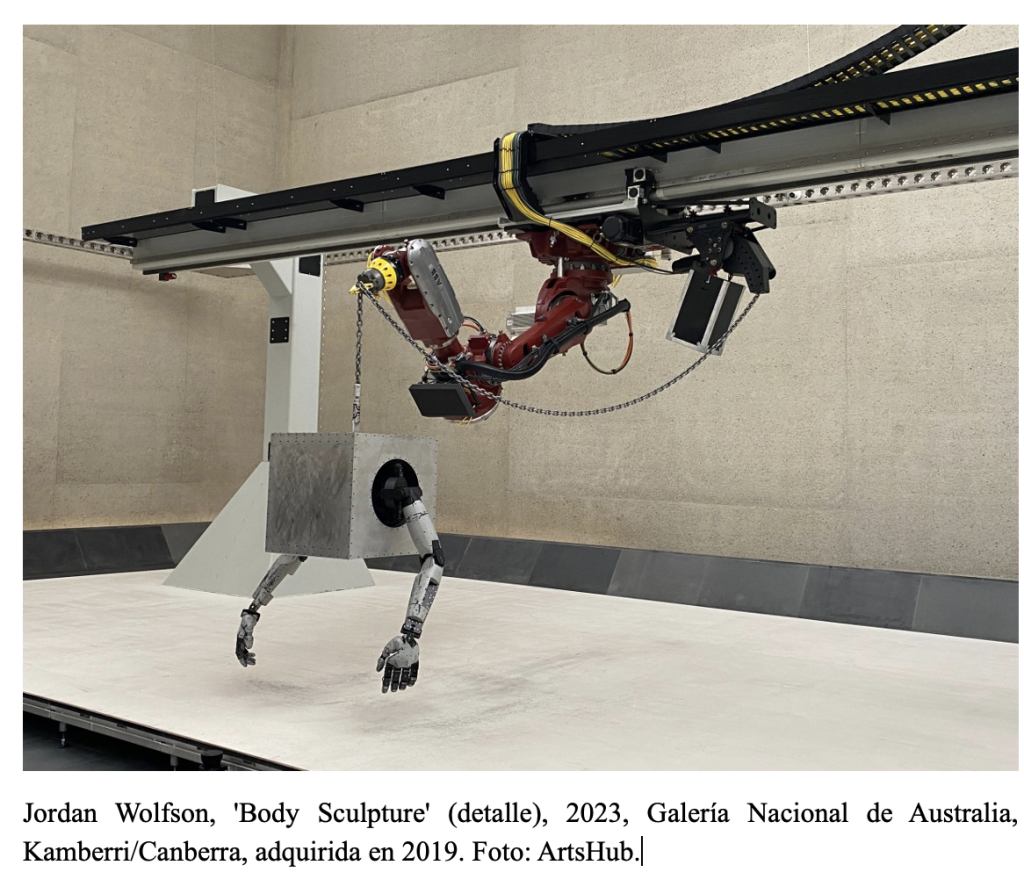
    The installation consists of a steel block with two articulated arms, suspended by a chain from an industrial robotic arm. The movement is not random: it is programmed with a 30-minute choreography designed to evoke human emotions, from fear to empathy.

    This project was developed in collaboration with technologist Mark Setrakian, an expert in animatronics and special effects with experience in films such as Hellboy and Men in Black. The movement system uses kinematic interpolation algorithms, combining hydraulic systems and electric motors to simulate organic movements with millimetric precision.

    For those working with techniques like CNC milling, the logic behind Body Sculpture is familiar: it is a sculpture generated and controlled by an automated system that translates digital information into movement and physical form. But what sets this piece apart is its ability to express, not just execute.

    Technical Components of Body Sculpture
    Industrial Robotic Arm
    The sculpture is suspended by a chain connected to a large industrial robotic arm, similar to those used in the automotive industry. This arm is mounted on a steel structure that allows horizontal and vertical movements, enabling complex and precise choreography.

    Metal Cube with Articulated Arms
    The central element of the sculpture is a metal cube, approximately the size of a clothes dryer, made of aluminum and aerospace-grade plastics. Two humanoid arms with oversized hands emerge from this cube, capable of detailed and expressive movements.

    Adaptive Control System
    The sculpture’s movement is managed by an adaptive control system developed by robotics expert Mark Setrakian. This system allows real-time adjustments during performances, using sensors to meticulously track and correct movements.

    Specialized Collaborations
    In addition to Setrakian, the project involved Richard Taylor, co-founder of Wētā Workshop, as well as professionals in musical composition, acting, and choreography. These collaborations enriched the performative and emotional dimension of the work.

    Technical Design and Functionality
    The sculpture performs for approximately 30 minutes, divided into three acts that combine gentle and violent movements, evoking human emotions such as vulnerability, sensuality, and despair. The movements are programmed to simulate human gestures, such as hugging itself or striking the ground, creating an immersive experience for the viewer.

    The sound system reaches levels of up to 100 decibels, incorporating percussion effects and mechanical noises that intensify the sensory experience.

    A Work That Questions the Viewer
    Unlike previous works such as Female Figure or Colored Sculpture, which explored violence, sexualization, and fetishism, Body Sculpture addresses human vulnerability. The sculpture does not represent a body, but its movements echo our own. The chain that holds it suggests submission or control, but also support and connection.

    Each session requires the audience to remain silent and wear earplugs, as the sound and force of the movement reach high levels. The viewer does not observe a passive work: they confront a presence. And that presence moves, falls, recoils, trembles. As if it were thinking. As if it were feeling.

    Implications for Sculptors and Digital Artists
    For sculptors working with industrial robots, parametric modeling, or automated prototyping, Body Sculpture is a case study. Not only for its technical execution, but for the way it transforms a robotic arm—traditionally associated with mechanical production—into an expressive, even vulnerable, entity.

    The sculpture becomes a medium that shapes not only matter, but also emotion. Wolfson’s challenge is direct: Can a machine represent the human condition without a body, a soul, or a face?

  • LIGHTS, RHYTHMS AND GEARS: THE MECHANICAL ART OF ROBOT RHAPSODY

    In the current context, where automation and artificial intelligence are the foundation of technological change in industry, KUKA, one of the world’s leading robotics brands, does not hesitate to go further. In the artistic and technological proposal “Robot Rhapsody,” we not only break the schemes imposed by automation but also change the rules of the…

  • COFRIDA: THE SYSTEM THAT BRINGS HUMANS AND ROBOTS TOGETHER IN ARTISTIC CREATION

    The intersection between human creativity and technology has led to surprising innovations in the artistic field. A notable example is the development of CoFRIDA, a robotic system created by researchers at the Robotics Institute of Carnegie Mellon University, which enables the co-creation of paintings between humans and machines. CoFRIDA: A bridge between artists and robots…

  • ROBOHOOD AND ITS IMPACT ON DIGITAL CREATIVITY

    At the intersection of technology and art, solutions emerge that promise to transform traditional methods of artistic creation. Robohood, an innovative robotic art platform, leads this change with its Mobile Robotic Art Studio, a concept that redefines the boundaries of creativity through robotics and artificial intelligence. Art in the Age of Robotics The Mobile Robotic…

  • THE ART OF THE FUTURE: SOUGWEN CHUNG AND HUMAN-MACHINE COLLABORATION

    At the intersection of artificial intelligence and human creativity, Chinese-Canadian artist and researcher Sougwen Chung is redefining the boundaries of collaborative art. Her innovative project “Drawing Operations Unit: Generation 2” (D.O.U.G._2) introduces robotic arms equipped with artificial intelligence capable of learning and replicating the artist’s own brushstrokes. Through this fusion of technology and creative expression,…

  • ACRYLIC ROBOTICS: MERGING ART AND ROBOTICS TO CREATE PRECISION PAINTS

    In Montreal, the company Acrylic Robotics has revolutionized the art world by combining advanced technology and creativity. By using programmed robots, this startup allows digital artists to transform their works into physical paintings. Using robotic arms, the process precisely recreates the original brushstrokes of the works, facilitating the creation of customized art pieces at scale….

  • INNOVATION IN SCULPTURE: 7-AXIS ROBOTS FOR EXPANDED POLYSTYRENE

    Robotic automation has revolutionized multiple industries, and art is no exception. Seven-axis robots, designed for sculpting, carving, and milling expanded polystyrene (EPS), are transforming the way sculptures and prototypes are created. These robots not only improve efficiency and precision but also allow artists and manufacturers to explore new creative possibilities. What is a Seven-Axis Robot?…

  • ROBOTIC MAPPING: ROBOTIC ARMS USED IN THE PROJECTION OF DIGITAL ART ON FACADES AND PUBLIC SPACES

    The use of robotic arms in mapping for the projection of artistic images on large surfaces has revolutionized the way multimedia installations are executed. This approach combines robotic precision with advanced projection techniques to create immersive and detailed visual experiences. How do robotic arms work in mapping? Robotic arms, such as those from brands like…