English
 Italiano
 Українська
 Русский
 Español

AI-powered robotic stone carving combines digital models, scanning, automated toolpath generation, industrial robots, diamond tooling, and skilled hand finishing to produce sculptures and architectural stone components. The technology can remove large volumes of marble, limestone, granite, or sandstone while following complex three-dimensional geometry.
The robot does not conceive the sculpture independently. It executes a manufacturing process derived from a digital design, scan, or artist-approved model. Artificial intelligence may support selected stages, but the physical carving process still depends on CNC programming, robot kinematics, machining strategy, material knowledge, calibration, and human judgement.
The strongest contemporary workflows divide the work deliberately. Robots perform heavy roughing, repeated toolpaths, and accessible geometric detailing. Sculptors and stone specialists evaluate the material, refine undercuts, correct local imperfections, establish the final surface, and decide when the work is complete.
Quick Answer
- The artist or designer defines the concept and approves the digital form.
- Scanning or modelling creates the three-dimensional data.
- CAM or automated software converts geometry into machining strategies and toolpaths.
- The industrial robot positions the spindle and cutting tool around the stone.
- Diamond tools remove material through roughing, semi-finishing, and detailing operations.
- Human stone carvers inspect, refine, texture, polish, and complete the sculpture.
The technology is best understood as robot-assisted stone fabrication, even when AI is used elsewhere in the workflow.
What AI-Powered Robotic Stone Carving Actually Means
The phrase “AI-powered robotic stone carving” can describe several different levels of technology.
Artificial intelligence may be used to:
- generate or modify a proposed sculptural form;
- analyse scanned geometry;
- identify features in historical ornament;
- assist with segmentation or reconstruction;
- recommend tools or machining parameters;
- detect anomalies during production;
- support machine vision and inspection;
- optimise selected manufacturing decisions.
Other parts of the process may be highly automated without technically being AI.
These include:
- converting a 3D model into toolpaths;
- calculating robot positions;
- choosing predefined roughing and finishing operations;
- changing tools automatically;
- monitoring spindle load;
- executing a programmed cycle continuously;
- stopping the system when defined limits are exceeded.
A self-programming CAM system may appear intelligent because it removes many manual programming steps. That does not necessarily mean it uses machine learning or possesses autonomous artistic judgement.
Key distinction: AI can assist decisions or interpret data. CNC automation converts defined geometry and rules into repeatable machine operations. The two technologies may coexist, but they are not interchangeable terms.
How a Stone Sculpture Moves From Idea to Robot
A robotic stone-carving project begins long before the cutting tool touches the block.
The complete workflow may include:
- Concept Development: the artist, architect, restorer, or client defines the intended form and context.
- Digital Modelling: the sculpture is created, modified, or approved as a three-dimensional model.
- Scanning: an existing sculpture, maquette, ornament, or stone block may be digitised.
- Model Preparation: geometry is cleaned, scaled, repaired, divided, or adapted for fabrication.
- Stone Selection: the team chooses material according to dimensions, grain, colour, veining, defects, and application.
- Stock Positioning: the digital form is located inside the available block.
- Machining Strategy: roughing, semi-finishing, finishing, tools, approaches, and allowances are defined.
- Robot Simulation: toolpaths are checked for reach, collisions, singularities, and robot posture.
- Calibration: robot, tool, rotary table, and stone coordinate systems are aligned.
- Robotic Milling: the system removes material through successive operations.
- Inspection: the physical result is measured and compared with the approved geometry.
- Hand Finishing: sculptors establish final details, textures, polished areas, and undercuts.
- Installation: the finished work is transported, supported, anchored, or incorporated into the building.
Each stage can alter the final outcome. Accurate robotic movement cannot compensate for a poor scan, unsuitable block, incorrect toolpath, weak fixture, or flawed digital model.
The Difference Between Digital Design, CAM, and Robot Control
| Technology Layer | Primary Function | What It Does Not Decide Automatically |
|---|---|---|
| 3D Modelling or Scanning | Creates the geometry representing the intended sculpture or ornament. | Does not determine how the stone should be cut safely or efficiently. |
| CAM Software | Generates machining operations, cutting paths, tools, and process parameters. | Does not guarantee that every path is suitable for the selected robot and cell. |
| Robot Simulation | Checks robot positions, reach, configurations, and collisions. | Does not fully predict stone fracture, vibration, tool wear, or surface quality. |
| Robot Controller | Executes approved movement and process commands. | Does not interpret the artistic value of the result. |
| Machine Vision or AI | May analyse surfaces, classify information, detect deviation, or assist decisions. | Does not replace professional approval or material expertise. |
| Human Finishing | Evaluates form, surface, detail, stone character, and artistic completion. | Depends on the preceding robotic and digital stages being technically sound. |
Why Industrial Robots Are Used for Stone Carving
An industrial arm offers a large and flexible working envelope compared with many conventional fixed-axis machines.
A robot can potentially:
- approach the stone from several directions;
- change tool orientation continuously;
- work around free-form geometry;
- coordinate with a rotary table or linear track;
- machine sculptures larger than a compact enclosed CNC system;
- repeat a digital form at different scales;
- perform roughing and detailing with several tools;
- work for long production cycles inside a controlled cell.
These capabilities are particularly relevant to:
- figurative sculpture;
- architectural ornament;
- facade elements;
- columns and capitals;
- reliefs;
- monuments;
- restoration replacements;
- scaled reproductions;
- custom stone furniture and design objects.
The articulated structure also introduces limitations. Industrial robots are generally less rigid than dedicated stone-machining centres, and their stiffness varies significantly according to posture.
Why Seven-Axis Systems Are Common
A six-axis robot may be combined with a coordinated rotary table, creating a seven-axis machining system.
The rotary axis can:
- turn the stone toward the robot;
- improve access to the back and sides;
- reduce the need to reposition heavy blocks manually;
- keep the robot in more stable postures;
- extend the usable machining envelope;
- support continuous processing around the workpiece.
The robot and table must be calibrated and programmed as one coordinated system.
A rotation that improves access to one region may create:
- new collision risks;
- unfavourable robot configurations;
- cable interference;
- instability in the stone fixture;
- movement of the workpiece outside the safe zone.
The seventh axis increases access, but it also increases the number of variables that must be simulated and controlled.
How Stone Is Removed
Robotic carving generally progresses from aggressive volume removal toward progressively finer surface operations.
Primary Cutting
Large saws, discs, or other high-removal tools may first reduce the rectangular block to a shape closer to the final volume.
This can shorten the time spent using smaller robotic milling tools.
Roughing
Roughing removes most of the remaining material while leaving an intentional allowance around the final surface.
Relevant variables include:
- tool diameter;
- spindle power;
- depth of cut;
- stepover;
- stone hardness;
- robot posture;
- fixture strength;
- cooling and water delivery;
- debris evacuation.
Semi-Finishing
Semi-finishing reduces the remaining allowance and prepares the surface for smaller tools.
This stage may also reveal defects, inclusions, cracks, or unexpected differences between the block and the digital assumptions.
Robotic Finishing
Smaller diamond tools follow the surface more closely to reproduce detail and reduce the amount of manual work remaining.
The system may intentionally leave a thin material allowance in delicate or inaccessible regions.
Hand Finishing
Stone carvers use chisels, rasps, abrasives, rotary tools, and polishing methods to complete the work.
This stage may establish:
- fine facial or anatomical detail;
- sharp edges;
- deep undercuts;
- subtle surface transitions;
- intentional chisel texture;
- final polish;
- local corrections responding to veining or defects.
Why Diamond Tools Are Used
Stone requires tools capable of maintaining cutting performance against abrasive mineral material.
Robotic systems may use:
- diamond saw blades;
- diamond discs;
- finger bits;
- ball-nose tools;
- profiling wheels;
- engraving tools;
- grinding and polishing tools.
Tool selection affects:
- material-removal rate;
- surface texture;
- minimum accessible detail;
- tool life;
- spindle load;
- vibration;
- cooling requirements;
- remaining manual finishing.
The smallest tool is not always the best finishing tool. Very small tools may require slower movement, have shorter life, and remain unable to reach geometry hidden behind an undercut.
Why Water, Slurry, and Dust Management Matter
Stone milling creates dust, fragments, heat, and abrasive slurry.
The cell may require:
- water delivery at the cutting zone;
- drainage and slurry collection;
- filtration and water recirculation;
- dust extraction for dry operations;
- protected robot and controller equipment;
- corrosion-resistant components;
- regular cleaning and inspection;
- separation between operators and hazardous material.
Water can cool the tool and suppress airborne dust, but it also creates additional maintenance and environmental requirements.
Slurry must not accumulate around robot bases, positioners, cables, safety sensors, or electrical equipment.
Stone Is Not a Uniform Digital Material
A digital model is geometrically predictable. A natural stone block is not.
Stone may contain:
- veins;
- fissures;
- voids;
- mineral inclusions;
- changes in hardness;
- weathered regions;
- internal stresses;
- visual features that should remain aligned with the design.
Two visually similar blocks may behave differently under the same toolpath.
A robotic system may follow its programmed movement correctly while the stone chips, fractures, vibrates, or reveals a defect.
Experienced fabricators and carvers remain essential because they interpret the physical material rather than only the nominal geometry.
Marble, Granite, Limestone, and Sandstone Behave Differently
| Stone Type | Typical Uses | Machining Considerations |
|---|---|---|
| Marble | Figurative sculpture, ornament, relief, architectural interiors, and monuments. | Veining, local fractures, finish, translucency, and edge sensitivity vary by block. |
| Granite | Monuments, exterior elements, sculpture, and durable architectural components. | High hardness and abrasiveness increase tool wear and process forces. |
| Limestone | Facade ornament, restoration elements, reliefs, and architectural carving. | Porosity, bedding, fossil content, and weathering characteristics must be assessed. |
| Sandstone | Historic restoration, facade elements, monuments, and carved architectural work. | Layering, grain, erosion, and local friability affect cutting and edge quality. |
| Onyx and Decorative Stone | Interior sculpture, translucent elements, furniture, and high-value decorative work. | Fragility, visible structure, material cost, and final surface require careful planning. |
How 3D Scanning Supports Stone Carving
Three-dimensional scanning can capture the geometry of:
- an original sculpture;
- a clay or plaster maquette;
- an architectural ornament;
- a damaged historical element;
- a stone block;
- a partially completed carving;
- the physical result after robotic milling.
Scanning may support:
- digital archiving;
- replication;
- scaling;
- restoration analysis;
- comparison between model and fabricated result;
- reverse engineering;
- adaptive finishing.
A scan is not automatically a fabrication-ready model.
Captured data may contain:
- holes;
- noise;
- misaligned regions;
- unrecorded undercuts;
- surface detail irrelevant to machining;
- geometry too dense for practical toolpath generation.
Digital specialists must clean, repair, simplify, and approve the data before it becomes production geometry.
Replication, Restoration, and New Sculpture Are Different Tasks
Replication
Replication begins with an existing physical or digital reference. The objective may be to reproduce its geometry at the same or a different scale.
The workflow must define:
- acceptable geometric deviation;
- whether tool marks should be copied or reinterpreted;
- how missing regions are reconstructed;
- how the new stone differs from the original material;
- what level of hand finishing is required.
Restoration and Replacement
Historic architectural elements may be scanned and reproduced when the original is too damaged to remain in service.
This work requires:
- historical research;
- material matching;
- conservation approval;
- documentation of intervention;
- structural and installation analysis;
- distinction between original and replacement material.
New Artistic Work
A new sculpture may originate directly from a digital artist, sculptor, architect, or collaborative team.
The robot supports fabrication, but the artistic team determines:
- the intended form;
- scale;
- material;
- surface treatment;
- degree of visible automation;
- relationship between robotic and hand-made stages.
Technical similarity between the workflows does not make their cultural or legal purposes identical.
Can a Robot Reproduce a Masterpiece Exactly?
A robot can reproduce the approved digital geometry consistently, but “exactly” is a stronger claim than the process can usually support.
Differences may come from:
- scan resolution;
- missing or reconstructed geometry;
- stone type and veining;
- tool dimensions;
- unreachable undercuts;
- robot calibration;
- spindle and tool deflection;
- fixture movement;
- manual finishing decisions;
- the condition of the original sculpture.
A geometric reproduction in new stone is also not materially identical to the original. Natural stone contains unique mineral structure that cannot be duplicated through robot movement.
Claims of perfect or identical reproduction should therefore be replaced by measurable tolerances and documented comparison.
Robotic Repeatability Does Not Equal Sculptural Accuracy
Robot repeatability measures whether the arm can return consistently to a programmed pose under defined conditions.
The accuracy of a carved surface also depends on:
- absolute robot calibration;
- rotary-table calibration;
- tool-centre-point definition;
- tool length and wear;
- spindle runout;
- robot stiffness;
- cutting forces;
- stone and fixture movement;
- CAM strategy;
- physical inspection.
A repeatable robot can repeatedly reproduce the same tool-offset or calibration error.
Final quality must be evaluated on the physical stone.
Why Robot Posture Affects Surface Quality
An articulated robot does not have equal stiffness throughout its working envelope.
Surface quality can change when the robot:
- works near maximum extension;
- uses an unfavourable wrist configuration;
- changes posture abruptly;
- carries a long spindle or tool;
- machines with high cutting forces;
- passes near a singularity.
Toolpaths should be evaluated according to both geometric access and mechanical behaviour.
Possible corrections include:
- rotating the stone;
- repositioning the robot;
- changing tool orientation;
- using shorter tools;
- reducing cutting depth;
- dividing the process into separate setups;
- changing the machining direction.
Why Human Finishing Remains Important
Hand finishing is not merely a symbolic addition made to preserve a traditional narrative.
It can address operations that are technically difficult, inefficient, or visually sensitive for the robot.
These include:
- very deep undercuts;
- sharp internal corners;
- thin edges;
- delicate transitions;
- material defects revealed during cutting;
- surface textures defined through hand gesture;
- final polish and tonal control;
- judgement of when the sculpture is visually resolved.
Human carvers may also alter the final work intentionally rather than simply correcting the robot.
The finished sculpture can therefore differ from the original digital model because of informed artistic and material decisions.
Example: Robotic Roughing and Hand Completion of a Marble Figure
A sculptor creates a full-scale digital model from a combination of clay scanning and manual digital refinement.
A seven-axis robotic system removes the main volume and mills the figure close to the approved surface. Additional material is intentionally retained around the fingers, hair, facial details, and deep folds.
After robotic processing, stone carvers inspect the block. A previously hidden vein passes through one hand, requiring a local adjustment to reduce fracture risk.
The carvers refine the anatomy, sharpen selected transitions, introduce final chisel marks, and polish only the surfaces intended to reflect light.
The robot establishes the large geometry and removes exhausting material volume. The final sculpture remains dependent on human interpretation of the form and the specific stone block.
Three Models of Robotic Stone Fabrication
Monumental Labs: Robotics Combined With an Artisanal Workshop
Monumental Labs presents robotic stone carving as part of a broader sculpture and architectural-ornament workshop.
Its published process combines:
- digital design;
- stone sourcing;
- seven-axis CNC robots;
- five-axis sawing and milling equipment;
- diamond tooling;
- hand carving and polishing;
- delivery and installation.
The company describes its technology platform as AI-powered, but its own process documentation also makes the human role explicit: fabricators select toolpaths and parameters, while stone carvers finish the pieces by hand.
This model treats robotics as part of an integrated production studio rather than as a standalone autonomous sculptor.
Robotor: Automated Toolpath Generation for Stone Milling
Robotor specialises in integrated multi-axis systems developed specifically for sculpture and stone machining.
Its OR-OS platform is presented as self-programming software that starts from a three-dimensional file and converts the model into CNC milling paths through an interface designed to reduce the need for specialist robot-programming knowledge.
This model focuses on:
- application-specific robot hardware;
- automated toolpath generation;
- continuous production monitoring;
- stone-oriented machining strategies;
- integrated safety and process management;
- reducing the programming barrier for operators.
Self-programming does not mean the artistic work is independently designed by the robot. The approved three-dimensional model, stone selection, process settings, and final evaluation remain external inputs.
ScultoRob: A Configurable Seven-Axis Milling Platform
ScultoRob combines a six-axis industrial robot with a coordinated rotary table, creating a seven-axis configuration for carving and milling stone and other materials.
Published system features include:
- coordinated rotary positioning;
- offline programming and robot simulation;
- online machine management;
- automatic tool changing;
- processing of marble, natural stone, wood, plastics, and other materials.
The rotating table improves accessibility around the workpiece, while automatic tool changing allows several machining stages to be performed inside the same process.
The platform still requires application-specific tooling, calibration, fixtures, process parameters, and skilled supervision.
What Artificial Intelligence Can Improve
AI may become increasingly useful in selected parts of stone fabrication.
Potential applications include:
- detecting cracks or visual anomalies from images;
- classifying stone surface characteristics;
- suggesting block orientation based on visible veining;
- predicting tool wear from process data;
- identifying inefficient robot postures;
- optimising roughing sequences;
- reconstructing missing ornament from reference data;
- comparing scanned output with the approved model;
- supporting production scheduling;
- generating initial design variations.
These uses require reliable data and validation.
An AI-generated tool recommendation should not be accepted automatically when it conflicts with:
- spindle limits;
- robot payload;
- stone condition;
- tool availability;
- safety requirements;
- conservation constraints;
- surface-quality expectations.
AI can support decision-making. Responsibility for the machining process remains with the people and organisations operating the system.
What AI Does Not Solve
Artificial intelligence does not remove the need for:
- stable workholding;
- robot calibration;
- correct tool-centre-point data;
- collision-free motion;
- appropriate spindle power;
- water and dust management;
- tool inspection;
- physical stone assessment;
- safety guarding;
- professional conservation judgement;
- final sculptural evaluation.
A poor physical system cannot be repaired through more advanced image generation or software language.
Can Robotic Carving Preserve Traditional Craft?
Robotics can preserve some forms of stone knowledge while changing how labour is distributed.
Potential benefits include:
- reducing exposure to heavy repetitive material removal;
- making large stone projects more feasible;
- creating demand for specialised digital and manual finishing skills;
- documenting forms through scanning;
- supporting restoration and architectural reproduction;
- allowing carvers to focus on high-value detail and surface work.
Potential risks include:
- reducing opportunities to learn foundational manual techniques;
- treating digital fidelity as equivalent to artistic quality;
- standardising surfaces excessively;
- using automation mainly to imitate historical ornament without understanding it;
- hiding the contribution of programmers, fabricators, and finishing teams.
Technology does not preserve craft automatically. Preservation depends on how knowledge, credit, training, and responsibility are organised around the machine.
Who Is the Author of a Robot-Carved Sculpture?
Authorship may involve several contributors:
- the artist who created the concept;
- the sculptor who produced the original maquette;
- the digital artist who prepared the model;
- the scan and reconstruction team;
- the CAM specialist;
- the robot integrator;
- the stone fabricator;
- the hand carvers and finishers;
- the client, curator, or institution commissioning the work.
The robot is the execution platform. It does not automatically become the legal or cultural author because it physically removes the stone.
Credits should describe the real production chain rather than compressing the complete project into the phrase “made by AI.”
Can Robotic Stone Carving Be Sustainable?
Natural stone can provide long service life, and robotic machining may allow material to be used for durable sculpture and architectural components.
However, sustainability cannot be inferred from the presence of a robot or from stone alone.
A complete assessment should consider:
- quarrying and block extraction;
- stone transport;
- robot and spindle electricity use;
- water consumption;
- tool wear;
- slurry and waste management;
- roughing offcuts;
- failed or rejected pieces;
- building or sculpture service life;
- repairability;
- future reuse or recycling.
Digital nesting and accurate roughing may reduce unnecessary material removal in selected projects, but every claim should be supported by measured process data.
Safety in Robotic Stone-Carving Cells
Stone machining combines industrial robot hazards with high-speed cutting equipment and heavy workpieces.
The risk assessment should address:
- robot movement;
- spindle and tool rotation;
- tool breakage;
- stone fragments;
- heavy-block instability;
- rotary-table movement;
- dust and respirable particles;
- water near electrical equipment;
- slippery surfaces;
- automatic tool changing;
- manual setup and inspection;
- safe restart after interruption.
The cell may require:
- physical guarding;
- interlocked access;
- emergency stops;
- safe setup modes;
- spindle monitoring;
- workpiece-retention verification;
- dust extraction or wet processing;
- personal protective equipment;
- trained operators;
- documented maintenance and inspection.
Safety principle: removing the most exhausting manual carving operations does not remove the hazards of machining stone.
Can Refurbished Industrial Robots Be Used?
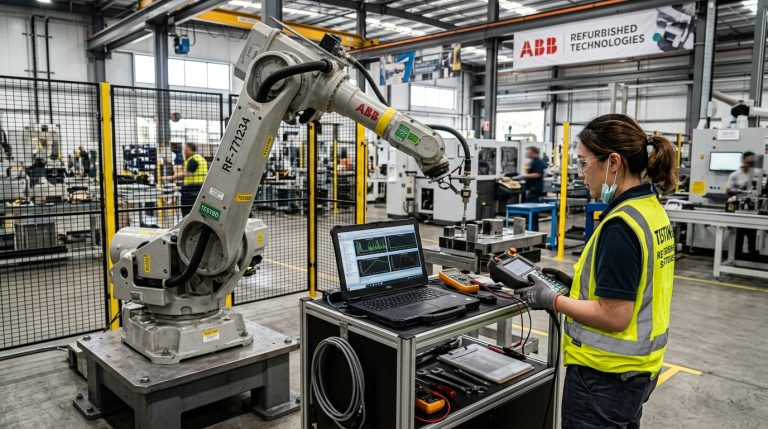
Refurbished industrial robots can potentially support stone carving when their mechanical condition, controller, payload, reach, protection, and software compatibility match the process.
The assessment should verify:
- gearbox condition and backlash;
- brakes, motors, and encoders;
- robot mastering;
- controller and teach pendant;
- offline-programming compatibility;
- external-axis support;
- communication with spindle and cell controls;
- environmental protection;
- payload and wrist-moment limits;
- availability of backups and documentation;
- spare-parts and service support.
Stone milling creates severe process conditions. A robot suitable for light handling may not remain suitable after the addition of:
- a heavy spindle;
- long cutting tools;
- water and dust exposure;
- continuous machining cycles;
- high process forces;
- a coordinated rotary table.
A refurbished robot must be evaluated as part of the complete stone-machining cell.
RHTS provides new and refurbished industrial robots that can be assessed for robotic milling, sculpture, architectural stonework, and digital fabrication.
The Complete Cost of a Robotic Stone-Carving System
The industrial arm is only one part of the investment.
A complete system may require:
- robot and controller;
- stone-compatible spindle;
- diamond tools;
- automatic tool changer;
- rotary table or linear axis;
- heavy-duty workpiece fixture;
- CAM and simulation software;
- safety equipment;
- water and slurry management;
- dust extraction;
- electrical and structural installation;
- scanning and measurement equipment;
- programming and commissioning;
- operator training;
- hand carving and finishing;
- transport and final installation.
Economic comparison should distinguish between:
- robot purchase cost;
- cell investment;
- production cost;
- finishing cost;
- installation cost;
- the value of reduced lead time;
- the artistic or architectural value of the completed work.
What Are the Main Limitations?
- The robot does not design the sculpture. A digital model or approved scan remains necessary.
- AI claims are often broader than the actual process. Automated CAM is not automatically artificial intelligence.
- Stone remains unpredictable. Veins, fractures, and hardness variations can change the process.
- Robots are less rigid than dedicated machine tools. Posture and cutting forces affect surface quality.
- Deep undercuts remain difficult. Tool diameter and spindle access limit reachable detail.
- Hand finishing is often necessary. Fine surfaces, sharp details, and artistic judgement remain human tasks.
- Scanning does not capture everything perfectly. Hidden or damaged geometry may require reconstruction.
- Natural materials cannot be reproduced identically. Each stone block has unique structure.
- Safety infrastructure is substantial. Heavy stone, rotating tools, dust, water, and robot movement must be controlled.
- The full cell can be expensive. Tooling, software, fixtures, positioners, and finishing may exceed the cost of the robot.
How to Evaluate a Robotic Stone-Carving Project
Robotic Stone Carving Evaluation Framework
- Purpose: Is the project a new sculpture, reproduction, restoration element, or architectural component?
- Digital Source: Will the geometry come from modelling, scanning, or a combination of both?
- Stone: What material, block dimensions, structure, and visible characteristics must be considered?
- Scale: What robot reach, positioner, and workpiece handling equipment are required?
- Tooling: Which spindle, saws, diamond tools, and tool-changing system are needed?
- Process: How will roughing, semi-finishing, finishing, and hand carving be divided?
- Software: How will geometry become toolpaths and controller-compatible robot programs?
- Simulation: How will collisions, singularities, tool access, and rotary-axis movement be validated?
- Accuracy: What geometric tolerance and surface quality are required?
- Material Management: How will water, dust, slurry, fragments, and tool wear be controlled?
- Safety: How will heavy stone, robot motion, spindle hazards, and operator access be managed?
- Finishing: Which details and surfaces will still require skilled manual work?
If the stone, digital source, required detail, and division between robotic and manual work are not defined, choosing a robot or software platform is premature.
Frequently Asked Questions
What Is AI-Powered Robotic Stone Carving?
AI-powered robotic stone carving is a digital fabrication workflow that may use artificial intelligence, automated software, industrial robots, scanning, CNC toolpaths, and diamond tools to produce sculpture and architectural stonework.
Does the Robot Design the Sculpture?
No. The robot normally executes machining paths derived from a human-created, scanned, reconstructed, or AI-assisted three-dimensional model.
Is Automatic Toolpath Generation the Same as AI?
Not necessarily. Software can generate toolpaths automatically through predefined geometric and machining rules without using machine learning or autonomous artistic decision-making.
Can Robots Carve Marble and Granite?
Yes, when the robot, spindle, diamond tooling, fixture, process parameters, and environmental systems are suitable for the selected stone.
Can a Robot Reproduce a Historical Sculpture?
A robot can reproduce approved digital geometry from a scan or model, but differences can remain because of scanning limits, tool access, calibration, stone structure, and hand finishing.
Why Is Hand Finishing Still Necessary?
Human carvers complete fine details, undercuts, textures, polished areas, local corrections, and aesthetic decisions that may be inefficient or inaccessible for the robotic tool.
What Is a Seven-Axis Stone-Carving Robot?
It is typically a six-axis industrial arm coordinated with an additional rotary table or positioner that turns the stone and improves access around the workpiece.
Does Robot Repeatability Guarantee an Accurate Sculpture?
No. Final accuracy also depends on calibration, spindle behaviour, tool wear, robot stiffness, cutting forces, fixtures, stone movement, and the CAM strategy.
Can Refurbished Robots Be Used for Stone Sculpture?
Potentially, when their mechanical condition, controller, reach, payload, environmental protection, external-axis support, and software compatibility match the intended machining process.
Will Robotic Carving Replace Stone Sculptors?
Robotic systems can automate heavy and repetitive material removal. Artists, stone carvers, digital specialists, fabricators, and engineers remain responsible for design, material interpretation, finishing, quality, and authorship.
The Robotic Renaissance Is a Hybrid Production Model
AI-powered robotic stone carving is changing how large sculptures, architectural ornament, replacement elements, and complex stone forms can be produced.
Digital models and scans make geometry transferable. Automated software reduces some programming work. Multi-axis robots move cutting tools around large blocks. Diamond tooling removes material systematically. Measurement systems compare the result with the approved design.
None of these technologies eliminates the physical character of stone or the need for human judgement.
The strongest contemporary workshops do not present a simple conflict between robot and artisan. They divide the process according to capability.
The robot removes heavy volume, follows repeatable paths, and establishes complex geometry. The sculptor evaluates the stone, resolves inaccessible detail, establishes surface character, and decides when the work has reached artistic completion.
The result is neither purely automated nor purely manual. It is a hybrid form of production in which digital accuracy, industrial machinery, natural material, and trained human perception remain inseparable.
Explore related guidance in the Robot Art & Architecture and Milling Robots sections.
Artists, stone workshops, architectural fabricators, restoration specialists, and universities can also contact RHTS with the intended stone, block dimensions, spindle payload, working envelope, positioner, controller, and surface-quality requirements for an initial robot-platform assessment.
Official Company Sources
- Monumental Labs: Robotic Stone Sculpture and Architectural Ornament
- Monumental Labs: Robotic Milling and Hand-Finishing Process
- Robotor: Multi-Axis Stone-Milling Systems and OR-OS Software
- TorArt: Robotor Stone-Milling Integration
- Studio Corsanini: ScultoRob for Marble and Natural Stone
- Roboticom: ScultoRob Seven-Axis Robotic Carving System