English
 Italiano
 Українська
 Русский
 Español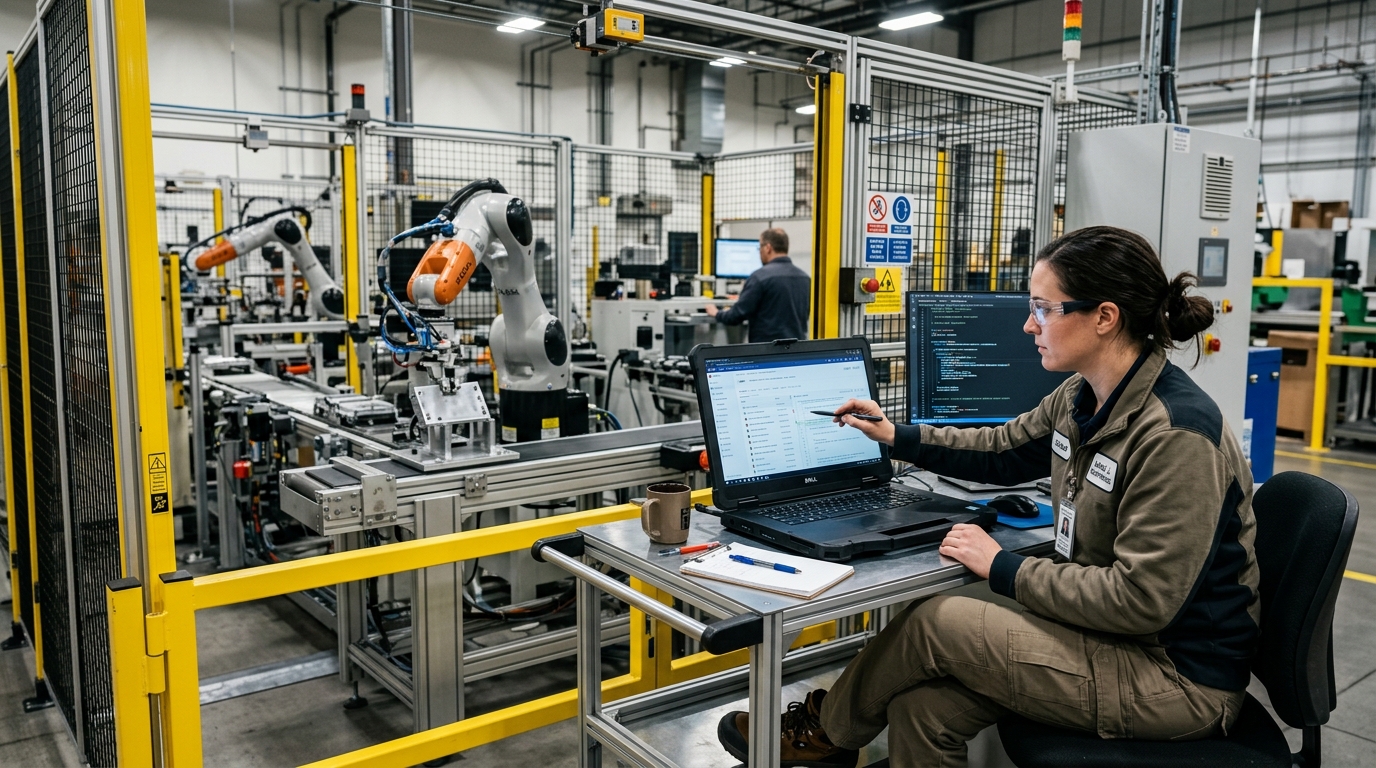

Robot program version control should make it possible to determine which program is approved for production, what changed, who authorized the change, and which related configuration belongs with that release. Saving occasional copies of robot code is not enough when several engineers, controllers, offline programming tools, PLCs, or production cells are involved.
Manufacturers need a controlled record that connects robot programs with the parameters, reference data, configuration files, backups, and documentation required to reproduce the intended operating state. The exact files depend on the robot brand, controller, application, and integration architecture, but the management principles remain similar.
This guide explains what manufacturers should include in robot program version control, how to distinguish backups from controlled releases, what information should accompany each revision, and how to prevent an undocumented program change from becoming a production or maintenance problem.
What Should Robot Program Version Control Cover?
Version control should cover more than the main motion program. A robot may depend on subprograms, variables, tool and work-object definitions, application parameters, communication settings, calibration-related data, and interfaces with other cell equipment. A useful system identifies which elements together create the approved production configuration.
The objective is traceability. An engineer investigating a fault or restoring a controller should be able to identify the correct released configuration rather than choosing among files called “latest,” “final,” or “backup2.” Version records should therefore connect each production release with a clear identifier and supporting information.
Why Robot Program Version Control Matters in Production
Small Program Changes Can Affect the Cell
A modification does not have to involve a complete robot path. Changes to positions, speeds, timing logic, tool data, condition checks, communication variables, or program calls can alter cell behavior. Effective robot program version control should therefore record what was changed and the operational reason for the modification.
Production Needs an Identifiable Release
The program currently stored in the controller should be distinguishable from the formally approved production release. Temporary troubleshooting edits may exist during commissioning or maintenance, but they should not silently become the new production standard. A release process establishes which configuration has been reviewed and accepted for use.
This distinction also simplifies troubleshooting. When an unexpected behavior appears, maintenance personnel can compare the controller state with the approved release and determine whether an unauthorized or incomplete change may have occurred.
Which Robot Files and Data Should Manufacturers Track?
Robot Programs and Dependent Files
Track the main robot program and every dependent program needed to run the application. This may include routines for initialization, homing, tool handling, error recovery, machine loading, pallet patterns, cleaning, inspection, or other process functions. The required file structure is controller-specific, so manufacturers should follow the documentation for the installed platform.
Configuration and Reference Data
Programs may rely on data that exists outside the visible sequence of instructions. Relevant records can include tool definitions, coordinate frames, payload information, application variables, user-defined parameters, I/O mappings, communication settings, and other configuration required by the cell. Only data that is relevant to restoring or identifying the operating configuration needs to be included.
Where PLC logic, vision recipes, CNC programs, or other systems directly affect the robot sequence, their compatible versions should also be identifiable. This does not require storing every machine file in one repository, but the relationship between compatible releases should be documented. The RHTS guide to industrial robot data architecture provides additional context on how controller data, storage, permissions, interfaces, and version control can be organized across an automated cell.
Eight Items to Track for Every Production Release
A practical release record should contain enough information to identify the software state without creating unnecessary administrative work. For each approved robot program revision, manufacturers should track:
- Release identifier: Assign a unique revision or release number instead of relying only on filenames or modification dates.
- Program files: Preserve the main program and all required subprograms, routines, data files, and dependent modules.
- Configuration state: Record relevant tool data, frames, application parameters, communication configuration, and controller-specific settings required by the application.
- Change description: State exactly what was modified and why, such as a revised position, sequence condition, recovery routine, or process parameter.
- Author and date: Identify who created the revision and when the controlled change was made.
- Approval status: Record whether the revision is under development, awaiting validation, approved for production, superseded, or archived.
- Compatibility information: Identify associated PLC, vision, CNC, post-processor, recipe, or other software revisions when compatibility matters.
- Validated backup: Preserve the controller backup or other recovery package associated with the accepted production configuration when the controller supports it.
These records create a practical chain between engineering changes and the configuration actually authorized for manufacturing.
How Should Program Revisions Be Organized and Approved?
Separate Development From Production Releases
Development files should not be confused with released production software. Manufacturers can use separate repository areas, permissions, branches, status fields, or another controlled method suitable for their organization. The specific tool matters less than maintaining an unambiguous distinction between work in progress and an approved release. Similar version-control requirements also appear in parametric design and robotic fabrication workflows, where robot programs, simulation files, post-processors, calibration data, and design files may need to remain synchronized.
A defined approval process should also state who is allowed to change robot programs and who can authorize a production release. Validation requirements should reflect the consequence of the change. A minor documentation correction and a change affecting robot motion or cell sequencing do not necessarily require the same review.
How Are Backups Different From Version Control?
A controller backup captures information needed for recovery, while robot program version control records the history and identity of changes. These functions overlap but are not interchangeable. A backup may restore a controller after hardware replacement or data loss, yet it does not automatically explain why files changed or whether the backup corresponds to an approved production state.
Manufacturers should therefore associate important backups with defined releases. The related RHTS article on robotic machining traceability and program version uncertainty explains why identifying the exact CAM, post-processor, robot program, and production release becomes especially important when information is distributed across several systems.
How Should Manufacturers Handle Changes Made on the Shop Floor?
Direct edits from a teach pendant are sometimes necessary during commissioning, maintenance, or process adjustment. Robot program version control becomes especially useful when those changes would otherwise remain only inside the controller. A defined procedure should require relevant edits to be reviewed, documented, and transferred back into the controlled master configuration before they are treated as permanent.
The same principle applies after recovery work. If maintenance restores an older backup and then modifies positions or logic to restart production, the resulting controller state may no longer match either the old release or the previously approved current release. That new state should be reconciled with the version record rather than left undocumented.
How Should Version Control Be Integrated With Cell Management?
Robot software should be managed in the context of the complete automated cell. Changes involving motion, equipment interfaces, protective functions, operating modes, or recovery procedures may require additional technical review beyond ordinary software administration. ISO 10218-2:2025 addresses the integration, commissioning, operation, and maintenance of industrial robot applications and cells; manufacturers can consult the ISO 10218-2:2025 industrial robot application and cell safety standard when determining the standards applicable to their installation.
Access control should also match responsibility. Operators may need to select approved programs without being authorized to modify protected configuration data. Maintenance and engineering personnel may require broader access, but changes should still be attributable and recoverable according to the plant’s procedures.
Robot program version control is most useful when it becomes part of commissioning, maintenance, and change management rather than a separate documentation exercise. Before a modified cell returns to normal production, the organization should know which software configuration is installed and whether the corresponding records have been updated.
Manufacturers reviewing how robot programs, controllers, backups, PLC interfaces, and other automation software should be managed within a specific cell can contact Robotic Hi-Tech Solutions with the robot platform and application requirements for a technical assessment of the integration.
FAQ
What is robot program version control?
Robot program version control is the controlled process of identifying revisions to robot software and related configuration, recording changes, and distinguishing approved production releases from development or temporary files.
Is saving robot backups enough for version control?
No. Backups support recovery, but they do not necessarily provide change history, approval status, revision descriptions, or a clear relationship between different production releases.
Should tool and coordinate data be version controlled?
They should be tracked when changes to those values can affect the application or when the data is necessary to reproduce the approved configuration. The required data depends on the controller and process.
Should PLC programs be stored with robot programs?
Not necessarily in the same repository. However, compatible PLC and robot releases should be identifiable when their logic depends on each other for sequencing, communication, or process behavior.
How should teach pendant changes be handled?
Relevant permanent edits should be documented and incorporated into the controlled master configuration. Otherwise, the controller may contain a production program that differs from the archived engineering version.
Should every small robot program change create a new revision?
A controlled system should preserve meaningful changes that alter the released configuration. The organization should define its revision rules so that changes affecting production behavior remain identifiable without creating unnecessary versions for irrelevant edits.
Who should approve a robot program release?
The responsible person depends on the manufacturer’s engineering and change-control procedures. Approval authority should be defined in advance and should reflect the technical and production consequences of the change.
How often should robot program backups be created?
There is no universal interval appropriate for every installation. A backup should be created when needed to preserve an important validated state, particularly after approved configuration changes, with frequency determined by the plant’s recovery and change-management requirements.