English
 Italiano
 Українська
 Русский
 Español
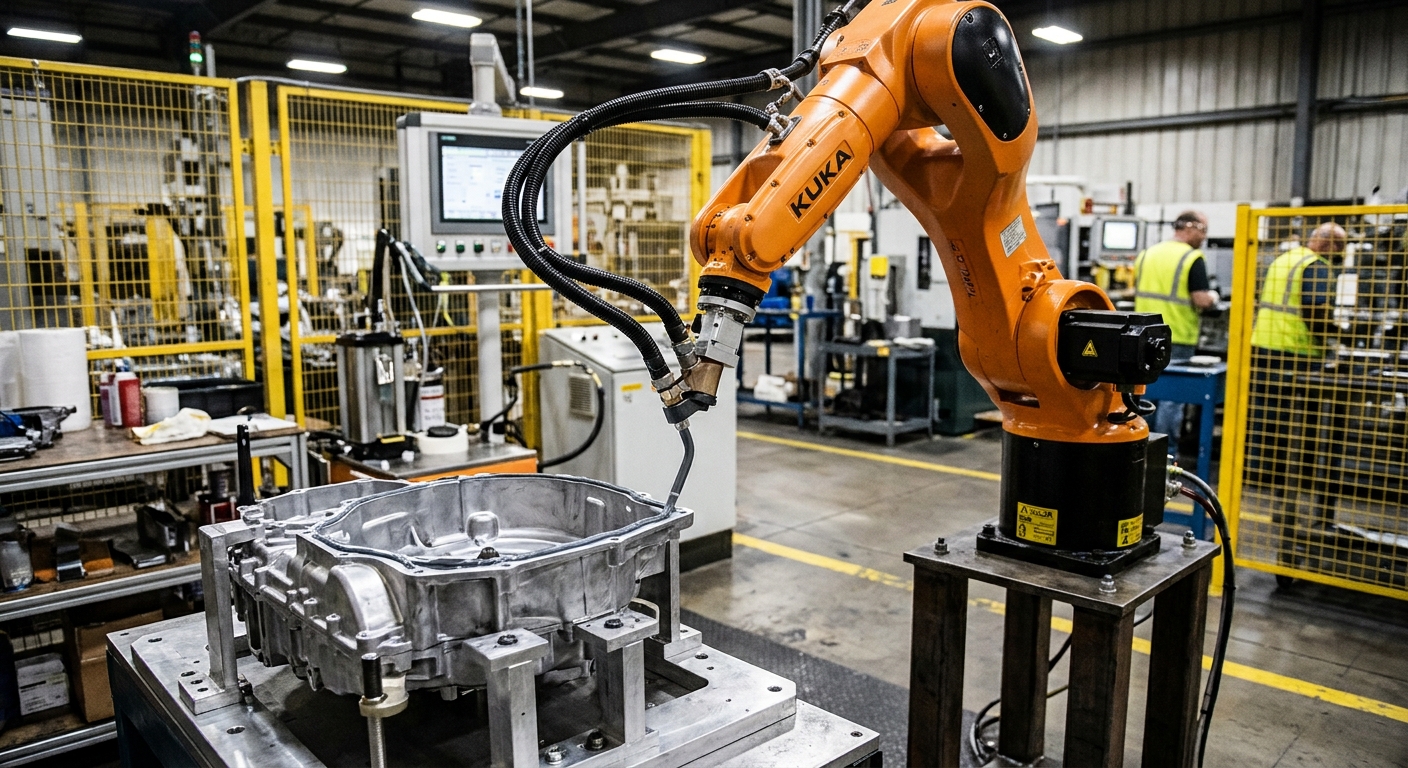

Industrial robots can automate adhesive and sealant application by moving a dispensing nozzle along programmed paths while a controlled system delivers material. This arrangement helps manufacturers regulate bead position, application speed, and material flow. However, successful automation depends on more than robot repeatability. Adhesive properties, surface conditions, dispensing equipment, and production requirements must work together.
Robotic adhesive application is used in manufacturing operations that require bonding, sealing, gasketing, or controlled material deposition. Typical applications include automotive assemblies, electronic enclosures, industrial equipment, and components with complex joining surfaces. The robot provides programmable movement, while the dispensing system manages material delivery according to the selected process.
This article explains how robotic dispensing systems operate, which technical factors affect bead quality, and how manufacturers can evaluate automation feasibility. It also covers nozzle calibration, material handling, process monitoring, safety, and commissioning. The objective is to help production engineers distinguish applications that benefit from robotic dispensing from those where simpler equipment may be sufficient.
How does robotic adhesive application work?
A robotic dispensing cell combines an industrial robot, material supply equipment, a dispensing device, and a control system. In robotic adhesive application, the robot follows a programmed trajectory while the dispenser applies adhesive or sealant to the workpiece. The required equipment depends on material behavior, application geometry, and production conditions.
Robot movement and dispensing coordination
The controller coordinates nozzle movement with dispensing commands. Material flow must begin and end at appropriate positions along the programmed path. Delays between valve operation and material delivery can produce gaps or excessive deposits, particularly around corners and path transitions.
Material supply and dispensing equipment
Supply systems may include pumps, pressure vessels, cartridges, hoses, metering units, and application valves. Equipment selection depends on viscosity, required flow, material compatibility, and whether the process uses one-component or two-component products.
For two-component adhesives, the system must also maintain the specified mixing ratio and provide suitable mixing equipment. Incorrect proportions can affect curing and final bond properties.
Which manufacturing applications benefit from robotic dispensing?
Robotic adhesive application is particularly useful when manufacturing requires controlled movement across multiple surfaces, changing nozzle orientations, or repeated complex trajectories. Nevertheless, production volume and part geometry should justify the additional integration requirements.
Structural bonding and component assembly
Industrial adhesives can join components without requiring mechanical fasteners at every connection point. Robotic systems can apply material along specified bonding areas before parts enter an assembly or curing operation.
Applications may include metal assemblies, composite components, vehicle structures, and industrial housings. Adhesive selection must account for substrate compatibility, joint design, service conditions, and manufacturer instructions.
Sealing and gasket formation
Sealants help protect joints against moisture, dust, or other environmental exposure when the material and joint design are suitable. Robots can follow enclosure edges, panel joints, and irregular sealing paths.
For formed-in-place gaskets, the deposited bead must provide suitable continuity and geometry. Compression behavior, curing conditions, and assembly timing influence the final sealing performance.
What determines adhesive bead quality?
Bead quality in robotic adhesive application depends on the interaction between robot motion, dispensing flow, material characteristics, and nozzle geometry. A correctly programmed path cannot compensate for unstable material delivery or unsuitable application conditions.
Flow rate and robot travel speed
Flow rate determines how much material enters the nozzle over time. Robot speed determines how that material is distributed along the path. Their relationship influences deposited bead dimensions.
If the robot accelerates while material flow remains unchanged, less material may be deposited per unit of travel. Deceleration can produce the opposite effect. Process development should therefore examine straight sections, corners, starts, and stops separately.
Viscosity and material temperature
Viscosity describes a material’s resistance to flow. Some adhesives change viscosity with temperature or shear conditions. These changes can affect dispensing pressure, flow stability, and bead formation.
Temperature control may be necessary for certain products, but operating limits must follow the adhesive manufacturer’s technical documentation. Material heating should never be assumed suitable for every formulation.
How should the robot and dispensing tool be calibrated?
Calibration connects programmed robot coordinates with the physical position of the dispensing nozzle. In robotic adhesive application, incorrect references can move the deposited bead away from the intended joint even when the robot executes its program correctly.
Tool center point calibration
The tool center point, or TCP, defines the reference position used to control the nozzle. Its location should correspond to the dispensing tool geometry established during programming.
Incorrect TCP data can cause positional errors when the nozzle changes orientation. The article How extruder TCP calibration affects accuracy in robotic 3D printing explains a related calibration problem in material deposition systems.
Workpiece references and fixture stability
The workpiece coordinate system must correspond to the component’s actual position. Fixtures should hold parts consistently without obstructing the nozzle or creating collisions.
When part dimensions or loading positions vary, additional measurement or sensing may be required. Otherwise, the robot can follow the correct programmed trajectory relative to an incorrectly positioned component.
How can manufacturers control dispensing defects?
Common defects in robotic adhesive application include interrupted beads, excessive deposits, incorrect positioning, trapped air, and inconsistent material delivery. Their causes should be investigated individually rather than corrected through arbitrary changes to robot speed.
Managing start and stop transitions
Dispensing valves and material supply systems have response characteristics that influence deposition timing. The robot program may require coordinated valve commands, controlled acceleration, and suitable approach or departure movements.
These issues resemble certain material-deposition challenges described in How to validate deposition repeatability before production. Although adhesive properties differ from printing materials, the need for representative process testing is similar.
Inspection and process monitoring
Monitoring may include material pressure, flow measurement, temperature, dispensing status, or visual inspection. The appropriate method depends on the defect types that must be detected.
Vision systems can inspect selected bead characteristics when lighting, sensor resolution, and surface conditions permit. The article Robotic machine vision inspection: Moving the sensor instead of the part discusses related sensor positioning and calibration considerations.
What should engineers check before implementing automation?
Feasibility assessment should begin with the adhesive specification and the actual production requirement. Robot selection follows from the necessary working envelope, payload, trajectory, and integration constraints.
The following eight checks provide a practical framework for evaluating a robotic adhesive application project:
- Material compatibility: Verify adhesive chemistry, viscosity, storage conditions, curing requirements, and compatibility with dispensing components.
- Bead specifications: Define required location, width, height, continuity, and acceptable variation using measurable criteria.
- Robot accessibility: Check reach, wrist orientation, joint limits, collision clearance, and nozzle access throughout the trajectory.
- Dispensing equipment: Evaluate pump capacity, metering method, valve response, hose arrangement, and material supply requirements.
- Component positioning: Examine fixture repeatability, part tolerances, loading variation, and workpiece reference calibration.
- Production timing: Include dispensing, robot travel, material preparation, inspection, and any required curing or assembly operations.
- Quality verification: Establish inspection methods, sample frequency, defect classification, and acceptance criteria.
- Maintenance requirements: Define nozzle cleaning, material changeover, flushing procedures, calibration checks, and replacement intervals.
These checks should be completed using representative components and the intended adhesive. A successful demonstration on a simplified test piece does not automatically establish production capability.
What safety requirements apply to robotic dispensing cells?
Robotic dispensing combines machinery hazards with potential chemical exposure. Risk assessment should address robot movement, maintenance access, dispensing pressure, material handling, and foreseeable operating failures.
Robot safeguarding and operator access
Protective measures depend on the cell design and risk assessment. These may include physical guarding, interlocked access, safety-rated controls, and procedures for maintenance or intervention.
The OSHA technical guidance on industrial robots provides information about robotic system hazards and safeguarding considerations. Applicable legal requirements and relevant machinery standards must also be assessed for the installation.
Chemical handling and maintenance
Adhesives and sealants may require ventilation, protective equipment, controlled storage, or specific cleaning procedures. Requirements depend on the chemical formulation and operating conditions.
Engineers should consult the product safety data sheet and technical documentation before selecting dispensing equipment or maintenance procedures. Pressurized components must also be isolated safely before servicing.
How should a robotic dispensing cell be validated?
Commissioning should demonstrate that the complete robotic adhesive application system meets the defined requirements. Robot positioning, dispensing flow, material behavior, and workpiece variation must be evaluated together under representative production conditions.
Testing under representative production conditions
Initial trials should examine bead dimensions, continuity, start and stop behavior, and material delivery stability. Testing should include the expected operating speeds, nozzle orientations, and component variations.
Repeated trials can help identify variation between cycles. Where the application involves structural bonding or environmental sealing, suitable joint or seal testing must confirm the required functional performance.
Manufacturers evaluating a dispensing cell can contact Robotic Hi-Tech Solutions with component drawings, adhesive specifications, production targets, and quality requirements. These details provide a basis for discussing equipment selection and integration feasibility.
Frequently asked questions
Can industrial robots apply both adhesives and sealants?
Yes. Industrial robots can support both processes when equipped with compatible dispensing systems. Material properties, application geometry, and curing requirements determine the necessary configuration.
What type of robot is suitable for adhesive dispensing?
Articulated robots are commonly considered for complex three-dimensional paths. Cartesian or other motion systems may be suitable for simpler geometries. Selection depends on reach, payload, orientation, and production requirements.
Does robotic dispensing guarantee consistent bead dimensions?
No. Consistency depends on material flow, robot movement, nozzle condition, temperature, and component positioning. The complete process requires testing and monitoring.
Can robots dispense two-component adhesives?
Yes. Suitable systems use metering and mixing equipment designed for the specified components. Mixing ratio, working time, and material compatibility must be controlled.
How is adhesive flow synchronized with robot movement?
The robot controller coordinates motion with dispensing commands. Depending on the equipment, additional control functions may regulate flow in relation to travel speed or process conditions.
Can robotic adhesive application reduce material waste?
It may reduce excess deposition when dispensing parameters are controlled appropriately. Actual savings depend on the original process, material characteristics, reject rates, and maintenance losses.
Is machine vision necessary for robotic dispensing?
Not always. Fixed fixtures and stable components may allow dispensing without vision. Sensors become useful when part positioning varies or automated bead inspection is required.
How should robotic dispensing performance be measured?
Relevant indicators include bead geometry, continuity, material consumption, application cycle time, defect frequency, and functional joint performance. Acceptance limits should reflect the product requirements.