English
 Italiano
 Українська
 Русский
 Español
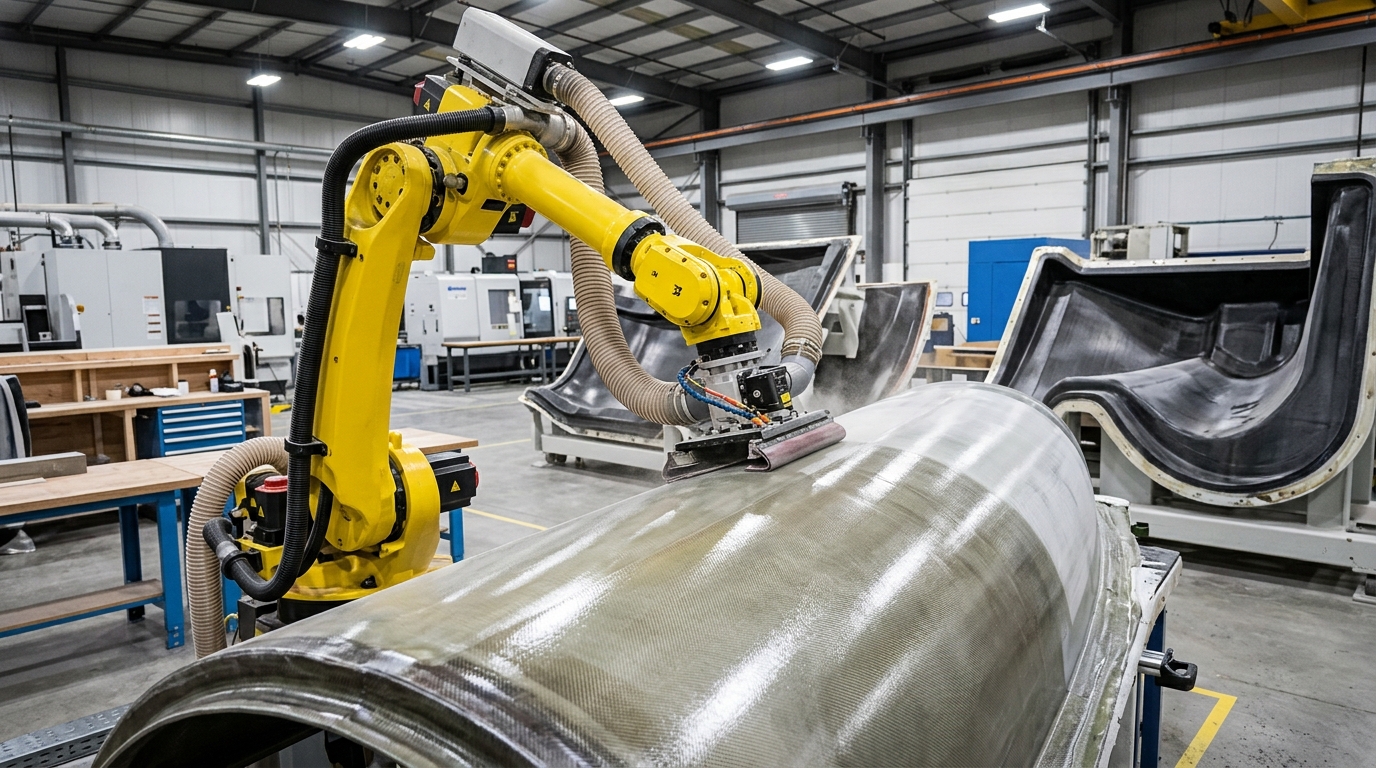

Robotic sanding can automate surface preparation and finishing on large composite parts by combining programmed motion, suitable abrasives, and controlled contact with the workpiece. Industrial robots can follow curved surfaces, reach different working angles, and perform repeated finishing passes. However, consistent results depend on more than the robot’s movement accuracy. Tool compliance, surface geometry, material behavior, and dust extraction must work together.
Large composite components present particular challenges. Their surfaces may contain complex contours, local thickness variations, molded features, and areas with different stiffness. Manual sanding requires operators to manage pressure, coverage, and abrasive wear across these changing conditions. Automation can reduce variation in the process, but only when the finishing system accommodates the actual part geometry.
This article explains how robotic sanding systems operate, which tools and control methods are suitable, and how manufacturers can evaluate automation before production. It also covers programming, workholding, surface inspection, safety, and practical selection criteria for large composite finishing applications.
How robotic sanding works on composite surfaces
A robotic sanding cell uses an industrial manipulator to position and move an abrasive tool across a defined surface. The robot follows a programmed path while the finishing equipment removes material according to the selected process conditions.
Robot motion and surface coverage
The controller coordinates tool position, orientation, and travel speed. For curved components, the abrasive must follow the surface without creating excessive pressure at edges or transitions. Path spacing determines whether adjacent passes provide adequate coverage.
Material removal and process stability
Material removal depends on abrasive type, contact force, tool speed, dwell time, and composite construction. Excessive sanding can damage the resin-rich surface or expose reinforcement fibers. Process trials should establish acceptable removal conditions before automated operation.
Which composite parts benefit from automated finishing?
Robotic sanding is particularly relevant when components are large, geometrically complex, or repeatedly manufactured. Examples include composite panels, molded covers, marine structures, and tooling surfaces. The application must still be evaluated against production volume and finishing requirements.
Large curved components
Curved surfaces require continuous changes in tool orientation. A multi-axis robot can follow these contours while maintaining a programmed approach direction. However, its usable reach and working posture must be verified across the complete component.
Parts with variable surface stiffness
Thin composite sections may deflect under abrasive pressure. Unsupported regions can produce uneven contact even when robot positioning remains consistent. Appropriate fixtures and compliant tooling help manage these differences without assuming the component is perfectly rigid.
How to select robotic sanding tools
The end effector determines how abrasive contact occurs. Common configurations include orbital sanders, rotary abrasive tools, and specialized finishing heads. Selection depends on the surface shape, required finish, accessibility, and permitted material removal.
Orbital and rotary abrasive systems
Orbital tools can support surface preparation and finishing over suitable areas. Rotary tools may be useful for specific contours or localized operations. Neither configuration is universally preferable; abrasive behavior and actual surface results determine suitability.
Compliant finishing heads
Compliant tools allow limited movement between the robot and the workpiece. This helps accommodate small geometric variations. The compliance range must be controlled because excessive movement can reduce path accuracy or produce inconsistent material removal.
Why force control matters in robotic sanding
Maintaining appropriate contact force is a central requirement in robotic sanding. A position-controlled path alone cannot fully compensate for part deviations, fixture movement, or changes in abrasive contact conditions.
Active and passive force control
Passive systems use mechanical compliance to accommodate contact variation. Active systems use measured force and control adjustments to regulate interaction with the surface. Their performance depends on sensor integration, controller response, and the finishing tool.
Preventing excessive material removal
High contact force or prolonged dwell can create local surface damage. Engineers should evaluate pressure distribution, abrasive condition, and movement speed together. A stable force reading does not necessarily guarantee uniform removal across different surface curvatures.
How to program finishing paths for large parts
Offline programming can generate robot paths from digital part geometry. The resulting program must account for the actual fixture, robot configuration, tool dimensions, and accessibility. Simulation identifies potential motion problems before physical testing.
Tool orientation and path spacing
Tool orientation influences abrasive contact, particularly near curved transitions. Path spacing should provide sufficient overlap without unnecessary repeated passes. The article Why tool orientation is critical for surface finish explains related considerations in robotic machining.
Using external axes for extended reach
Large components may exceed the practical reach of a stationary robot. A linear track can reposition the manipulator along the workpiece. However, the additional axis requires coordinated programming, calibration, and mechanical alignment.
The article Linear axis robotic milling: critical selection criteria examines external-axis integration principles that also matter when designing large robotic finishing cells.
How to maintain consistent finishing quality
Finishing quality depends on controlled abrasive contact and reliable part positioning. Robot repeatability helps reproduce motion, but it cannot independently correct changes in material condition, tool wear, or workpiece deformation.
Workholding and reference calibration
Fixtures must support the component without introducing unacceptable distortion. The robot also needs accurate workpiece coordinates and tool reference data. These relationships should be checked after fixture adjustments or end-effector changes.
Surface inspection and process feedback
Inspection methods may include visual assessment, surface measurements, and geometry verification. The appropriate method depends on the specified finish. Results can guide adjustments to abrasive selection, path spacing, contact force, or finishing sequence.
Safety and dust management in composite finishing
Sanding composite materials can generate airborne particles. Dust characteristics depend on the reinforcement, resin system, coatings, and abrasive process. The cell therefore requires a material-specific exposure assessment and suitable extraction equipment.
Dust extraction and containment
Extraction should capture dust close to its generation point where practical. Enclosures, filtration, housekeeping procedures, and appropriate protective equipment may also be necessary. Dust collection equipment must be compatible with the materials and identified fire or explosion hazards.
The robot cable routing and dress pack reliability guide explains how moving hoses and cables should be managed around industrial robot tools. This is relevant when integrating extraction hoses into a finishing cell.
OSHA provides additional information about industrial robot system safety, including hazards associated with robot operation, programming, and maintenance. Applicable local regulations and the cell-specific risk assessment must also be considered.
Eight checks before implementing robotic sanding
Before selecting equipment, manufacturers should evaluate the complete finishing process. The following checks help identify technical limitations and define meaningful acceptance tests.
- Define the required finish: Specify surface appearance, permitted defects, material removal limits, and inspection criteria.
- Review composite construction: Identify reinforcement type, resin system, coatings, and areas vulnerable to sanding damage.
- Measure part variation: Compare actual component geometry with the digital model and establish acceptable deviations.
- Verify robot coverage: Check reach, wrist orientation, singularities, and collision clearance throughout the finishing area.
- Evaluate abrasive tooling: Test tool geometry, abrasive grade, compliance, wear, and replacement procedures.
- Validate contact control: Measure how force and surface results change across different component regions.
- Assess dust protection: Determine extraction, containment, filtration, maintenance, and operator protection requirements.
- Run representative trials: Inspect finished samples against defined acceptance criteria before approving production.
Frequently Asked Questions
Can industrial robots sand carbon fiber components?
Yes. Industrial robots can sand suitable carbon fiber composite surfaces. The process must control material removal and dust exposure while avoiding unintended damage to reinforcement fibers.
Is force control necessary for robotic sanding?
Force control is particularly useful when surface geometry varies. Some applications can use passive compliance, while others benefit from active force regulation.
Can one robot finish an entire large composite part?
Possibly. Coverage depends on component dimensions, robot reach, tool orientation, and accessibility. External axes or multiple robot positions may be necessary.
What abrasives are suitable for composite finishing?
Selection depends on the composite material, coating, finishing stage, and surface specification. Representative tests should establish suitable abrasive types and grades.
How is robotic sanding quality inspected?
Inspection can combine visual checks, surface measurements, and geometric verification. Acceptance criteria should reflect the component’s manufacturing requirements.
Can robotic sanding replace manual finishing completely?
Some operations can be automated extensively. Complex edges, repairs, inaccessible features, or variable components may still require manual intervention.
Does robotic sanding require offline programming?
Not always. Offline programming is useful for complex surfaces and large components, but teaching and other programming methods may suit simpler applications.
What information is needed to specify a robotic sanding cell?
Engineers need component geometry, material details, surface requirements, production expectations, available floor space, and applicable safety constraints.
For an application-specific assessment, contact Robotic Hi-Tech Solutions with the component dimensions, composite construction, finishing requirements, and expected production conditions. These details support a technical review of robot reach, tooling, workholding, and process validation.