English
 Italiano
 Українська
 Русский
 Español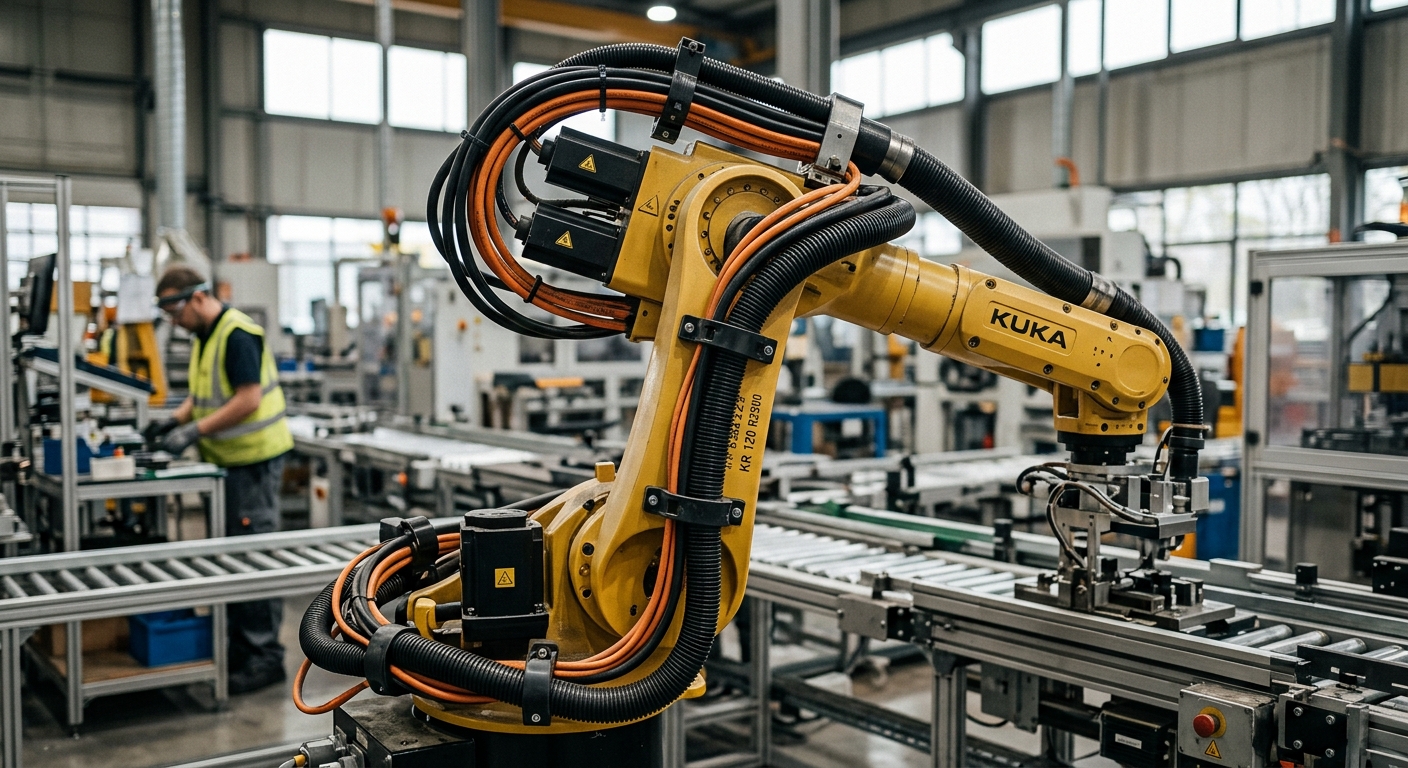

Robot dress packs often fail because cables and hoses are forced to bend, twist, rub, or stretch beyond the conditions intended by their manufacturers. A dress pack may contain electrical cables, pneumatic hoses, welding lines, communication cables, and process-fluid lines. If these components cannot follow the robot’s movement freely, repeated cycles can gradually damage conductors, insulation, connectors, or hose walls.
Correct robot cable routing manages motion throughout the complete programmed path. The objective is to provide enough controlled movement for every robot position without leaving excess material that can catch on the cell, strike the workpiece, or form an uncontrolled loop. Routing must account for wrist rotation, arm extension, tool orientation, dress-pack stiffness, and the location of clamps and supports.
This article explains the main causes of dress pack failure, how routing affects service life, what should be checked during integration, and how maintenance teams can identify early warning signs. The central principle is simple: the dress pack must be treated as a moving mechanical system, not as a fixed bundle attached after programming is complete.
What Is a Robot Dress Pack?
A robot dress pack is the group of cables, hoses, connectors, protective conduits, brackets, clamps, and recovery devices used to supply the robot’s end effector. Its contents depend on the process. A welding robot may require welding power, gas, cooling water, and control signals, while a handling robot may use electrical connections and pneumatic lines.
The pack moves whenever the robot changes position. Its components therefore experience repeated bending and, depending on the route, torsion, pulling, compression, and contact with nearby surfaces. Even when each cable is suitable for dynamic service, the complete assembly can fail if its movement is poorly controlled.
Why Do Robot Dress Packs Fail?
Repeated bending and excessive tension
Dynamic cables are designed to flex under defined conditions, but incorrect robot cable routing can still exceed their limits. A cable that becomes taut at the end of the robot’s reach can also transfer force to its connector or clamp.
This damage may begin internally. Conductors can deteriorate before the outer jacket shows an obvious defect. Intermittent communication errors, unstable sensor signals, or faults appearing only in certain robot positions may therefore indicate a cable problem.
Twisting, abrasion, and impact
Twisting occurs when robot motion rotates a bundle without allowing that rotation to be distributed or released. It is especially relevant around the wrist, where several axes may move through large angles during a short part of the cycle.
Abrasion occurs when the pack repeatedly rubs against the robot, tooling, guarding, fixtures, or itself. Impact can occur when an uncontrolled loop accelerates and then strikes the arm or surrounding equipment. These conditions can damage the protective cover and eventually expose the cables or hoses inside it.
How Robot Cable Routing Affects Reliability
Routing controls where movement occurs.
Good robot cable routing guides bending into suitable sections and prevents motion from becoming concentrated near connectors or rigid brackets. Clamps should retain the pack without crushing it, and moving sections need enough length to complete the programmed path without being pulled tight.
Adding excessive slack is not a reliable solution. A long, loose loop can become trapped, whip during rapid movements, or rub against the cell. The required length should be established from the actual motion envelope and the way the routing system manages that movement.
Robot programs influence cable loading.
Two programs that reach the same tool position can load the dress pack differently. Axis configuration, wrist rotation, approach direction, and the sequence between points all influence how the bundle bends and twists.
Reliability assessment must therefore include the production program, not only manual movement through a few positions. The route should be observed during normal motion, transition moves, recovery paths, tool changes, maintenance positions, and any alternative product programs used in the cell.
Why the Robot Wrist Requires Special Attention
Combined wrist-axis movement
The final robot axes can change tool orientation rapidly while the upper arm remains nearly stationary. This combined motion can twist the dress pack, push it against the wrist housing, or pull it toward the tool flange. The problem may be difficult to see when each axis is tested separately.
Robot cable routing near the wrist must allow access to the end effector without placing connector bodies or rigid hose fittings inside high-flex zones.
Tool changes can alter this behavior. A longer tool, a different connector position, or a rotated mounting plate may require a new dress-pack assessment even if the robot program changes only slightly.
How the Application Changes Dress Pack Requirements
Process conditions determine what the pack must withstand and how robot cable routing should be designed. Welding applications can expose it to heat, spatter, and sharp metal edges. Machining and trimming cells may introduce chips, dust, vibration, and contact with fixtures or workpieces. Handling applications can require fast acceleration and repeated wrist reorientation.
Environmental protection should match the real exposure, but a protective sleeve cannot correct an unsuitable route. A thicker or stiffer cover may change how the bundle bends and can transfer motion to another location. Any protective change should therefore be evaluated throughout the robot cycle.
Dress pack reliability also depends on the surrounding cell architecture. The article Who Is Responsible When Robotic Automation Fails but the Robot Is Not at Fault? explains how tooling, sensors, interfaces, maintenance, and integration decisions can cause failures even when the robot operates correctly.
Eight Checks for Reliable Robot Cable Routing
The following checks should be completed during design, commissioning, program changes, and periodic inspection:
- Inspect every programmed position: Confirm that the dress pack remains controlled at working points, approach positions, home positions, tool-change stations, and maintenance locations.
- Check full extension: Verify that no cable, hose, connector, or branch becomes taut when the robot reaches the most demanding point in its operating envelope.
- Review minimum bend conditions: Compare bends with the requirements provided by the cable, hose, conduit, or dress-pack manufacturer.
- Observe wrist rotation: Run combined wrist movements and look for accumulated twisting, pinching, sudden loop movement, or contact with the tool.
- Locate abrasion points: Examine areas where the bundle touches the robot, brackets, fixtures, guarding, and adjacent dress-pack sections.
- Inspect clamps and supports: Confirm that they are secure, correctly positioned, and not crushing the bundle or creating a rigid bending point.
- Verify connector strain relief: Check that motion and tension are absorbed by the routing system rather than transferred directly to plugs, fittings, or termination points.
- Test realistic production motion: Observe the pack at normal operating speed and through representative cycles because slow manual movement may not reveal whipping or impact.
How Should Dress Pack Problems Be Diagnosed?
Diagnosis should begin by recording when the fault occurs. If an electrical or communication error appears repeatedly near the same robot position, technicians can examine which cable sections bend, twist, or tighten at that point. The same method applies to pneumatic pressure loss or process-fluid leakage.
A robot cable routing inspection should cover jackets, protective conduits, hose surfaces, clamps, connector entries, brackets, and areas hidden behind the arm. Polished surfaces, flattened conduit, exposed reinforcement, displaced clamps, or recurring debris near a contact point can indicate mechanical interference.
Replacing a damaged cable without correcting its route may reproduce the failure. After replacement, the team should run the complete cycle, verify the routing under operating conditions, and document any change to cable length, clamp position, bracket orientation, or program configuration.
Dress pack routing should also be verified during cell acceptance and after changes that affect robot motion or tooling. This robot CNC cell commissioning checklist explains how FAT, SAT, interface testing, and process validation help confirm that the complete installation is ready for production.
Safety During Inspection and Maintenance
Robot cable routing inspection can place a person inside the robot’s operating space or close to stored pneumatic, hydraulic, electrical, and mechanical energy. Work must follow the site’s risk assessment, isolation procedures, manufacturer instructions, and applicable regulations.
ISO 10218-2:2025 addresses the integration, commissioning, operation, maintenance, and decommissioning of industrial robot applications and cells. The standard provides a safety framework, but it does not replace an application-specific risk assessment or the legal requirements that apply at the installation site.
For an assessment of routing, tooling, program motion, and cell integration, companies can contact Robotic Hi-Tech Solutions. A technical review should use the actual robot model, process equipment, environmental conditions, and programmed operating range.
FAQ
Can a dress pack fail even if its outer cover looks intact?
Yes. Conductors, shields, or internal hose layers can deteriorate before external damage becomes visible. Position-dependent electrical or pneumatic faults require further inspection and testing.
Does adding more cable slack prevent failures?
Not necessarily. Too little length creates tension, while too much can cause whipping, snagging, or abrasion. The length must suit the complete motion envelope and routing system.
Should cable routing be checked after changing a robot program?
Yes. New points, axis configurations, speeds, or tool orientations can change how the pack bends and twists, even when the physical equipment remains unchanged.
Why do dress packs often fail near connectors?
Connectors are relatively rigid. If strain relief is ineffective, repeated movement or tension becomes concentrated where the flexible cable enters the connector.
Can protective conduit correct poor robot cable routing?
It can provide additional protection, but the contact source should still be corrected. Continued rubbing can damage the conduit and transfer stress to the internal components.
How often should a robot dress pack be inspected?
The interval should reflect manufacturer instructions, operating hours, cycle severity, environment, failure history, and the site’s maintenance plan. One universal interval is not suitable for every application.
Can robot speed affect dress pack reliability?
Yes. Higher acceleration and rapid direction changes can increase loop movement and impact. Routing should be observed at the speeds used during actual production.
Is dress pack replacement enough after a recurring failure?
No. The team should identify the mechanical or routing cause. Otherwise, the replacement may experience the same bending, twisting, tension, or abrasion that damaged the previous pack.