English
 Italiano
 Українська
 Русский
 Español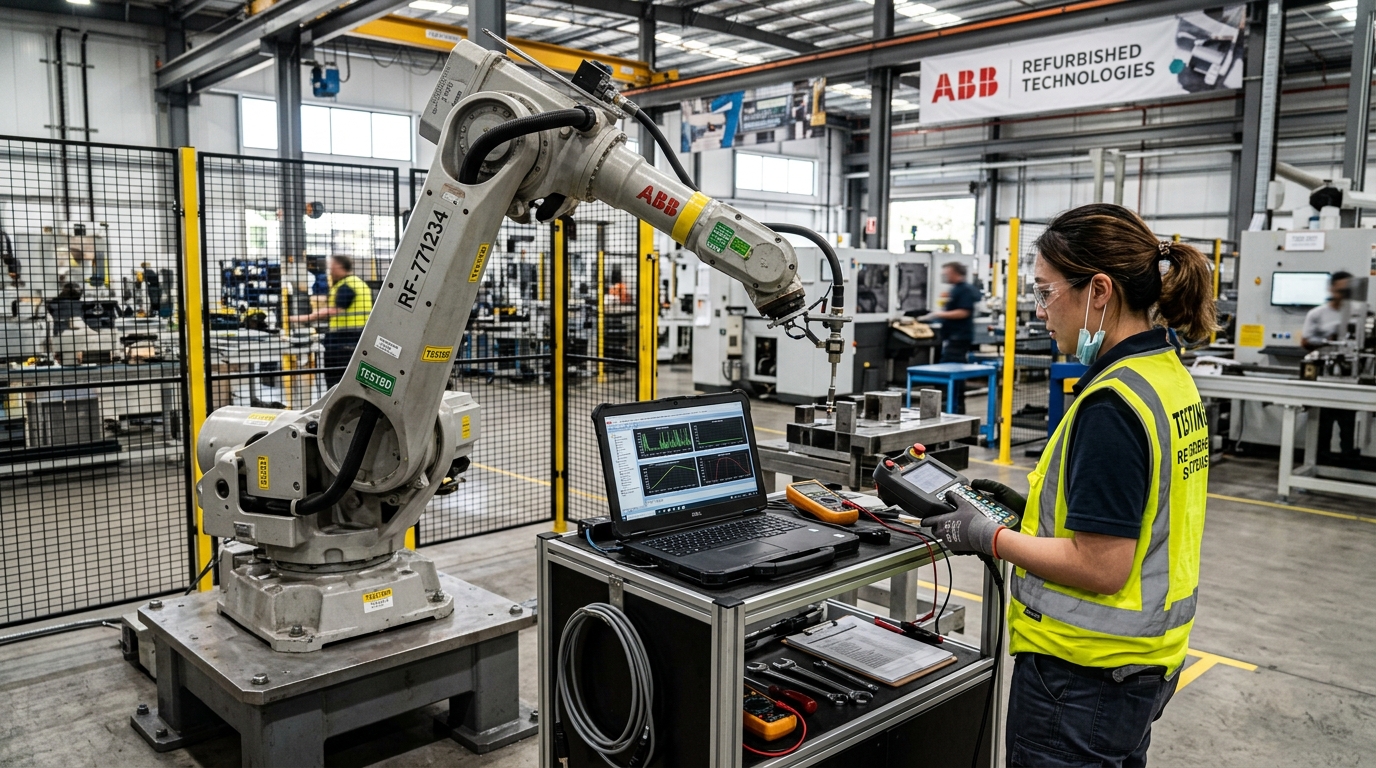

What Should a Robot Acceptance Test Prove?
A refurbished robot acceptance test should confirm that the robot delivered matches the agreed configuration, operates without obvious mechanical or electrical faults, completes defined motion tests, and is supplied with the documentation needed for installation and future maintenance. The test should be based on written acceptance criteria rather than a general demonstration that the robot powers on and moves.
A robot acceptance test should cover the manipulator, controller, teach pendant, cables, drives, brakes, operating modes, diagnostic status, mechanical condition, and any accessories included in the sale.
A refurbished robot acceptance test is not automatically the same as final validation of a complete production cell. Tooling, guarding, fixtures, process equipment, external axes, safety devices, software interfaces, and application performance may still require separate testing after integration.
Define acceptance criteria before the test
The buyer and supplier should identify what will be tested, how each test will be performed, and what evidence will be recorded. Criteria should reflect the exact robot model, controller generation, intended application, and manufacturer information where applicable. Generic limits should not be substituted for model-specific service criteria.
Verify Robot Identity, Configuration, and Documentation
Start by confirming that the equipment being tested is the equipment described in the purchase agreement. Record the robot model, serial number, controller type, teach pendant, electrical configuration, and other major components included in the supply.
Check what refurbishment work was actually completed.
The term “refurbished” does not by itself define which components were inspected, repaired, replaced, cleaned, calibrated, or tested. Request a written description of the refurbishment scope together with available maintenance, repair, lubrication, mastering, calibration, and component-replacement records.
Where operating-hour information is available, record it, but do not use hours alone as proof of mechanical condition. Previous loading, collisions, maintenance, environment, repairs, storage, and application history can also affect the condition of an industrial robot.
Inspect Mechanical Condition and Robot Joints
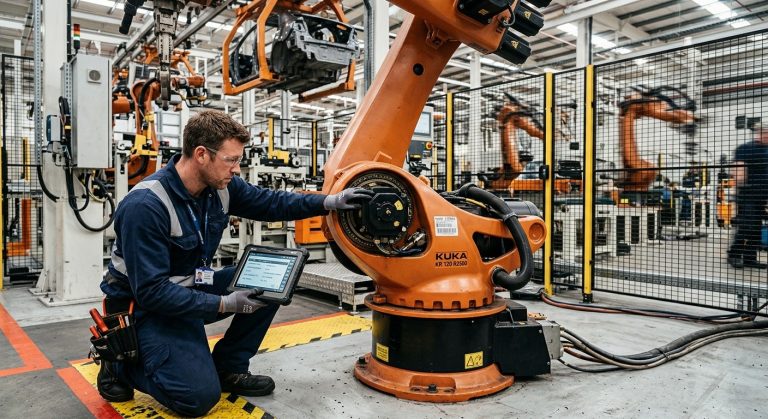
During a robot acceptance test, a mechanical inspection should look for abnormal joint movement, unusual noise, vibration, damaged covers, leaks, damaged seals, loose interfaces, and evidence of impact. A mechanical inspection should look for abnormal joint movement, unusual noise, vibration, damaged covers, leaks, damaged seals, loose interfaces, evidence of impact, and other visible irregularities. Cable routing and connectors should also be inspected because damage in these areas may cause intermittent faults after installation.
Evaluate joint play under controlled conditions.
Joint movement should be assessed with a defined method rather than by simply pushing the arm and judging it by feel. An external measurement may include the effects of reducers, bearings, couplings, brakes, shafts, mounting interfaces, and structural compliance.
For a more detailed explanation of this issue, the RHTS guide to gearbox backlash inspection in refurbished industrial robots explains why test conditions and model-specific criteria matter when evaluating mechanical play.
Test the Controller, Drives, and Electrical Functions
During the robot acceptance test, the controller should start normally and reach an operating state without unexplained active faults.
Review alarms and diagnostic information.
Active alarms should be investigated before acceptance rather than simply cleared. Where the controller provides diagnostic or maintenance information, review relevant fault histories and system status according to the manufacturer’s procedures and available service tools.
Each axis should be exercised through an appropriate range of motion while observing for irregular movement, abnormal sounds, drive faults, unexpected vibration, brake-related problems, or other behavior that differs from normal operation. Testing should remain within safe operating conditions.
Check Operating Modes and Safety Functions
Industrial robot testing introduces hazards because personnel may work near equipment capable of powered movement. The acceptance procedure therefore needs controlled access, suitable operating procedures, competent personnel, and appropriate safeguards for the test arrangement.
Separate robot checks from complete cell validation
Verify the robot functions that can reasonably be tested before integration, including available operating modes, emergency-stop behavior, enabling-device operation where applicable, and relevant status indications. The exact functions depend on the robot and controller configuration.
These checks do not automatically validate the safety of the final application. OSHA’s industrial robot systems and safety guidance address risk assessment, safeguards, maintenance, operating conditions, and validation considerations for robot applications. Applicable legal and technical requirements depend on the installation and jurisdiction.
Eight Checks to Complete Before Accepting a Refurbished Robot
A practical robot acceptance test checklist should connect the sales specification with observable test results. The following eight items provide a useful minimum structure, although additional tests may be necessary for the intended application.
- Confirm identification: Match the robot model, serial number, controller, teach pendant, cables, options, and accessories against the agreed supply.
- Review refurbishment records: Identify which components were inspected, serviced, repaired, replaced, calibrated, or left unchanged.
- Inspect mechanical condition: Look for leakage, impact damage, abnormal joint play, damaged covers, irregular motion, noise, or vibration.
- Test every robot axis: Move the axes through suitable test motions while observing drives, brakes, feedback, alarms, and mechanical behavior.
- Check controller operation: Confirm normal startup, pendant operation, communication with the robot, diagnostic status, and supplied controller functions.
- Verify operating and safety functions: Test applicable modes and safety-related controls using a defined procedure and safe test environment.
- Check mastering or calibration status: Review available records and confirm that work affecting robot geometry was followed by the appropriate manufacturer procedure.
- Record final results: Document measurements, faults, corrections, unresolved findings, configuration details, and the final acceptance decision.
Include Functional Motion and Application-Relevant Testing
A robot that completes basic joint movements has passed only a limited functional check. Acceptance testing should reflect the intended use when the purchase specification includes application-related requirements. For integrated systems, the principles covered in this guide to robot cell commissioning, FAT, SAT, and process validation provide additional context on how equipment testing differs from final system validation.
Where position or path performance must be quantified, the measurement method and acceptance values should be agreed in advance. Results should not be compared with an arbitrary tolerance unless that tolerance is supported by the robot specification, manufacturer documentation, an applicable test method, or the contractual requirement.
Payload also affects testing. A no-load motion demonstration does not necessarily reproduce the mechanical or drive conditions that will exist with the intended end-of-arm equipment and workpiece. Any loaded test must remain within the robot’s permitted load and configuration requirements.
Document the Acceptance Decision and Outstanding Work
The final robot acceptance test report should identify the equipment tested, date, test conditions, procedures, observations, measurement results, alarms found, corrective actions completed, and any remaining issues.
Acceptance can also be conditional when a clearly defined issue remains to be corrected. The outstanding item, responsible party, required evidence, and retest condition should be written rather than left as a verbal agreement.
The acceptance record should travel with the equipment documentation. It gives maintenance personnel a known starting condition and helps separate pre-existing observations from problems that appear later during transport, installation, integration, or production.
If a specific refurbished robot needs to be evaluated against its intended application, buyers can contact Robotic Hi-Tech Solutions with the robot model, controller, planned process, payload requirements, and available inspection records for a technical review.
FAQ
Should an acceptance test include every robot axis?
Yes. Each controlled robot axis should be exercised because a successful movement on one or two axes does not establish the condition of the remaining joints, drives, brakes, or feedback systems.
Is a power-on test enough for a refurbished robot?
No. Powering on confirms only a limited part of the system. Acceptance should also address motion, mechanical condition, diagnostics, supplied components, documentation, controller functions, and relevant safety functions.
Should gearbox backlash be measured during acceptance?
It may be appropriate when mechanical play is relevant to the application or purchase specification. The method and acceptable result should be defined for the particular robot and axis rather than using a universal value.
Does low operating time mean the robot can be accepted without mechanical testing?
No. Operating hours are useful background information but do not establish mechanical condition by themselves. Service history, loading, collisions, repairs, lubrication, storage, and previous operating conditions also matter.
Should mastering be checked after refurbishment?
Yes when refurbishment or repair work may have affected axis reference positions or robot geometry. The appropriate verification or mastering procedure depends on the robot manufacturer and the work performed.
Can the acceptance test replace final cell commissioning?
No. Robot acceptance evaluates the equipment supplied. Final commissioning must consider the integrated application, including tooling, fixtures, peripherals, guarding, software interfaces, process behavior, and applicable safety requirements.
Who should perform a refurbished robot acceptance test?
The test should be performed or supervised by personnel competent to work with the relevant robot system and capable of following the required electrical, mechanical, programming, and safety procedures.
What happens if the robot fails one acceptance item?
The failed item should be documented and investigated. Depending on the agreed acceptance criteria, the supplier may correct the issue and repeat the affected test before final approval.