English
 Italiano
 Українська
 Русский
 Español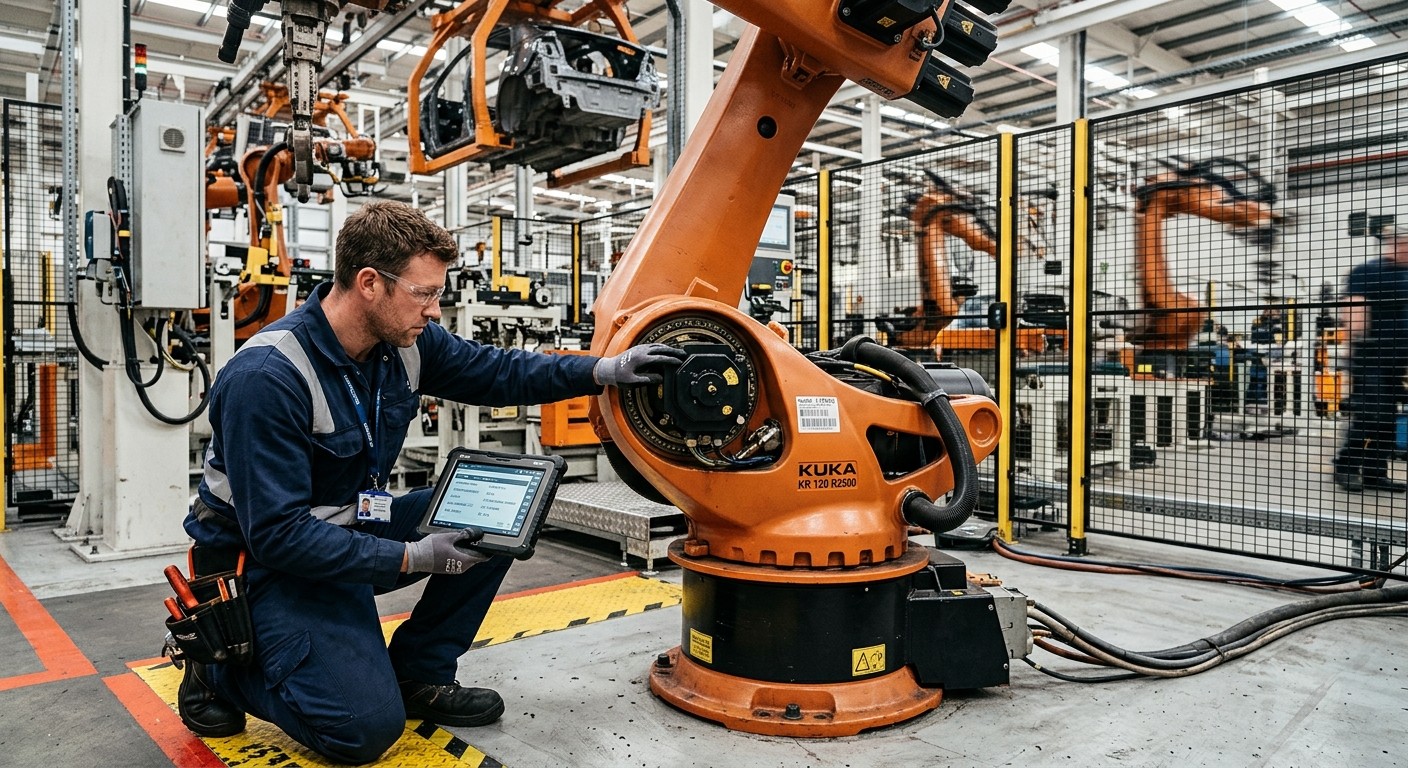

Robot operating hours are useful when evaluating a used or refurbished industrial robot, but they cannot determine mechanical condition on their own. An hour counter provides information about accumulated operating time, while wear depends on additional factors such as loading, movement patterns, maintenance, collisions, lubrication, environment, and previous repairs.
A robot with relatively few recorded hours may still require mechanical work if it operated under demanding conditions or received inadequate maintenance. Conversely, a robot with more hours may remain suitable for service when it has been maintained correctly, and its mechanical components pass the required inspections.
The practical approach is therefore to treat operating hours as one part of a broader condition assessment. Buyers should verify where the hour information comes from, review available maintenance records, inspect the robot mechanically, and consider how demanding its future application will be before making a purchasing decision.
What Do Robot Operating Hours Actually Tell You?
Robot operating hours provide a record of time accumulated according to the counting method implemented by the robot manufacturer and controller. They can help compare machines of similar type, identify differences within a group of robots, and provide context when reviewing maintenance and service information.
Hours Are Historical Data, Not a Condition Measurement
The important distinction is that operating time describes usage history rather than directly measuring wear. The counter does not measure gearbox backlash, bearing condition, brake performance, lubrication quality, vibration, cable deterioration, or structural damage.
Hours therefore become more meaningful when they are considered alongside inspection results. A buyer should avoid converting an hour reading into a simple conclusion such as “low hours means good condition” without supporting mechanical evidence.
Why Low Robot Operating Hours Do Not Guarantee Good Condition
Low recorded hours can be attractive when comparing used robots, but the number does not explain how those hours were accumulated. Two robots with similar operating time may have experienced very different loads, movements, environments, maintenance practices, and production processes.
Application Severity Matters
A robot performing frequent acceleration, direction changes, or movements with significant loads may experience different mechanical demands from one performing slower or less demanding motions. Robot pose and load distribution can also affect individual axes differently. Operating time alone does not record these differences in mechanical duty.
Previous collisions also matter. A collision or overload event may affect components regardless of the total number of hours. For this reason, visible condition, operational testing, diagnostic information where available, and service records should accompany the hour reading.
Why High Robot Operating Hours Do Not Automatically Mean a Robot Is Worn Out
Higher robot operating hours should lead to closer inspection rather than automatic rejection. Industrial robots are serviceable machines, and their condition depends partly on maintenance, component replacement, lubrication, repairs, and how they were operated.
Maintenance History Changes the Interpretation
A robot with documented preventive maintenance and properly performed repairs provides more information to the buyer than an apparently low-hour robot with no service history. Records can show whether gearboxes, motors, brakes, batteries, cables, or other components have received attention during the machine’s life.
Replacement of a component also changes how total robot hours should be interpreted. A gearbox installed later in the robot’s service life has not necessarily accumulated the same operating history as the complete machine. Component history therefore matters when evaluating condition.
Which Mechanical Conditions Cannot Be Determined From Hours?
Several important mechanical conditions require direct inspection or testing. The hour counter cannot establish whether a particular joint has excessive play, whether a brake behaves correctly, or whether abnormal noise originates from a reducer, bearing, motor, or another component.
Gearbox Backlash and Joint Play
Mechanical play is especially relevant when an application depends on stable motion during changes of direction. A controlled inspection should distinguish gearbox backlash from movement caused by bearings, couplings, brakes, mounting interfaces, or structural deflection. The RHTS guide to verifying gearbox backlash before buying a refurbished industrial robot explains why the test method and robot conditions need to be defined.
Brakes, Motors and Bearings
Brake behavior, motor operation, bearings, seals, lubrication, and abnormal vibration require their own checks. Visible oil or grease leakage, unusual sound, inconsistent movement, or unexpected axis behavior can justify additional investigation, but the diagnosis should follow the manufacturer’s procedures for the specific robot.
How Should Operating Hours Be Used During a Used Robot Inspection?
Start by recording the available robot operating hours together with the robot identification, controller type, and available service documentation. The meaning of counters can vary by robot system, so buyers should confirm what a particular counter represents rather than assume that every displayed value measures the same operating state.
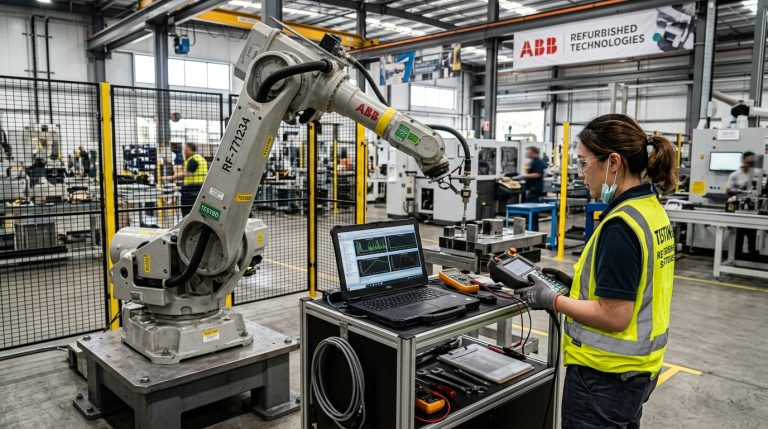
The robot should then be inspected as a complete system. This includes the arm, joints, cabling, controller, teach pendant, connections, and any equipment included with the sale. Operational testing can reveal issues that are invisible in an hour count or photographs.
Inspection and maintenance also involve hazards associated with unexpected movement and stored energy. Personnel performing these activities should follow the manufacturer’s safety procedures and applicable workplace requirements. OSHA provides general guidance on industrial robot systems and safety hazards.
Eight Checks to Use Alongside Robot Operating Hours
The following checks provide better context when comparing the recorded hours of a used or refurbished robot:
- Verify robot identification: Confirm the model, serial identification, controller, manufacturing information, and configuration so that records belong to the machine being inspected.
- Confirm what the hour counter measures: Determine whether the displayed value refers to controller power time, robot operating time, servo activity, or another manufacturer-defined counter.
- Review maintenance records: Look for documented lubrication, inspections, component replacements, repairs, mastering, and other service work.
- Inspect gearbox and joint condition: Check for abnormal play, noise, vibration, leakage, or other indications requiring further mechanical assessment.
- Test brake and axis behavior: Follow appropriate service procedures to identify abnormal operation rather than assuming brakes are satisfactory because the robot moves.
- Inspect cables and connectors: Look for damaged insulation, crushed sections, unsuitable repairs, contamination, worn connectors, or routing problems.
- Review previous application information: When available, determine the former payload, process, environment, and operating pattern because these provide context for accumulated hours.
- Match condition to the future process: Evaluate the robot against the requirements of its intended application instead of using the same acceptance criteria for every process.
When Can Robot Operating-Hour Data Be Misleading?
Robot operating hours become less useful when their origin or meaning cannot be confirmed. A displayed number without information about the relevant counter, controller history, previous repairs, or associated robot identification should not be treated as complete service history.
Controller and Robot History Should Be Checked Together
The buyer should determine whether the controller and mechanical arm have remained together throughout their working life when that information is available. Controller replacement, repairs, component changes, or incomplete documentation can complicate the interpretation of recorded values.
This does not mean that the hour data should be discarded. Instead, uncertainty should be documented and compensated for with stronger mechanical inspection and operational testing.
How Much Weight Should Operating Hours Have in a Buying Decision?
Robot operating hours should influence the inspection process, but they should not become the sole selection criterion. Mechanical condition, maintenance history, controller compatibility, available software options, spare-parts support, payload, reach, application requirements, and included equipment may all affect whether a robot is suitable.
The intended process also determines how demanding the assessment should be. Material handling and processes requiring tighter path control do not necessarily impose the same performance requirements. The acceptance decision should therefore reflect the actual production task.
When evaluating a used or refurbished robot for a specific application, buyers can contact Robotic Hi-Tech Solutions to discuss robot configuration, mechanical inspection considerations, controller compatibility, and integration requirements before selecting equipment.
FAQ
Are low robot operating hours always better?
No. Lower hours indicate less recorded operating time, but they do not prove better mechanical condition. Maintenance, loading, collisions, storage, environment, and previous repairs also need to be considered.
Can robot operating hours tell me whether a gearbox is worn?
No. Operating hours provide historical context but do not measure gearbox condition. Backlash, noise, leakage, vibration, and other mechanical indicators require appropriate inspection or testing.
Should I reject a used robot because it has high hours?
Not solely because of the hour count. Higher operating time justifies careful inspection and review of maintenance records. The actual mechanical condition and intended application are more informative.
Can two robots with the same operating hours have different mechanical condition?
Yes. Their previous payloads, movement patterns, environments, maintenance histories, collisions, and component replacements may have been different even if their recorded hours are similar.
Do replaced gearboxes have the same hours as the robot?
Not necessarily. If a gearbox was replaced during the robot’s service life, the replacement component may have accumulated fewer operating hours than the complete robot. Service documentation is needed to establish that history.
Can I rely only on the hour counter when buying a refurbished robot?
No. Use it together with mechanical inspection, operational testing, maintenance records, controller checks, and verification of the robot’s configuration and intended application.
What if the seller cannot document the robot’s operating hours?
Treat the operating history as uncertain. The robot may still be assessable, but greater emphasis should be placed on mechanical inspection, operational testing, service records, and documented refurbishment work.
What is more important: operating hours or mechanical inspection?
They answer different questions. Hours describe accumulated use, while mechanical inspection examines current condition. For a purchasing decision, the hour reading is most useful when supported by documented inspection and service information.