English
 Italiano
 Українська
 Русский
 Español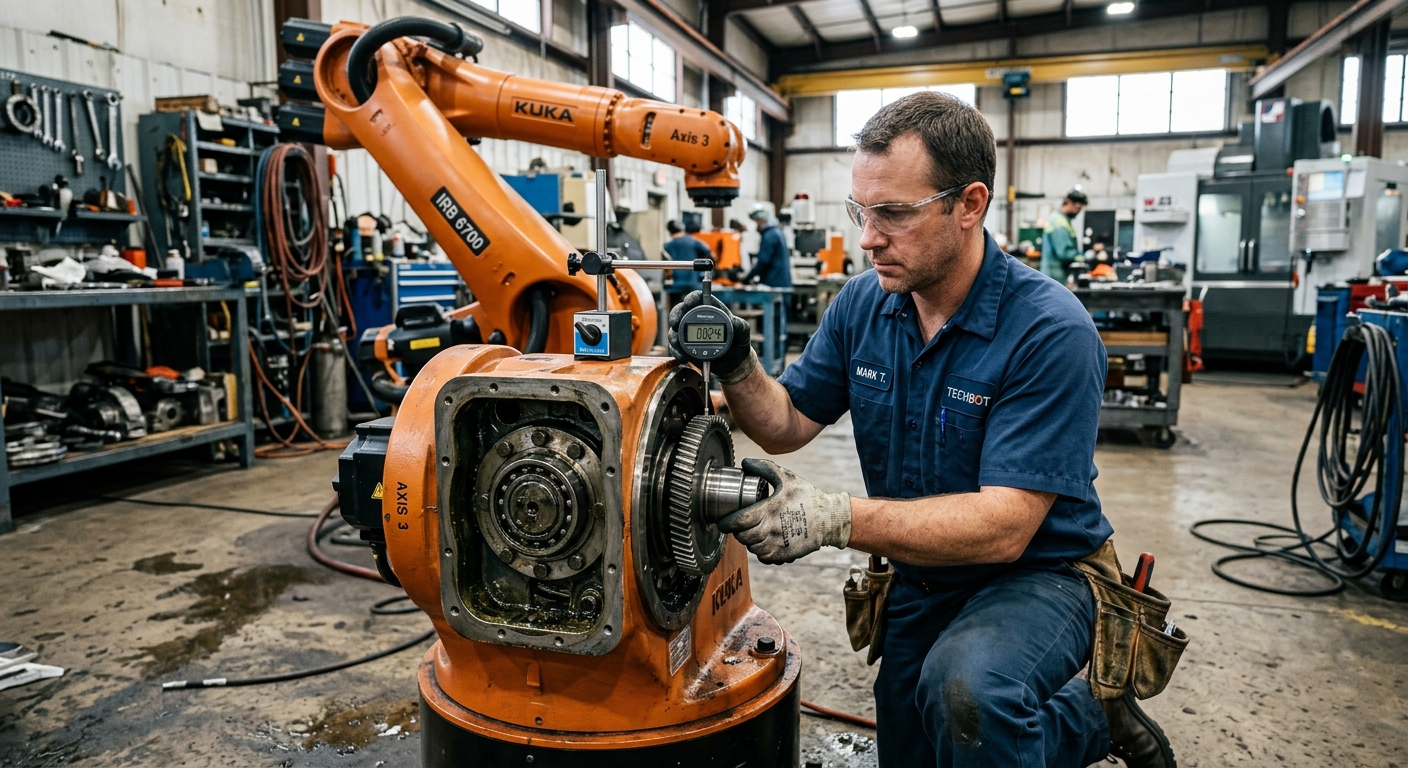

Gearbox backlash should be checked before buying a refurbished industrial robot because excessive mechanical play can affect positioning behavior, path consistency, and suitability for demanding applications. A useful gearbox backlash check is not a quick push on the arm followed by a subjective judgment. It requires a controlled test, a known robot condition, and a clear understanding of what the measurement represents.
The buyer should compare measured joint movement with manufacturer documentation or a qualified service reference for the exact robot and reducer configuration. A value considered acceptable on one model cannot be transferred automatically to another model, axis, payload class, or reducer design.
This guide explains how to separate backlash from other sources of joint movement, prepare the robot for inspection, choose suitable measurement methods, and review the records needed before purchase. It also explains why one reading should not be treated as proof of gearbox condition, especially when the robot will be reused for machining, inspection, or other accuracy-sensitive work.
What Gearbox Backlash Means in an Industrial Robot
Backlash is mechanical clearance that permits a small change in output position when applied torque changes direction. In a robot joint, the reducer is one possible source. Precision reducer manufacturers may specify backlash and lost motion separately, so the terms should not be treated as identical.
Backlash, lost motion, and compliance
Lost motion can include effects beyond gear clearance, while compliance describes elastic deflection under load. In an assembled robot, measured movement may also include bearings, couplings, shafts, brakes, mounting interfaces, and structural flex.
For this reason, an external joint test usually measures total joint behavior rather than reducer backlash in isolation. Locating the source may require additional mechanical inspection.
Why Gearbox Backlash Matters in a Refurbished Robot
Mechanical play becomes more relevant when the application depends on stable tool position during direction changes. Robotic machining, trimming, drilling, dispensing, and some inspection tasks can be more sensitive to joint condition than basic transfer work.
A robot that remains serviceable for palletizing may not be the preferred choice for a process with tighter path-control requirements. The purchasing decision should therefore be based on the intended process, not only on whether the robot completes a basic motion test.
How to Perform a Gearbox Backlash Check
A practical inspection begins by selecting one joint at a time and placing the robot in a defined, stable configuration. Document the measurement point, loading direction, robot temperature, brake state, fixture arrangement, and any applied force or torque required by the test method.
Use controlled direction reversal
The principle is to observe joint response when load direction is reversed without intentionally commanding a large axis movement. Depending on the manufacturer’s procedure, the check may use a dial indicator, displacement sensor, encoder-based service routine, or dedicated diagnostic method.
Do not rely on hand movement alone.
Manually pushing the arm may reveal obvious looseness, noise, or abnormal behavior, but it does not provide a standardized backlash value. Lever length, applied force, gravity, brake condition, and structural deflection affect what the inspector feels.
What Tools and Records Should Be Available
Combine measurement equipment with documentation. Useful equipment may include a dial indicator or displacement sensor with a rigid mount, manufacturer service software when available, and the fixtures required by the procedure.
Request evidence from the refurbishment process
Ask for robot identification, controller model, operating-hour information if available, maintenance history, mastering or calibration records, gearbox work performed, lubrication records, and mechanical test results.
Robotic Hi-Tech Solutions also discusses mechanical inspection and gearbox backlash assessment in refurbished robots, showing why the scope of refurbishment should be documented rather than assumed.
Control the Test Conditions Before Comparing Results
Backlash measurements are useful only when test conditions are repeatable. Robot posture changes gravity loading, while measurement location changes apparent displacement through the lever arm.
If the seller provides a value, request the test method as well. Without the joint tested, robot pose, measurement radius, loading method, direction, temperature condition, and acceptance reference, two results may not be directly comparable.
Inspection must also account for robot hazards. OSHA states that robot maintenance and inspection programs should consider manufacturer recommendations and documented procedures. Its robotics guidance for inspection and maintenance provides a useful safety reference for planning these activities.
Eight Checks to Complete Before Accepting the Robot
- Confirm the exact robot model, serial number, controller generation, and axis being tested.
- Identify the reducer installed and ask whether it was replaced, rebuilt, adjusted, or left unchanged.
- Record robot pose and measurement point so repeated tests use the same geometry.
- Document how load is applied and reversed, including force or torque when the procedure specifies it.
- Repeat the measurement under the same conditions to check consistency.
- Check for abnormal noise, vibration, leakage, damaged seals, or irregular joint motion.
- Review mastering, calibration, lubrication, maintenance, and repair records.
- Compare results with model-specific manufacturer or qualified service criteria, not a generic limit.
How to Interpret the Measurement
A displacement outside an applicable service limit is a reason for further investigation, but it does not automatically prove that the reducer is the only defective component. The inspection should determine whether movement comes from the gearbox, bearings, coupling, brake system, mounting arrangement, or another part of the joint.
Compare each axis against its own criteria.
Differences between axes are meaningful only when each axis is evaluated against its own design and service criteria. Large joints and wrist joints may use different reducer types, loads, and measurement procedures, so a uniform limit across all axes is not a reliable rule.
When Further Inspection Is Worth Requesting
Further inspection is justified when readings are inconsistent, abnormal noise or vibration appears, leakage is visible, service history is incomplete, or gearbox replacement history is uncertain.
A broader mechanical review can also help determine whether the measured movement is part of a wider condition issue. This guide to evaluating refurbished industrial robots discusses gearbox backlash together with brake performance, controller condition, mastering, documentation, and other factors that should be checked before reuse.
For demanding applications, buyers may also want a broader performance test. ISO 9283 addresses performance criteria and test methods for manipulating industrial robots, including pose accuracy and repeatability. It does not replace gearbox diagnosis but helps separate overall robot performance from one mechanical condition indicator.
A final purchasing review should consider payload, reach, process forces, accuracy needs, controller, tooling, and mechanical records together.
For a model-specific evaluation, you can contact Robotic Hi-Tech Solutions with the robot model, intended process, payload, reach, controller generation, and available inspection records.
FAQ
Can gearbox backlash be checked without removing the reducer?
Yes. Joint-level movement can often be evaluated with the reducer installed. However, the result may include other components and should not automatically be interpreted as isolated reducer backlash.
Is a dial indicator enough to verify gearbox condition?
No. It can measure displacement, but the test also needs a defined setup, loading method, robot pose, measurement radius, and acceptance reference.
Can I judge backlash by pushing the robot arm by hand?
Hand movement may expose obvious looseness or noise, but it is not a controlled measurement because applied force and structural deflection are difficult to reproduce.
Does low operating time guarantee low backlash?
No. Maintenance, loading, collisions, lubrication, storage, repairs, and previous application conditions can also affect mechanical condition.
Does backlash affect robot repeatability?
Mechanical play can influence motion during reversals, but repeatability is a system-level performance characteristic and should be tested with an appropriate robot performance method.
Should every axis have the same backlash limit?
No. Axes can use different reducers, loads, and service procedures. Use criteria for the specific robot model and joint.
Should the gearbox be replaced if the reading is high?
Not automatically. Confirm the method and locate the source of movement first because bearings, couplings, brakes, or mounting interfaces may contribute.
What should the seller document?
Request the test method, results by axis, acceptance criteria, repair and maintenance history, gearbox replacement information, lubrication records, and mastering or calibration work completed after repairs.