English
 Italiano
 Українська
 Русский
 Español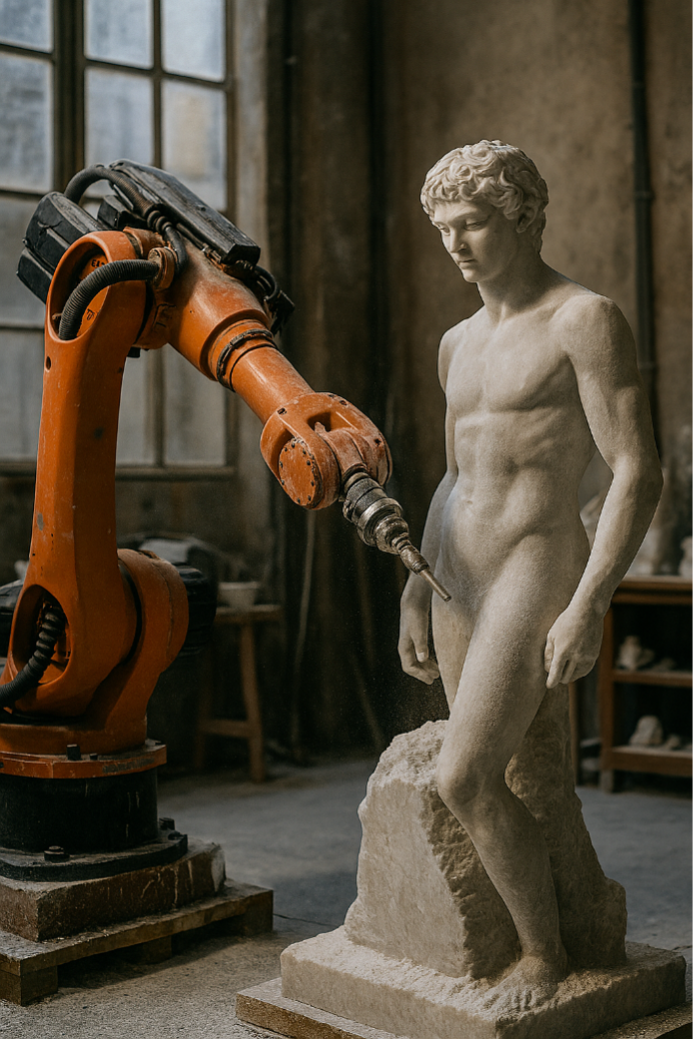

Robotic sculpture with industrial arms uses programmable multi-axis movement to carve, mill, deposit, form, assemble, polish, or manipulate material. The robot does not design the sculpture independently. It executes paths and process instructions developed from the artist’s concept, digital model, material strategy, and selected fabrication method.
Industrial arms are valuable in sculpture because they can work across large three-dimensional envelopes, maintain controlled tool orientation, repeat complex movements, and carry tools that would be difficult to use consistently by hand.
However, the robot arm is only one part of the system. The final result depends on tooling, fixtures, material behaviour, programming, calibration, process forces, safety, and finishing. A geometrically accurate digital model does not automatically become a physically accurate sculpture.
Quick Answer
- Subtractive sculpture: the robot mills, carves, cuts, or grinds material away.
- Additive sculpture: it deposits clay, polymers, concrete, metal, or experimental compounds.
- Forming: the robot bends, presses, heats, or shapes material through controlled movement.
- Assembly: it positions and joins individual components into larger structures.
- Kinetic sculpture: the robot or robot-driven mechanism becomes part of the moving artwork.
The appropriate process depends on the intended form, material, scale, surface quality, and level of artistic control.
What Robotic Sculpture Actually Means
Robotic sculpture is not one single fabrication technique. It describes the use of programmable robotic systems to create, transform, assemble, or animate three-dimensional artistic work.
The robot may operate as:
- a carving machine;
- a milling platform;
- a large-format 3D-printing system;
- a material-forming device;
- a welding or assembly tool;
- a polishing or finishing system;
- a camera or scanning platform;
- a visible kinetic element inside the sculpture itself.
In some projects, the robot remains a production tool hidden from the audience. In others, its physical movement becomes part of the artwork and its interpretation.
The term therefore includes both sculpture made by robotic fabrication and sculpture in which robotics remains visibly present.
What the Artist Defines and What the Robot Executes
| Project Layer | Human Decision | Robot Contribution |
|---|---|---|
| Concept | Defines meaning, context, scale, and intended experience. | Has no independent artistic intention. |
| Geometry | Creates or selects the physical and digital form. | Executes paths derived from that geometry. |
| Material | Selects material, finish, visible texture, and acceptable variation. | Applies cutting, deposition, force, heat, or movement. |
| Toolpath | Defines strategy, direction, sequence, and process limits. | Reproduces the programmed motion. |
| Imperfection | Determines which tool marks, material variations, or deviations remain visible. | Produces repeatable movement but interacts with imperfect physical material. |
| Final selection | Evaluates, edits, finishes, accepts, or rejects the result. | Creates the physical output defined by the system. |
Key distinction: the robot controls physical execution. Artistic authorship remains connected to the people who define the concept, process, material, variation, and interpretation.
Subtractive Robotic Sculpture
Subtractive sculpture removes material from a larger block or prepared workpiece. The robot may carry a spindle, cutting tool, grinder, saw, hot wire, or specialised carving tool.
Typical materials include:
- foam;
- wood;
- plastics;
- composites;
- wax;
- stone;
- selected metals;
- model-making and tooling boards.
The process often begins with a digital model. CAM or custom path-planning software converts the geometry into roughing and finishing operations.
Roughing
Roughing removes the main volume of unwanted material. The objective is speed and stable material removal rather than final surface quality.
Roughing strategies must account for:
- tool diameter;
- cutting depth;
- robot stiffness;
- material resistance;
- chip evacuation;
- workpiece stability;
- remaining finishing allowance.
Finishing
Finishing follows the final surface more closely and uses smaller steps between tool passes. The goal may be dimensional accuracy, a smoother surface, or a deliberate pattern of visible tool marks.
The finishing result depends on:
- tool type and condition;
- path direction;
- stepover;
- robot posture;
- vibration;
- material grain or structure;
- calibration quality.
Related process guidance is available in the Milling Robots section.
Why Robotic Carving Is Different From CNC Machining
Industrial robots and CNC machines can both follow programmed paths, but their mechanical structures are different.
| Selection Factor | Industrial Robot | CNC Machine |
|---|---|---|
| Working Envelope | Flexible three-dimensional reach and variable tool orientation. | Defined machine volume with more predictable linear axes. |
| Rigidity | Lower structural stiffness, especially in extended postures. | Typically designed for higher machining rigidity. |
| Part Access | Can approach complex geometry from several orientations. | Access depends on machine axes and fixture configuration. |
| Large Parts | Can work around large sculptures and use external tracks or positioners. | Part dimensions are limited by the machine enclosure and axis travel. |
| Accuracy | Highly dependent on calibration, posture, load, tooling, and process forces. | Often better suited to tight machining tolerances. |
| Creative Flexibility | Can potentially change between carving, deposition, scanning, or handling tools. | Usually optimised for subtractive operations. |
Process principle: robotic carving is strongest when multi-axis access, scale, and working-envelope flexibility matter more than achieving machine-tool-level rigidity.
Robotic Sculpture in Wood
Wood is widely used in robotic sculpture because it combines structural strength with machinability and visible material character.
Robotic workflows can create:
- large reliefs;
- free-form sculptures;
- laminated timber components;
- carved panels;
- molds and patterns;
- furniture and functional art;
- assembled structures.
The toolpath must account for grain direction, knotting, moisture, tool engagement, dust extraction, and the possibility of local splitting.
Wood also changes after machining. Internal stress and moisture variation can produce movement that was not visible in the digital model.
The artist may remove machining marks manually, preserve them as evidence of the process, or combine robotic roughing with hand finishing.
Robotic Sculpture in Stone
Stone carving requires careful control of tooling, process forces, dust, cooling, and workpiece support.
A robotic system may be used for:
- rough removal of large volumes;
- three-dimensional carving;
- surface texturing;
- engraving;
- preparing forms for manual finishing;
- reproducing or scaling scanned geometry.
The suitability of a robot depends on the stone type, required depth of cut, tool technology, stiffness, and surface expectations.
Hard stone and aggressive material removal can create forces that exceed the practical capabilities of a lightly configured robotic cell. The robot, spindle, tool, fixture, and process parameters must be evaluated as one system.
Additive Robotic Sculpture
Additive robotic sculpture builds form through controlled material deposition rather than removal.
Potential materials include:
- clay;
- ceramic compounds;
- thermoplastic polymers;
- fibre-reinforced polymers;
- concrete and mortar;
- metal wire;
- pastes and experimental bio-based materials.
The robot follows deposition paths while the material-delivery system controls flow, temperature, pressure, or feed rate.
The physical result depends on more than the path. Layer stability, cooling, curing, shrinkage, gravity, bead width, and material bonding all influence the final form.
Multi-axis robotic movement can support non-planar deposition and changing nozzle orientations. This creates additional geometric freedom but also increases path-planning and collision complexity.
Explore related applications in the 3D Printing Robots section.
Forming, Bending, and Material Manipulation
A robot can shape material without removing or depositing it. Depending on the process, the arm may bend, press, fold, heat, stretch, or manipulate a workpiece.
Possible applications include:
- sheet-metal forming;
- wire bending;
- hot forming of thermoplastics;
- fabric manipulation;
- composite placement;
- controlled deformation of thin materials;
- experimental forming with custom tools.
Forming processes depend on force, material springback, temperature, fixture design, and tool geometry.
The final shape may not correspond directly to the programmed robot path because the material responds dynamically. The workflow may require testing, measurement, and compensation.
Robotic Assembly as Sculpture
Some sculptural forms are created from many individual components rather than from one continuous block.
A robot can:
- pick and position unique elements;
- orient components according to a digital model;
- apply adhesive or fastening operations;
- weld metal components;
- stack blocks or modular units;
- coordinate with a second robot or human operator;
- construct repeated but non-identical patterns.
The design must include a valid assembly sequence. A component may have a correct final position but remain impossible to insert after surrounding elements have already been placed.
Gripping points, approach directions, tolerances, temporary supports, and connection methods must therefore be designed together with the sculptural geometry.
Welding and Metal Deposition in Robotic Sculpture
Industrial robots can use welding or metal-deposition processes to create frames, shells, lattices, and near-net-shape sculptural forms.
Possible methods include:
- robotic arc welding;
- wire-arc additive manufacturing;
- joining prefabricated metal components;
- surface build-up;
- controlled creation of welded textures.
Metal processes introduce additional technical requirements:
- heat input;
- distortion;
- welding sequence;
- shielding gas;
- fume extraction;
- electrical safety;
- thermal protection;
- post-weld finishing.
A robot can reproduce a welding path, but the final geometry may change as heat accumulates and the structure deforms.
Robotic Polishing and Surface Finishing
After carving, printing, welding, or forming, the sculpture may require secondary finishing.
A robot can potentially carry:
- sanding tools;
- polishing heads;
- grinding tools;
- abrasive brushes;
- coating or spray equipment;
- surface-texturing tools.
Finishing processes often require controlled contact force. A rigid position-only path may produce inconsistent pressure on a surface that differs slightly from the digital model.
Force control, compliant tooling, surface scanning, or adaptive paths may be needed when the robot must follow the real component rather than an idealised geometry.
How a Digital Sculpture Becomes a Robot Toolpath
The digital model must be converted into executable process information.
A typical subtractive workflow includes:
- creating or scanning the sculptural geometry;
- preparing the model for fabrication;
- defining roughing and finishing strategies;
- selecting tools and cutting parameters;
- generating paths and tool orientations;
- simulating the robot and cell;
- postprocessing for the selected controller;
- calibrating the tool and workpiece;
- testing representative material;
- executing and inspecting the physical result.
An additive workflow follows a similar logic but replaces machining operations with slicing, deposition strategy, material flow, and layer-control parameters.
For a deeper explanation of this digital chain, read how parametric design becomes robotic fabrication.
Why Tool Orientation Matters in Robotic Sculpture
Tool position defines where the process occurs. Tool orientation determines how the tool meets the material.
Orientation affects:
- cutting direction;
- tool engagement;
- surface texture;
- deposition angle;
- grinder or polishing contact;
- collision risk;
- wrist posture;
- cable and hose behaviour.
A sculptural surface may require continuously changing orientation. This is one of the main advantages of a six-axis robot, but it also creates kinematic complexity.
A mathematically valid orientation field can still produce abrupt wrist rotations, singularities, or inaccessible robot configurations. The path must be checked in the context of the actual robot and cell.
Calibration and Physical Accuracy
Robotic sculpture often begins with precise digital geometry, but final accuracy depends on the physical system.
Important calibration layers include:
- robot mastering;
- tool-centre-point calibration;
- tool-orientation calibration;
- workpiece coordinate definition;
- fixture position;
- external-axis calibration;
- alignment between scanned and digital geometry.
If the tool centre point is incorrect, the physical error changes when the tool rotates. If the workpiece frame is inaccurate, the complete sculpture may be shifted or rotated relative to the programmed path.
Robot repeatability does not guarantee total sculptural accuracy. Tool deflection, process forces, material movement, and fixture stability also affect the result.
Example: Robotic Roughing With Manual Final Carving
An artist develops a large free-form timber sculpture from a digital model. A robot equipped with a spindle removes the main material volume and creates the general surface with additional finishing allowance.
The artist then completes selected areas manually, softens tool transitions, and introduces details that were intentionally excluded from the robotic path.
The robot reduces the time required for heavy material removal and establishes the overall geometry. Manual carving remains part of the final artistic language.
The finished sculpture is neither entirely robotic nor entirely manual. It results from a deliberate division between digital control, mechanical execution, material response, and hand judgement.
Hybrid Robotic and Manual Sculpture
Robotic fabrication does not require the removal of manual work. Many projects use the robot for one stage and the artist for another.
Hybrid workflows may include:
- robotic roughing followed by hand carving;
- robotic printing followed by sanding or coating;
- robotic assembly followed by manual joining;
- robotic scanning followed by manual digital editing;
- robotic polishing combined with selective hand finishing;
- hand-built material forms modified by robotic tools.
The division of work should reflect the strengths of each method. Robots provide repeatable movement, scale, and controlled toolpaths. Human work provides tactile judgement, local interpretation, and fast adaptation to unexpected material conditions.
Kinetic Sculpture and the Robot as the Artwork
In kinetic sculpture, the robot may remain visible rather than functioning only as production equipment.
The arm can move:
- lights;
- mirrors;
- screens;
- objects;
- instruments;
- sound-producing mechanisms;
- fabric or flexible materials;
- custom sculptural extensions.
Movement becomes part of the composition. Speed, pauses, acceleration, repeated cycles, and interaction with the surrounding space can define the experience.
When audiences or performers are present, the project also becomes a human–machine safety system. The artistic sequence must remain inside a technically validated operating envelope.
What Tools Can Be Used for Robotic Sculpture?
| Tool | Sculptural Application | Main Technical Requirement |
|---|---|---|
| Spindle | Milling and carving wood, foam, plastics, composites, and selected stone. | Stiffness, cutting-force control, extraction, and calibration. |
| Hot Wire | Cutting foam and lightweight model materials. | Wire orientation, thermal control, path continuity, and ventilation. |
| Extrusion Head | Printing clay, polymer, concrete, or experimental compounds. | Material flow, temperature, pressure, and layer stability. |
| Welding Torch | Metal assembly, wire deposition, and structural sculpture. | Heat management, shielding, fume extraction, and distortion control. |
| Gripper | Assembly and positioning of sculptural components. | Reliable gripping, component variation, and accessible placement paths. |
| Polishing or Grinding Head | Surface finishing and controlled texture. | Contact force, compliance, tool wear, and surface tracking. |
What Makes an Industrial Robot Suitable for Sculpture?
The robot should be selected from the physical process, not from brand or visual appearance.
The evaluation should include:
- required reach;
- tool and cable payload;
- tool centre of gravity;
- process forces;
- mounting configuration;
- robot stiffness in the expected working area;
- controller generation;
- offline-programming compatibility;
- external-axis requirements;
- software and communication options;
- spare-parts and support availability;
- mechanical condition and calibration.
A large payload specification does not guarantee good machining behaviour. A robot carrying a lightweight spindle may still produce poor results if it works in an extended, mechanically weak posture.
Can Refurbished Robots Be Used for Robotic Sculpture?
Refurbished industrial robots can support sculpture, digital fabrication, education, and artistic research when their mechanical condition and controller capabilities match the intended process.
They may provide access to:
- large working envelopes;
- industrial payload capacity;
- six-axis movement;
- external tracks and positioners;
- established industrial controllers;
- platforms suitable for custom tooling.
The term refurbished should describe documented technical inspection and preparation. A repainted used robot is not automatically a reliable fabrication platform.
The evaluation should verify:
- gearbox and mechanical condition;
- brakes, motors, encoders, and cabling;
- controller and teach pendant;
- software options;
- system backups;
- programming compatibility;
- maintenance and spare-parts support;
- operational testing under representative conditions.
RHTS provides new and refurbished industrial robots that can be evaluated for robotic milling, additive sculpture, assembly, and creative fabrication.
The Complete Cost of a Robotic Sculpture System
The robot arm may represent only one part of the investment.
A complete budget may include:
- robot and controller;
- transport and installation;
- electrical infrastructure;
- spindle, extruder, gripper, or other tool;
- fixtures and workpiece supports;
- external tracks or positioners;
- software and licenses;
- programming and simulation;
- dust, chip, fume, heat, or material management;
- safety equipment;
- commissioning and calibration;
- test materials;
- manual finishing;
- training and technical support.
A refurbished robot can reduce the cost of the core movement platform, but it does not eliminate the engineering required around it.
Safety in Robotic Sculpture Studios
Artistic use does not reduce the hazards of an industrial robot.
The safety assessment should consider:
- robot speed and moving mass;
- spindle, blade, grinder, or welding hazards;
- material release and flying debris;
- dust and fumes;
- heat and electrical equipment;
- workpiece stability;
- operator access;
- manual tool changes;
- program and setup changes;
- performer or audience proximity;
- emergency stopping and safe recovery.
Guarding, safety scanners, emergency stops, extraction, interlocks, reduced-speed modes, and controlled operating procedures may be required depending on the process.
Safety principle: the sculpture may be experimental, but the operation of the industrial robot must remain controlled and validated.
What Are the Main Limitations of Robotic Sculpture?
- Robot movement does not guarantee final accuracy. Tooling, fixtures, calibration, forces, and material behaviour affect the sculpture.
- Industrial robots are less rigid than dedicated machine tools. Aggressive carving may create vibration and surface errors.
- Materials remain unpredictable. Wood moves, clay deforms, polymers shrink, and metal distorts under heat.
- Programming requires specialist knowledge. Complex surfaces and changing tool orientations need simulation and validation.
- Surface finishing may remain necessary. Milling marks, printed layers, welds, and joining points may require additional work.
- Large sculptures create logistical constraints. Material handling, fixturing, transport, and installation must be planned.
- Safety infrastructure can be substantial. Open artistic environments cannot ignore industrial hazards.
- Not every sculpture benefits from robotics. The robot should provide meaningful value in scale, geometry, process, repetition, or material transformation.
How to Evaluate a Robotic Sculpture Project
Robotic Sculpture Evaluation Framework
- Artistic Intent: What must the robotic process contribute to the sculpture?
- Process: Will the robot carve, print, form, assemble, weld, polish, or move?
- Material: How does the selected material respond to the tool and process?
- Scale: What working envelope and workpiece support are required?
- Tool: What payload, centre of gravity, power, and process forces must be handled?
- Quality: What dimensional accuracy and surface finish are necessary?
- Workflow: How will geometry become toolpaths and robot programs?
- Calibration: How will the digital model be aligned with the real material?
- Finishing: Which manual or secondary processes remain necessary?
- Safety: Which mechanical, thermal, electrical, or material hazards must be controlled?
- Support: Who will program, integrate, operate, and maintain the system?
- Budget: Does the estimate include the complete fabrication process?
If the project cannot define the material process, tool, working envelope, and required quality, selecting a robot model is premature.
Frequently Asked Questions
What Is Robotic Sculpture?
Robotic sculpture is the use of programmable robotic systems to carve, mill, print, form, assemble, polish, weld, or animate three-dimensional artistic work.
Which Materials Can Industrial Robots Sculpt?
Depending on the tool and process, robots can work with foam, wood, plastics, composites, clay, concrete, stone, metal, wax, and experimental materials.
Can Industrial Robots Carve Stone?
They can support selected stone-carving and surface-processing operations when the robot, spindle, tooling, fixture, dust control, and cutting parameters are suitable for the material and required quality.
Can a Robot Replace Hand Carving?
A robot can perform heavy material removal, repeat digital geometry, and create complex toolpaths. Many artists still use manual carving and finishing for local interpretation, texture, and final judgement.
Can the Same Robot Mill and 3D Print a Sculpture?
Potentially, but the cell requires suitable tools, separate calibration, material systems, extraction, programming, safety controls, and validation for both processes.
Are Refurbished Robots Suitable for Sculpture?
Yes, when their mechanical condition, controller, reach, payload, software compatibility, and support match the intended sculptural process.
Does Robot Repeatability Guarantee an Accurate Sculpture?
No. Final accuracy also depends on calibration, tool deflection, robot posture, fixtures, process forces, and material behaviour.
Is Robotic Sculpture Completely Automated?
Not necessarily. Projects often combine digital modelling, automated fabrication, inspection, manual intervention, assembly, and hand finishing.
Robotic Sculpture Connects Digital Intent With Physical Material
Robotic sculpture with industrial arms expands the range of physical operations available to artists, designers, fabricators, and research laboratories.
A robot can remove material, deposit new material, assemble components, shape surfaces, or become part of the moving artwork itself. Its main contribution is programmable movement across a large and flexible three-dimensional space.
But the sculpture is not created by movement alone. Tooling, fixtures, material behaviour, calibration, safety, and finishing determine whether the digital intention survives the transition into physical form.
The strongest projects use robotics where it contributes something essential: scale, complex access, controlled repetition, digital variation, heavy material transformation, or a visible relationship between machine and artwork.
The robot executes the process. The artist determines why the process matters.
Explore related applications in the Robot Art & Architecture section, or read how industrial robot arms support expressive artistic projects.
Artists, studios, universities, and fabrication laboratories can also contact RHTS with the intended material, process, tool, workpiece dimensions, and required surface quality for an initial robotic-platform assessment.