English
 Italiano
 Українська
 Русский
 Español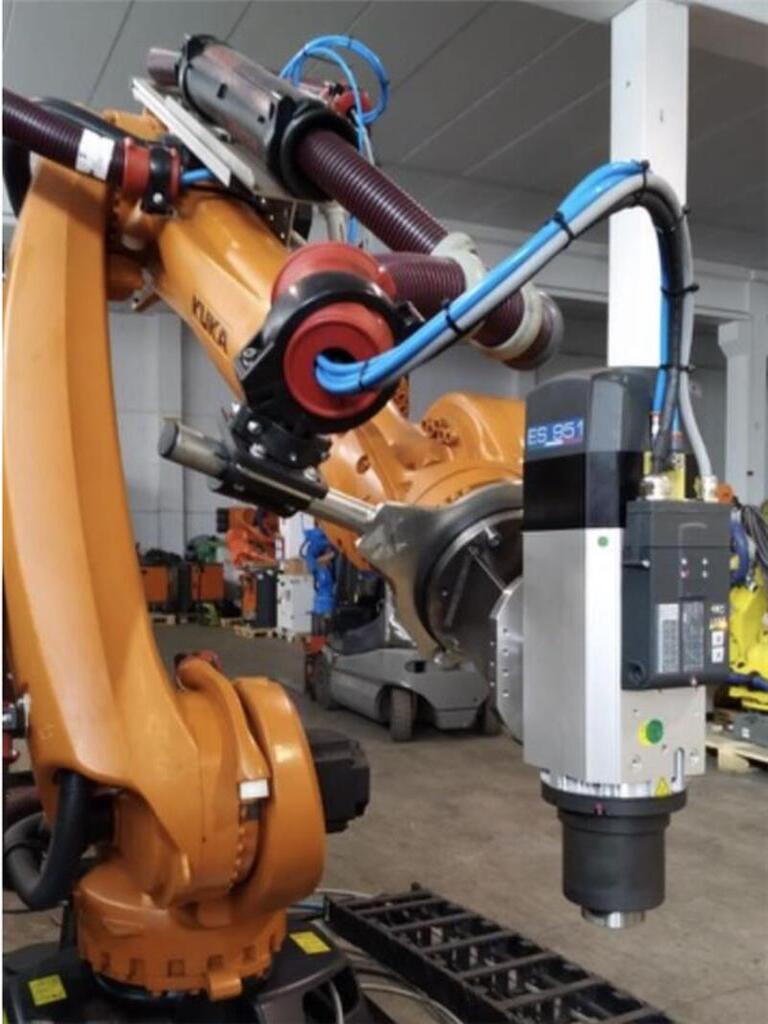

Industrial robotic arms can be used in artistic projects to control movement, tools, light, cameras, materials and physical objects with a level of precision and spatial freedom that is difficult to reproduce manually. Their value does not come from making art independently. It comes from allowing artists and designers to transform programmed movement into line, rhythm, texture, choreography, interaction or material change.
A robot designed for welding, handling or machining can become a painting system, sculpting platform, kinetic installation, camera rig or performance instrument when it is equipped with the appropriate tool and integrated into a suitable creative workflow.
The artistic result remains dependent on human intention. The robot contributes movement and repeatability; the creator defines the concept, visual language, process rules, material choices and acceptable variation.
Quick answer
- Painting and drawing: the robot controls paths, pressure, orientation and repeated gestures.
- Sculpture and carving: it moves cutting or forming tools across complex three-dimensional geometry.
- Performance: robot motion can be synchronised with sound, light, performers or other machines.
- Photography and film: it creates repeatable camera paths and controlled long-exposure movement.
- Interactive installations: sensors and software allow movement to respond to people or data.
The robot becomes expressive when movement is designed as part of the artistic language rather than used only as a production function.
Why industrial robotic arms are useful in artistic projects
Industrial robots offer six-axis movement, programmable speed, repeatable positioning and the ability to carry different tools. In manufacturing, these capabilities are used to produce consistent results. In art, they can be used to explore movement, variation and material behaviour.
A robotic arm can:
- follow complex three-dimensional paths;
- repeat a gesture with controlled variation;
- maintain a defined tool orientation across curved surfaces;
- coordinate motion with lighting, audio or external data;
- work continuously during long performances or installations;
- carry tools that are too heavy or difficult to control manually;
- translate digital geometry directly into physical action.
These capabilities do not guarantee artistic value. They become relevant only when the movement, scale or technical process contributes directly to the idea of the project.
What the robot contributes—and what remains human
| Project element | Robot contribution | Human contribution |
|---|---|---|
| Movement | Executes programmed paths, speeds, orientations and timing. | Defines gesture, rhythm, visual intention and emotional effect. |
| Tool | Carries and positions brushes, cameras, lights, spindles or custom mechanisms. | Chooses or designs the tool and determines how it should interact with the work. |
| Material | Applies controlled movement, pressure, cutting or deposition. | Selects the material and interprets variation, resistance and surface behaviour. |
| Variation | Changes parameters according to software, sensors or external data. | Defines which variables may change and what limits preserve the project’s identity. |
| Meaning | Has no independent cultural or aesthetic judgement. | Defines context, interpretation, authorship and artistic relevance. |
| Selection | Can produce multiple controlled outcomes. | Decides what should be retained, modified, repeated or rejected. |
Key distinction: industrial robotic arms provide controlled physical capability. Artistic expression comes from how that capability is designed, directed and interpreted.
Robotic painting and drawing
Painting and drawing are among the clearest examples of industrial robotic arms used in artistic projects. The robot can hold a brush, marker, spray tool or custom applicator and move it across flat or curved surfaces.
The process may control:
- path geometry;
- stroke direction;
- movement speed;
- tool angle;
- distance from the surface;
- brush or applicator pressure;
- pigment flow;
- repetition and variation.
A robot can create continuous lines and repeated gestures, but the final result is still influenced by the tool and surface. A brush bends. Paint accumulates. A wall may not be perfectly flat. These physical conditions introduce variation even when the robot follows the same path.
An artist may choose to reduce that variation or make it visible. The creative decision is not simply the programmed line, but the relationship between the programmed movement and the behaviour of the material.
Robotic sculpture, carving and material removal
Industrial robots can carry spindles, cutting tools, hot-wire systems, grinding tools or other end effectors used to shape foam, wood, plastics, composites, stone and selected metals.
Robotic sculpture is particularly useful when the project involves:
- large workpieces;
- complex surface geometry;
- multiple tool orientations;
- repeated related forms;
- direct fabrication from digital models;
- roughing followed by manual or robotic finishing.
The artist or designer defines the form, surface intention and finishing strategy. The robotic system translates that intention into toolpaths and physical material removal.
Technical performance depends on robot stiffness, tool selection, cutting forces, fixture stability, calibration and the programmed path. The flexibility of the robot does not remove the engineering requirements of the machining process.
Related technical guidance is available in the Milling Robots section.
Robotic movement in theatre, dance and live performance
In performance, the movement of the robot can become part of the work itself. The industrial arm may carry a light, screen, camera, object, instrument or scenic component.
Its motion can be synchronised with:
- music;
- live performers;
- projection;
- stage lighting;
- video playback;
- other robots;
- real-time audience input.
Repeatability is valuable because the robot can reproduce the same choreography during rehearsals and performances. The creative team can then refine timing, distance and interaction with human performers.
However, a robot in a performance environment introduces safety challenges. Performers may move unpredictably, audiences may be nearby and production conditions can change. The choreography must therefore be developed together with the safety architecture.
Robotic photography, film and light painting
An industrial robot can create repeatable camera or lighting trajectories that would be difficult to produce with a tripod, dolly or manually operated rig.
Creative applications include:
- precisely repeated camera movements;
- high-speed product or performance shots;
- long-exposure light trails;
- motion-controlled visual effects;
- photogrammetry and scanning;
- synchronisation between camera, object and lighting movement.
The robot can reproduce a camera path across multiple takes, allowing visual elements to be combined or compared. It can also orient a light source through a programmed sequence to generate controlled patterns in space.
The artistic result still depends on framing, timing, composition, exposure and visual direction. The robot provides repeatable movement; the creative team determines what the movement communicates.
Interactive robotic installations
An interactive installation can connect robot motion to sensors, machine vision, sound, audience position or environmental data.
The system may respond to:
- distance between the audience and the robot;
- body movement or gesture;
- sound level or musical input;
- temperature, light or other environmental signals;
- online or real-time datasets;
- the position of physical objects;
- force or contact detected through sensors.
The robot is not improvising in the human sense. It is executing a rule set that maps input data to movement.
The artist defines which inputs matter, how the robot should respond and what boundaries must remain fixed. The expressive behaviour emerges from that authored relationship between data, movement and audience.
Example: an audience-responsive light installation
A robotic arm carries a narrow light source through a dark gallery. A vision system detects the number and position of visitors inside the installation area.
When the room is empty, the robot follows a slow, repetitive path. As visitors approach, the path becomes more complex and the movement speed changes within predefined safety limits.
The robot does not decide how to communicate with the audience. The artist has designed the relationship between presence, movement and light. The industrial robot provides the physical range and repeatability needed to make that relationship visible.
How controlled variation creates expressive results
A creative robotic system does not need to repeat identical movement. Parameters can be changed between cycles or during execution.
Possible variables include:
- path position;
- speed and acceleration;
- tool orientation;
- stroke length;
- pressure or force;
- distance from the surface;
- timing;
- response to sensor data.
Variation can be generated from parametric models, recorded movement, external data, random values or artificial intelligence. The important point is that the creator defines the range and logic of variation.
A system that changes unpredictably without meaningful constraints is not automatically expressive. Controlled variation becomes artistic when it supports the concept and remains technically understandable.
What tools can an industrial robotic arm carry?
The end effector determines how robotic movement becomes artistic action.
| End effector | Creative use | Key technical consideration |
|---|---|---|
| Brush or marker | Painting, drawing and surface marking. | Pressure, orientation, surface distance and tool compliance. |
| Camera | Motion-controlled film, photography and scanning. | Payload, vibration, cable routing and trajectory smoothness. |
| Light source | Light painting, kinetic lighting and performance. | Power supply, thermal management and synchronisation. |
| Spindle or cutting tool | Carving, sculpture and digital fabrication. | Stiffness, cutting forces, extraction and calibration. |
| Extrusion system | Clay, polymer, concrete or composite deposition. | Material flow, layer bonding, path speed and curing. |
| Custom kinetic mechanism | Performance, sound, movement and interactive objects. | Centre of gravity, communication, safety and maintenance. |
Design principle: the robot arm provides movement. The end effector defines the physical language through which that movement becomes visible, audible or material.
What software is used in creative robotic projects?
The software workflow depends on the application. Creative robotic projects may combine:
- CAD and parametric modelling;
- CAM and toolpath generation;
- robot simulation and offline programming;
- custom scripts;
- machine-vision software;
- real-time control systems;
- audio and lighting software;
- generative or AI-based systems;
- industrial PLC and communication tools.
For a sculptural project, the workflow may begin with a three-dimensional model and generate machining paths. For an interactive installation, software may translate sensor data into robot targets and movement parameters.
The system must still account for robot reach, joint limits, collision zones, tool orientation and safety. A visually convincing digital animation is not automatically an executable robot program.
How the artist’s role changes in robotic art
Using an industrial robot moves part of the artistic process from direct physical gesture to system design.
The artist may become responsible for:
- defining movement rules;
- selecting parameters;
- designing variation;
- choosing tools and materials;
- testing the relationship between code and physical output;
- deciding which imperfections should remain visible;
- coordinating programmers, fabricators and integrators;
- interpreting and selecting the final outcome.
This does not reduce authorship. It changes where authorship is exercised.
The robot executes the system. The artist determines why the system exists and what should be expressed through it.
What are the limitations of industrial robotic arms in art?
Industrial robots expand creative capability, but they also introduce constraints.
- The robot does not understand artistic intention. Meaning and evaluation remain human responsibilities.
- Programming can require specialist knowledge. Complex projects may need collaboration with robotic integrators or software developers.
- Materials remain unpredictable. Paint, clay, wood, stone and polymers may not behave exactly as simulated.
- Safety cannot be treated as secondary. Industrial arms can move heavy tools at high speed.
- Robot repeatability does not guarantee process accuracy. Tooling, fixtures, calibration and material response affect the result.
- The complete system can be expensive. Tooling, software, integration, safety and commissioning may cost more than the robot arm.
- Some artistic processes are better performed manually. Robotics should add a necessary capability, not merely technological novelty.
The strongest projects use the robot where precision, spatial reach, repetition, synchronisation or controlled variation are essential to the work.
Can refurbished robots be used in artistic projects?
Refurbished industrial robots can be suitable for studios, universities, creative collectives and fabrication laboratories when their mechanical condition, controller generation and software compatibility are verified.
They may provide access to industrial-scale reach and payload while allowing more of the budget to be used for:
- custom end effectors;
- programming and simulation;
- fixtures and material systems;
- sensors and cameras;
- safety equipment;
- installation and commissioning;
- technical training and support.
The selected robot must still match the project’s payload, reach, movement and control requirements. A large robot is not automatically the best choice for a creative studio.
RHTS provides new and refurbished industrial robots that can be evaluated for artistic production, architecture, research and digital fabrication.
How to evaluate a robot for an expressive artistic project
Artistic robotics evaluation framework
- Creative intent: What should robotic movement contribute to the work?
- Operation: Will the robot paint, carve, move, film, illuminate, scan or interact?
- Tool: What end effector is required, and what is its weight and centre of gravity?
- Movement: What reach, speed, smoothness and orientation are needed?
- Material: How will the surface or material respond to the process?
- Variation: Should the system repeat, adapt or respond to external data?
- Environment: Will the robot operate in a studio, workshop, stage, gallery or public space?
- Safety: How close will performers, operators or audiences be?
- Workflow: Which software and technical skills are required?
- Support: Who will integrate, operate and maintain the complete system?
If the project can be produced more effectively with a simpler tool and the robot adds no meaningful spatial, material or conceptual capability, robotic integration may not be justified.
When programmed movement is essential to the artistic language, an industrial robot can become a precise and versatile production instrument.
Frequently asked questions
How can industrial robotic arms be used in artistic projects?
They can carry brushes, cameras, lights, spindles, extrusion systems or custom tools for painting, sculpture, performance, photography, interactive installations and digital fabrication.
Can an industrial robot improvise artistically?
A conventional robot does not improvise with human intention. It can produce variable outcomes when the artist programs rules, uses sensor feedback or connects the system to generative software.
Does robot repeatability make every artwork identical?
No. Repeatable movement can interact with variable materials, tools, surfaces or data. Artists can also change paths, speed, pressure and orientation between executions.
What types of robots are suitable for robotic art?
The correct robot depends on the required reach, payload, movement quality, controller, mounting position and software workflow. Small arms may suit drawing and scanning, while larger robots may be required for sculpture or stage applications.
Can refurbished robots be used by artists and studios?
Yes, when their condition, controller, software compatibility, safety requirements and technical support are properly evaluated.
Is the robot or the artist the author of the work?
The robot executes the programmed system. Artistic authorship remains connected to the people who define the concept, rules, tools, materials and interpretation of the result.
Programmed movement becomes expressive when it serves an artistic intention
An industrial robotic arm does not become artistic simply because it appears in a gallery or carries a creative tool. Its movement becomes expressive when it is connected to a concept, a material decision and a deliberate relationship with the audience or physical work.
The robot contributes precision, spatial range, repeatability and the ability to coordinate complex movement. The artist determines how those capabilities should become line, form, rhythm, light, sound or interaction.
This relationship creates a form of programmed expression. Repetition can become pattern. Motion can become choreography. Toolpaths can become sculpture. Sensor data can become behaviour.
The machine does not replace human sensitivity. It makes possible a new physical language through which that sensitivity can be organised and expressed.
Explore more projects and technical analysis in the Robot Art & Architecture section, or contact RHTS to discuss an industrial robot platform for an artistic installation, performance, fabrication process or research project.