English
 Italiano
 Українська
 Русский
 Español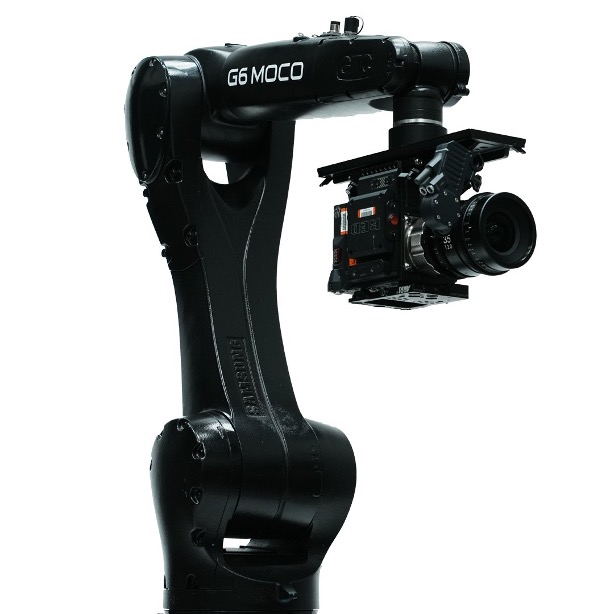

Industrial robots in film and live shows are used to control cameras, lighting, video screens, scenic elements and other production equipment through programmable, repeatable movement. Their six-axis motion allows production teams to create camera paths, visual effects and stage sequences that would be difficult to execute consistently with conventional rigs.
The robot does not replace the director, cinematographer, stage designer or performer. It provides a controlled movement platform. The creative team determines the framing, timing, choreography, visual intention and relationship between the machine and the audience.
Successful entertainment robotics therefore depends on more than selecting an industrial arm. The complete system must combine suitable payload and reach, motion-control software, camera or stage tooling, synchronisation, risk assessment and technical support.
Quick answer
- Film: robots execute repeatable camera and object movements across multiple takes.
- High-speed cinematography: they synchronise the camera with fast physical events.
- Virtual production: tracked robot movement can be coordinated with real-time digital environments.
- Live shows: robots move screens, lights, props and scenic structures according to programmed cues.
- Performance: robotic movement can become part of the choreography itself.
The robot becomes useful when precise, repeatable or synchronised movement contributes directly to the production concept.
Why industrial robots are used in entertainment production
Industrial robotic arms were developed for controlled movement in manufacturing. The same capabilities can be applied to film, television, advertising, theatre, concerts, exhibitions and live events.
A six-axis robot can:
- move a camera through complex three-dimensional paths;
- repeat the same movement across multiple takes;
- control speed, acceleration and tool orientation;
- coordinate movement with objects, lighting or special effects;
- carry cameras, screens, projectors, lights or scenic elements;
- respond to production cues or external control systems;
- operate on a linear track to extend the working range.
These capabilities provide production teams with a programmable movement system rather than a fixed mechanical rig.
However, industrial repeatability does not automatically create a usable cinematic or stage movement. The robot must be integrated with appropriate software, tooling, cable management and safety controls.
How robotic motion control works in film production
Motion control is the programmed movement of a camera, subject or physical effect along a defined path. A robotic camera system allows that movement to be stored, adjusted and repeated.
A typical workflow may include:
- defining the required camera position and framing;
- creating key positions or importing a digital trajectory;
- adjusting speed, acceleration and timing;
- coordinating focus, zoom, shutter or external triggers;
- simulating or testing the movement;
- recording several takes using the same path;
- modifying individual parameters without rebuilding the entire move.
Repeatable movement is particularly valuable when several visual layers must align. The same camera trajectory can be used for different performers, products, lighting conditions or visual-effects elements.
This does not mean every take must be identical. The production team can change timing, position, lens settings or object behaviour while preserving the underlying camera move.
What robotic camera systems contribute to cinematography
| Production requirement | Robot contribution | Creative decision |
|---|---|---|
| Repeatable takes | Reproduces the programmed camera path and timing. | Determines framing, performance and which elements change between takes. |
| High-speed movement | Accelerates and positions the camera according to a controlled trajectory. | Defines the relationship between camera speed, subject and visual effect. |
| Complex spatial path | Combines multiple axes to maintain camera orientation through the movement. | Defines perspective, rhythm and the visual purpose of the trajectory. |
| Visual-effects alignment | Repeats motion for plates, compositing or controlled physical effects. | Plans how the separate visual elements will be combined. |
| Product cinematography | Creates accurate movements around small objects or controlled events. | Defines lighting, lens choice, product movement and final composition. |
| Virtual production | Provides trackable camera position and orientation. | Coordinates the physical shot with the digital environment. |
Key distinction: a robot can reproduce movement, but the cinematic value of that movement still depends on direction, composition, performance, lighting and editing.
High-speed robotic cinematography
High-speed camera robotics is used when the camera must move rapidly while remaining synchronised with a short physical event.
Examples may include:
- liquid movement;
- product impacts;
- particles and powders;
- breaking or deforming objects;
- food and beverage shots;
- rapid performer or object movement;
- precisely timed practical effects.
The robot can trigger the camera or external equipment at defined points in the trajectory. This allows the shot to be coordinated with an event that may last only a fraction of a second.
The benefit is not speed alone. The system must also control acceleration, vibration, camera orientation and timing. An aggressive movement that produces excessive vibration or places the robot near a kinematic limit may be technically repeatable but visually unusable.
How robots support visual effects and compositing
Visual-effects workflows often require the same camera movement to be reproduced while different elements are recorded separately.
A robotic motion-control system can support:
- clean background plates;
- multiple passes with different lighting;
- separate performer or object layers;
- miniature and scale-model filming;
- repeatable practical effects;
- motion-matched computer-generated elements;
- controlled object and camera coordination.
Because the camera path can be repeated, the recorded elements share a common movement reference. This can reduce alignment problems during post-production.
Accuracy still depends on the complete system. Lens behaviour, camera mounting, mechanical vibration, track calibration, environmental conditions and external equipment can all affect the final match.
Industrial robots in virtual production
Virtual production combines physical cameras and sets with real-time digital environments. A robotic camera system can provide repeatable and measurable movement data that supports this relationship.
The production architecture may connect:
- the robot controller;
- camera and lens data;
- tracking systems;
- real-time rendering software;
- LED walls or projection systems;
- external objects or model movers;
- lighting and production-control systems.
The objective is to maintain correspondence between the physical camera and the virtual scene. When the camera moves, the digital perspective must update correctly.
A robot can repeat the trajectory for testing, rehearsal and final production, but system latency, coordinate calibration and data synchronisation must be validated.
How industrial robots are used in live shows
On stage, industrial robots may function as moving scenic equipment or as visible performers within the production.
They can be used to move:
- LED screens;
- lighting fixtures;
- projectors;
- cameras;
- mirrors and reflective surfaces;
- props and scenic structures;
- instruments or sound-producing objects;
- custom kinetic mechanisms.
The robot movement can be synchronised with music, timecode, video, lighting cues or show-control systems. The arm may remain visible as part of the visual language or be integrated behind the scenery.
Repeatability helps stage teams rehearse and reproduce a sequence, but every production must account for human performers, changing stage conditions and emergency procedures.
When the robot becomes part of the choreography
A robotic arm does not need to carry a conventional production tool. Its movement can itself become a scenic or expressive element.
Directors and choreographers can work with:
- the shape of the robot’s path;
- speed and acceleration;
- pauses and reversals;
- distance from performers;
- coordination between several robots;
- interaction with light, sound and projection;
- the contrast between mechanical and human movement.
The robot does not interpret the performance. The production team creates a movement score and defines how the machine relates to the human performers.
Example: a robotically controlled stage screen
A six-axis robot carries a lightweight video screen during a live performance. At the beginning of the sequence, the screen acts as a fixed background. It then rotates, advances toward the performer and changes orientation while the video content responds to its position.
The movement is programmed and synchronised with the soundtrack and media server. Rehearsals are used to refine the screen trajectory, performer marks and transition timing.
The robot does not determine the visual narrative. It provides the programmable movement that allows the screen to change from scenery into an active spatial element.
Robotic lighting and projection
Industrial robots can carry lighting or projection equipment through movements that exceed the range of conventional pan-and-tilt fixtures.
A robot-mounted light or projector can:
- change both position and orientation;
- move through three-dimensional trajectories;
- approach or withdraw from performers and objects;
- repeat lighting movements across rehearsals;
- coordinate with cameras and scenic elements;
- create controlled long-exposure light patterns;
- reposition projection surfaces or optical components.
The robot payload calculation must include the fixture, mounting hardware, cables and any additional control equipment. Thermal management, cable routing and electrical supply also need to be considered.
What components make up an entertainment robot system?
| System component | Primary function | Key consideration |
|---|---|---|
| Industrial robot | Provides multi-axis movement, reach and payload. | Speed, reach, payload, mounting and movement quality. |
| Robot controller | Executes motion and manages robot functions. | Controller generation, interfaces, software and safety functions. |
| End effector or rig | Connects the camera, light, screen, prop or object to the robot. | Weight, centre of gravity, stiffness and secure mounting. |
| Motion-control software | Creates, edits and synchronises production movements. | Usability, data exchange, timing and system compatibility. |
| Track or external axis | Extends the robot’s working envelope. | Calibration, floor installation and coordinated movement. |
| Show or production control | Coordinates cues, media, lighting and external equipment. | Communication protocols, latency and fail-safe behaviour. |
| Safety system | Controls access and hazardous motion. | Risk assessment, detection, emergency stops and operating modes. |
How to choose a robot for camera motion control
A robot suitable for general handling is not automatically suitable for cinematography. Selection must begin with the shot requirements and complete camera package.
Payload
The calculation must include the camera, lens, focus and zoom motors, mounting system, cables and any stabilisation or monitoring equipment.
Reach
The arm must cover the required camera positions without unstable postures, singularities or collisions. A track may be necessary when the shot exceeds the robot’s fixed working envelope.
Speed and acceleration
High-speed shots require more than a fast nominal robot. The camera package, track, mounting system and trajectory must remain stable during acceleration and deceleration.
Movement quality
Cinematography often requires smooth, visually controlled motion. The robot, software and path generation must support the required movement profile.
Controller and software compatibility
The controller must communicate with the selected motion-control, camera, lens, tracking and production systems.
Mounting configuration
The robot may be floor-mounted, inverted, wall-mounted or installed on a track. The configuration influences reach, infrastructure and risk assessment.
How to choose a robot for stage applications
Stage applications have different priorities from camera motion control. The robot may need to carry large scenic objects, operate repeatedly throughout a show and remain coordinated with people nearby.
The assessment should include:
- the total moving payload;
- the object’s dimensions and centre of gravity;
- the required movement envelope;
- the distance from performers and audience members;
- the show duration and duty cycle;
- communication with show-control systems;
- cue recovery after interruption;
- manual and emergency operating procedures;
- transport, assembly and repeated venue installation;
- redundancy and inspection requirements.
Large visual objects can create dynamic forces and collision hazards even when their weight remains within the robot’s nominal payload.
Safety in film studios and live performance environments
An industrial robot remains hazardous equipment when used in an artistic environment. Entertainment applications can be more difficult to control than factory cells because performers, camera crews and stage technicians move through the same space.
The safety concept should address:
- robot speed and moving mass;
- camera, light or scenic payloads;
- cable and hose movement;
- performer and crew access;
- unexpected changes to choreography;
- temporary installations and touring conditions;
- manual setup and recovery;
- loss of communication or show-control signals;
- emergency stopping and safe restart;
- inspection before each performance or production period.
Rehearsal does not replace engineering controls. A movement that has operated correctly many times can still become hazardous after a tooling change, mounting adjustment, software revision or altered performer position.
Safety principle: artistic intention never overrides the validated operating envelope of the robotic system.
What are the limitations of industrial robots in entertainment?
Robots offer strong production capabilities, but they also introduce constraints.
- Integration is specialised. Camera and stage systems may require custom hardware, software and communication.
- Setup requires time. Calibration, rehearsal and safety validation must be included in the production schedule.
- Industrial motion can appear mechanical. Paths may require detailed refinement to achieve the intended visual quality.
- Payload changes affect the system. A different lens, screen or prop can alter mass and centre of gravity.
- Temporary installations increase complexity. Touring systems must be reassembled and verified at each venue.
- Safety can restrict the creative concept. Some movements may not be feasible around performers or audiences.
- The complete system is the investment. Tooling, software, tracks, safety and engineering may exceed the cost of the arm.
A robot should be selected because programmable movement creates clear production value, not simply because robotics provides visual novelty.
Can refurbished industrial robots be used in film and live shows?
Refurbished industrial robots can be considered for film, stage, education and experimental production when their mechanical condition, controller generation and software compatibility match the intended application.
They may be useful for:
- film and media schools;
- fixed studio installations;
- creative research laboratories;
- previsualisation and movement testing;
- robotic lighting and projection;
- controlled stage or exhibition systems;
- custom entertainment-technology development.
However, a standard refurbished robot is not automatically a complete camera robot or certified stage system. The project still requires appropriate tooling, motion-control software, safety engineering, integration and commissioning.
The evaluation should verify:
- mechanical and controller condition;
- movement quality under the intended payload;
- software and communication options;
- track or external-axis compatibility;
- availability of backups and documentation;
- spare parts and technical support;
- installation and safety requirements;
- the total cost of the finished system.
RHTS provides new and refurbished industrial robots that can be evaluated as platforms for camera motion, stage automation, creative research and entertainment applications.
How to evaluate an entertainment robotics project
Film and live-show robotics evaluation framework
- Creative objective: What must the robotic movement contribute to the shot or performance?
- Payload: What camera, light, screen, object or scenic structure must be moved?
- Trajectory: What reach, speed, orientation and acceleration are required?
- Repeatability: Must the movement match across takes or performances?
- Synchronisation: Which cameras, effects, lights, media or show systems must be coordinated?
- Environment: Is the installation fixed, temporary, touring or public-facing?
- Human proximity: How close will performers, crew or audiences be?
- Software: Which motion-control and production platforms must communicate?
- Safety: What risk controls and operating modes are necessary?
- Support: Who will program, rehearse, operate, inspect and maintain the system?
If the project team cannot define these requirements, the robot model should not be selected yet. The creative sequence must first be translated into measurable motion, payload, control and safety requirements.
Frequently asked questions
How are industrial robots used in film production?
They are used for repeatable camera movement, high-speed cinematography, product shots, visual-effects passes, object movement, scanning and virtual-production workflows.
Why are robotic camera movements useful for visual effects?
A robot can reproduce the same camera trajectory across several takes, making it easier to align separately recorded performers, objects, backgrounds and physical effects.
How are industrial robots used in live shows?
They can move screens, lights, cameras, projectors, props and scenic structures or become visible choreographic elements within the performance.
Can industrial robots be synchronised with music and lighting?
Yes. A properly integrated system can receive cues or timing data from show-control, media, lighting or audio systems and execute programmed movements in coordination with them.
Are standard industrial robots safe to use near performers?
They require a project-specific risk assessment, appropriate safety systems, controlled operating limits and validated choreography. A standard robot should not be placed near performers without engineered safeguards.
Can a refurbished robot become a motion-control camera system?
Potentially, but the robot arm is only one component. The finished system also requires a camera rig, motion-control software, interfaces, calibration, safety engineering and technical commissioning.
Which robot is best for entertainment applications?
The correct model depends on payload, reach, speed, movement quality, controller compatibility, mounting configuration, external axes and the intended production environment.
Programmable movement is the connection between robotics and performance
Industrial robots are transforming film and live shows because they make complex movement programmable, repeatable and synchronised.
In film, this supports camera trajectories, visual-effects alignment, product cinematography and virtual production. On stage, the same technology can animate lights, screens, scenic objects and physical space.
The robot does not determine the visual language. It executes the movement system designed by directors, cinematographers, choreographers, stage designers, programmers and engineers.
The strongest applications begin with a clear creative requirement and convert it into technical parameters: payload, reach, trajectory, timing, interfaces and safety limits.
When those layers are integrated correctly, an industrial robot becomes more than automated equipment. It becomes a reliable motion platform through which cinematic and live-performance ideas can be executed in physical space.
Explore related applications in the Robot Art & Architecture section and read how industrial robotic arms are used in expressive artistic projects.
Production teams, studios and research laboratories can also contact RHTS to discuss the required robot reach, payload, controller and integration conditions for a film, stage or entertainment-technology project.