English
 Italiano
 Українська
 Русский
 Español

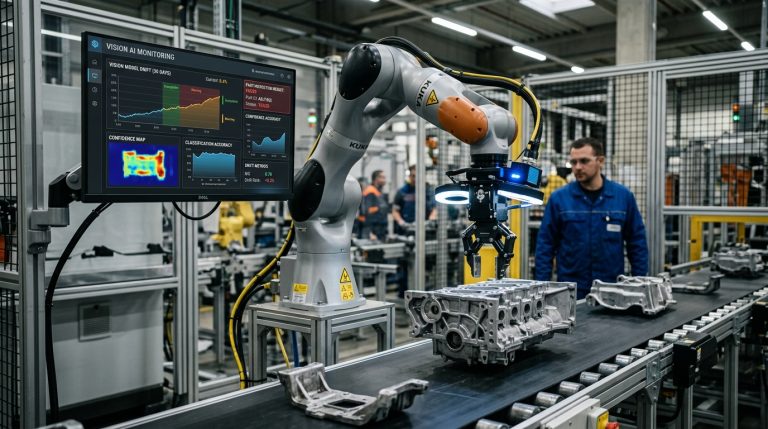
Refurbished industrial robots for education give universities, technical schools and makerspaces access to the same class of controllers, kinematics, safety systems and programming workflows used in real production environments. They can support training in industrial automation, robot programming, digital fabrication, manufacturing research, architecture and creative robotics without requiring every institution to purchase the latest robot generation.
The educational value does not come from the robot arm alone. It comes from the complete learning system: the controller, programming environment, tooling, fixtures, simulation software, safety architecture and projects developed around the equipment.
A refurbished robot can therefore become a practical teaching and research platform, provided its mechanical condition, controller generation, software compatibility and support requirements are evaluated before purchase.
Quick answer
- Students work with industrial-scale hardware rather than simplified demonstrations.
- One robot can support programming, automation, fabrication and interdisciplinary projects.
- Refurbished equipment can reduce the robot acquisition cost.
- The institution must still budget for tooling, safety, installation, software and training.
- The correct robot depends on the curriculum and intended applications.
A refurbished industrial robot is educationally valuable when it is selected as part of a complete laboratory workflow rather than purchased as an isolated machine.
Why industrial robots are valuable educational tools
Industrial robotics education involves more than teaching a robot to move between programmed points. A complete learning environment can expose students to mechanical systems, electrical control, software, industrial communication, process engineering and functional safety.
Students can observe how theoretical concepts behave in a physical system:
- joint and Cartesian coordinate systems;
- forward and inverse kinematics;
- tool and work-object calibration;
- trajectory planning and interpolation;
- payload and centre-of-gravity configuration;
- PLC and robot communication;
- sensor and machine-vision integration;
- offline programming and simulation;
- risk assessment and safeguarded operation;
- fault diagnosis and recovery.
These subjects become easier to understand when students can test them on real equipment, measure the result and see how programming decisions affect movement, cycle time and process stability.
What students can learn from a refurbished industrial robot
| Learning area | Practical activity | Skills developed |
|---|---|---|
| Robot programming | Create point-to-point, linear and circular paths using the teach pendant or offline software. | Coordinate systems, motion commands, speed control and program structure. |
| Automation integration | Connect the robot to PLCs, sensors, grippers and external equipment. | I/O logic, industrial communication, sequencing and diagnostics. |
| Digital fabrication | Use the robot for milling, drawing, cutting, scanning or additive processes. | CAD/CAM workflows, toolpaths, calibration and material-process control. |
| Machine vision | Locate parts, inspect components or adapt robot paths using cameras. | Image processing, coordinate transformation and sensor-based control. |
| Safety engineering | Design guarded zones, emergency stops and safe operating procedures. | Risk assessment, functional safety and human-machine interaction. |
| Maintenance and troubleshooting | Analyse alarms, calibration errors, communication faults and mechanical symptoms. | Root-cause analysis, preventive maintenance and technical documentation. |
Educational advantage: industrial robots allow students to connect software decisions with measurable physical consequences such as position, speed, force, collision risk and cycle time.
Where universities and makerspaces use industrial robots
The same robot platform can support different departments and project types when the laboratory is designed around interchangeable tools and flexible programming.
Industrial automation and manufacturing
Engineering students can develop handling, machine-tending, assembly, inspection and palletising exercises. These projects introduce production sequencing, cycle-time analysis, PLC communication and equipment integration.
Robotic milling and machining
A robot equipped with a suitable spindle can be used to study toolpath generation, calibration, cutting forces, vibration and surface quality. Light machining of foam, wood, plastics and selected composites may be suitable for laboratory exercises when tooling and extraction are designed correctly.
Technical guidance on this process is available in the Milling Robots section.
Architecture and digital fabrication
Architecture schools use industrial robots to connect parametric models with physical fabrication. Students can explore non-standard components, robotic assembly, material deposition, cutting, forming and large-scale prototyping.
These workflows teach students to design with production constraints rather than treating fabrication as a separate final step.
Related projects and methods are covered in the Robot Art & Architecture category.
Robotic 3D printing
Universities may integrate extrusion systems for polymers, clay, concrete or other materials. Students can investigate path planning, layer deposition, material flow, curing and the relationship between robot movement and printed geometry.
Explore additional applications in the 3D Printing Robots section.
Art, performance and interactive systems
Industrial arms can move brushes, cameras, lights, instruments or sculpting tools. These projects can combine programming with choreography, sound, vision, sensor input and human interaction.
Research in control, AI and perception
Research teams can study adaptive control, computer vision, path optimisation, state estimation, digital twins and data-driven automation. The robot becomes a repeatable physical platform on which algorithms can be tested.
Why institutions consider refurbished robots
New industrial robots can be appropriate when the curriculum requires current controller technology, manufacturer-supported education packages or specific collaborative features. Refurbished robots offer a different value proposition.
They may allow institutions to obtain:
- industrial-scale reach and payload;
- established KUKA, ABB, FANUC or Yaskawa platforms;
- real industrial controllers and teach pendants;
- equipment suitable for laboratory modification and experimentation;
- multiple robot cells within a limited capital budget;
- models already familiar to local integrators and industry partners.
The purchase price should not be the only criterion. A low-cost robot can become expensive if the controller is unsupported, software licenses are unavailable, documentation is incomplete or the institution cannot obtain suitable spare parts.
Used and refurbished robots are not equivalent
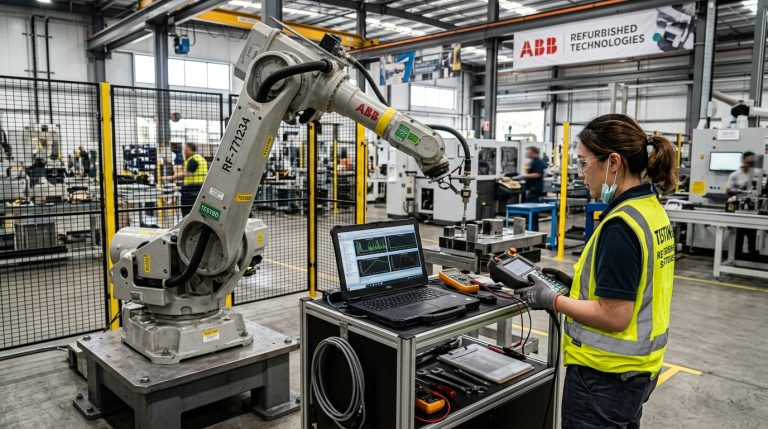
A used robot may be sold in its existing condition with limited testing. A refurbished robot should have undergone a documented technical process appropriate to its age and intended use.
The scope may include:
- mechanical and visual inspection;
- controller and teach-pendant testing;
- replacement of batteries and worn components;
- verification of brakes, motors, encoders and cabling;
- checking gearbox condition and backlash;
- software and option verification;
- mastering, calibration and operational testing;
- cleaning and preparation for installation.
The institution should request a clear description of the work completed. The term “refurbished” should refer to a verifiable technical condition rather than function as a marketing label.
Additional guidance is available in the Refurbished Robots category.
How refurbished robots compare with new educational systems
| Selection factor | Refurbished industrial robot | New educational robot or cell |
|---|---|---|
| Industrial realism | Provides authentic industrial hardware, controller logic and maintenance requirements. | May provide a simplified, compact or curriculum-focused environment. |
| Initial equipment cost | May reduce the acquisition cost of the robot arm and controller. | Usually includes current hardware, warranty and packaged support. |
| Software generation | May use an older controller requiring compatibility checks. | Generally supports current programming and connectivity tools. |
| Flexibility | Can support custom tooling, fabrication and research projects. | May be optimised for standard training exercises. |
| Integration effort | Requires engineering for safety, tooling, installation and commissioning. | May arrive as a more complete and documented training package. |
| Support | Depends on controller age, supplier capability and local expertise. | Usually includes current manufacturer support and training resources. |
Selection principle: refurbished equipment is strongest when industrial realism and flexible experimentation are more important than obtaining the newest controller generation or a ready-made teaching package.
What to verify before buying a refurbished robot for education
Robot selection should begin with the curriculum and research objectives. The institution should define what students are expected to learn and what physical processes the laboratory must support.
Robot model and payload
The payload must include the complete end effector, cables, sensors and any process loads. Purchasing a large robot without a defined use may increase space, safety and installation costs without improving educational value.
Working reach
The robot must cover the intended work area, fixtures and tools while maintaining usable joint configurations. Reach should be evaluated through simulation rather than nominal radius alone.
Controller generation
The controller determines programming language, communication protocols, simulation compatibility, available safety functions and software support.
Software and licenses
Verify which programming, simulation, CAM and communication options are included. A robot may be mechanically suitable but educationally limited if the required software cannot be obtained.
Documentation and backups
The laboratory should receive robot manuals, electrical documentation, system backups, mastering data and information about installed options.
Mechanical condition
Operating hours alone do not define condition. Maintenance history, storage, gearbox backlash, brakes, motors, cabling and controller condition must also be assessed.
Spare parts and technical support
Institutions should confirm whether replacement components, service expertise and controller support will remain available throughout the expected teaching period.
The complete cost of an educational robot laboratory
The robot arm may represent only one part of the investment. A realistic budget should include:
- robot and controller;
- transport and positioning;
- electrical installation;
- guarding, scanners and emergency-stop systems;
- fixtures and worktables;
- end effectors and tooling;
- software and licenses;
- computers and network equipment;
- dust, chip, fume or material management;
- commissioning and calibration;
- staff and operator training;
- maintenance and spare parts.
A refurbished robot can reduce the cost of the core equipment, but the institution still needs a complete and safe working cell.
How to design a flexible educational robot cell
A laboratory should support multiple courses and project types without requiring a complete rebuild for every semester.
Useful design principles include:
- a modular worktable or fixture system;
- interchangeable end effectors;
- accessible robot and PLC I/O;
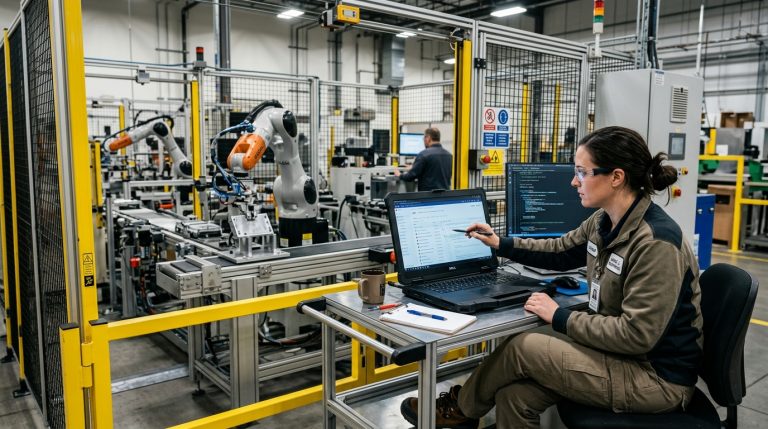
- offline programming and simulation workstations;
- clearly documented tool and work-object calibration procedures;
- protected areas for machining or material deposition;
- separate instructor and student access levels;
- recorded system backups and version control;
- safe observation positions for groups;
- space for future sensors, external axes or process equipment.
The laboratory should allow experimentation while preventing students from bypassing safety or damaging the system through uncontrolled configuration changes.
Example: one robot supporting several teaching modules
A university installs a medium-payload six-axis robot on a fixed base with a modular worktable. During the first semester, students learn coordinate systems, teach-pendant programming and PLC communication using a simple gripper.
In a digital-fabrication course, the gripper is replaced with a lightweight spindle for foam and wood machining. Architecture students generate toolpaths from parametric models, while engineering students evaluate calibration, vibration and cycle time.
A later research project adds a camera and force sensor for adaptive surface tracking. The robot remains the same, but interchangeable tooling and a documented software architecture allow it to support several disciplines.
The educational value comes from the flexibility of the complete cell, not from changing the robot for each application.
Safety requirements in university and makerspace laboratories
An educational environment does not reduce the hazards of an industrial robot. Students may be inexperienced, projects change frequently and tools may be modified more often than in a production cell.
The laboratory should have:
- a documented risk assessment;
- appropriate guarding or safety-rated detection;
- accessible emergency stops;
- controlled operating modes and speed limits;
- defined instructor authorisation;
- tool-specific safety procedures;
- pre-use inspection checklists;
- rules for program and configuration changes;
- training before independent access;
- procedures for faults, collisions and recovery.
Creative experimentation must remain inside an approved safety architecture. A new tool or process should trigger a new technical review when it changes payload, forces, hazards or human access.
How universities can structure an industrial robotics curriculum
A progressive curriculum can move from controlled exercises to interdisciplinary projects.
Level 1: operation and safety
Students learn robot anatomy, operating modes, emergency procedures, coordinate systems and basic teach-pendant use.
Level 2: programming and calibration
Students create motion programs, define tools and work objects, control speed and test repeatability.
Level 3: automation integration
Projects introduce PLCs, I/O, sensors, grippers, conveyors and sequence logic.
Level 4: simulation and digital fabrication
Students generate paths from CAD/CAM or parametric models and compare simulated behaviour with physical execution.
Level 5: adaptive and research applications
Advanced projects may use machine vision, force control, optimisation, AI, external axes or multi-robot coordination.
This progression allows students to understand the robot as both an industrial machine and a programmable research platform.
How to evaluate a refurbished robot for an educational institution
Educational robot selection framework
- Learning objectives: Which skills and disciplines must the robot support?
- Applications: Will it handle, mill, draw, print, scan, assemble or perform research tasks?
- Robot size: What payload and reach are genuinely necessary?
- Controller: Is the programming environment appropriate and supportable?
- Software: Are simulation, communication and fabrication tools available?
- Condition: What inspection, refurbishment and testing have been completed?
- Safety: Can the institution create a compliant laboratory environment?
- Support: Who will install, train, maintain and troubleshoot the system?
- Budget: Does the estimate include the complete cell and ongoing operation?
- Future use: Can the platform support new courses and research projects?
If the institution cannot define these requirements, purchasing a robot should wait until the educational and technical scope is clearer.
Frequently asked questions
Are refurbished industrial robots suitable for universities?
Yes, when their mechanical condition, controller generation, software compatibility and safety requirements are properly evaluated. They can provide realistic industrial training and flexible research capability.
Are refurbished robots identical to new robots?
No. They may provide comparable industrial functions for suitable applications, but their controller generation, remaining service life, software support, warranty and technical condition differ from new equipment.
What can students learn from an industrial robot?
Students can learn programming, kinematics, calibration, PLC integration, industrial communication, safety, machine vision, digital fabrication, troubleshooting and process engineering.
Can one robot be used by different university departments?
Yes. A modular cell with interchangeable tooling can support engineering, architecture, manufacturing, computer science, design and art projects.
What additional equipment does an educational robot require?
The laboratory may require guarding, emergency stops, worktables, fixtures, tools, software, computers, electrical installation, extraction systems and training.
Is a large robot always better for education?
No. Larger robots require more floor space, guarding and infrastructure. The correct size depends on the intended projects, payload and working envelope.
Can students use industrial robots safely?
Yes, within a properly engineered laboratory with risk assessment, controlled access, training, safe operating procedures and supervision appropriate to their competence.
A refurbished robot becomes valuable when it supports a complete learning system
Industrial robots can connect theoretical education with real automation, manufacturing and digital-fabrication practice. Students learn how code becomes movement, how tools interact with materials and how safety, calibration and system integration affect the final result.
Refurbished robots can make this level of equipment accessible to more universities and makerspaces, but affordability alone is not enough. The robot must be technically suitable, properly tested and supported by software, tooling, safety systems and qualified instruction.
The strongest educational laboratories begin with defined learning objectives. They select a robot that supports those objectives, build a modular cell around it and introduce complexity progressively.
When those conditions are met, an industrial robot becomes more than demonstration equipment. It becomes a shared platform for teaching, research, fabrication and interdisciplinary experimentation.
Explore further guidance in the Refurbished Robots section, or review available new and refurbished industrial robots. Institutions can also contact RHTS with their curriculum, intended applications, required reach and available laboratory space for an initial equipment assessment.