English
 Italiano
 Українська
 Русский
 Español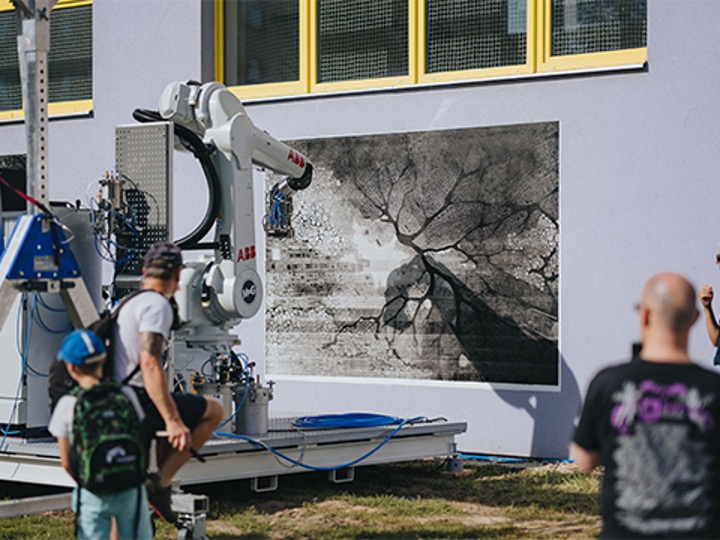

The ABB robot mural demonstrated how AI-assisted design and industrial painting technology can be connected in a complete urban-art workflow. The project combined ideas submitted by the public, design direction from human specialists, AI-generated visual content, an ABB IRB 5500 painting robot, and PixelPaint technology to produce a large mural in Mladá Boleslav, Czech Republic.
The robot did not conceive the artwork independently, and the artificial-intelligence system did not operate without human direction. Public participation, design interpretation, digital preparation, paint engineering, robot programming, and physical execution all contributed to the final result.
This distinction is important. The project was not an example of a machine replacing a mural artist. It was an example of several digital and industrial technologies being coordinated to translate a collectively defined concept into a permanent physical image.
Quick Answer
- Public participants contributed ideas about the mural’s style, mood, and themes.
- Škoda Design translated those ideas into inputs used by AI design tools.
- Artificial intelligence supported the generation of the final visual composition.
- ABB PixelPaint converted the digital image into controlled paint application.
- The ABB IRB 5500 positioned the printing head across the wall.
- PPG supplied a coating system adapted to the requirements of the outdoor mural.
The artistic result emerged from the complete human–software–robot–material workflow rather than from one autonomous machine.
What Was the ABB Robot Mural Project?
ABB created the mural for the City=Gallery Street Art Festival in Mladá Boleslav, a Czech city associated with Škoda Auto’s main production activities.
The project involved collaboration between:
- ABB Robotics;
- the Škoda Auto Endowment Fund;
- Škoda Auto;
- Škoda Design;
- PPG;
- City=Gallery festival organisers;
- members of the public who contributed ideas and voted on the creative direction.
The mural was applied to the wall of the Pastelka Art School. This location gave the project a public and educational context rather than limiting it to an industrial demonstration cell.
The process connected community participation with industrial automation. People contributed the conceptual material, design specialists structured it, AI tools helped generate the image, and the robotic system converted that image into physical paint.
Was the Mural Designed Entirely by Artificial Intelligence?
The final image was generated using AI tools, but describing the result as completely autonomous machine creativity would be misleading.
The creative chain included several human decisions:
- the public proposed ideas and preferences;
- an online vote helped establish the style, mood, and themes;
- Škoda Design converted those preferences into suitable AI inputs;
- project teams selected and prepared the resulting visual design;
- engineers adapted the image for the PixelPaint process;
- the location, materials, coatings, and final presentation were chosen by people.
The AI system operated inside a human-defined brief. It supported image generation, but it did not independently select the cultural context, wall, audience, production process, or meaning of the project.
The mural is therefore better understood as AI-assisted and robotically executed art rather than autonomous art produced by a machine.
What Each Part of the System Contributed
| Project Layer | Primary Contribution | Effect on the Mural |
|---|---|---|
| Public Participation | Provided ideas, themes, mood, and stylistic preferences. | Connected the work to the local community. |
| Human Design Direction | Structured the creative brief and interpreted public input. | Established visual and contextual coherence. |
| AI Tools | Generated visual possibilities from the defined inputs. | Supported the development of the final image. |
| Robot Programming | Converted the image and wall geometry into executable movement. | Controlled positioning, sequence, and coverage. |
| ABB IRB 5500 | Moved the printing head across the mural surface. | Provided the physical reach and controlled motion. |
| PixelPaint | Applied detailed patterns through individually controlled nozzles. | Transferred the digital image directly into paint. |
| Coating System | Provided primer, colour application, and exterior protection. | Supported reliable application and outdoor durability. |
Key distinction: the AI generated visual information, the robot generated movement, and PixelPaint applied material. Human participants defined why the mural existed and what it should represent.
What Is ABB PixelPaint?
PixelPaint is an ABB robotic painting technology originally developed for decorative and two-tone automotive finishes.
A typical PixelPaint system combines:
- an ABB IRB 5500 paint robot;
- a high-resolution printing head;
- approximately 1,000 individually controlled nozzles;
- a dosing-control package;
- ABB RobotStudio programming software;
- vision and process-control components appropriate to the application.
The printing head operates more like an industrial inkjet system than a conventional paint atomiser. Instead of spraying a broad paint cloud and masking the areas that should remain protected, PixelPaint places controlled droplets directly onto the target surface.
This allows the system to reproduce:
- contrasting colours;
- decorative patterns;
- high-resolution graphics;
- small details;
- complex images;
- controlled colour boundaries.
For the mural project, ABB applied the same underlying principle to an architectural surface instead of a vehicle body.
Why PixelPaint Is Different From Conventional Robotic Spray Painting
A conventional robotic paint system commonly uses an atomiser to create a controlled spray pattern. Paint is projected across an area, and masking may be required when precise colour separation or decorative patterns are needed.
PixelPaint follows a different logic.
| Painting Characteristic | PixelPaint | Conventional Spray Application |
|---|---|---|
| Paint Delivery | Controlled droplets are directed to specific image locations. | Paint is atomised into a wider spray pattern. |
| Image Detail | Designed for detailed decorative graphics and patterns. | Better suited to broader uniform coverage unless masks or stencils are used. |
| Masking | Can apply selected patterns without conventional masking. | Often requires masking for sharp boundaries and multicolour designs. |
| Overspray | Designed to place paint directly on the intended surface. | Requires management of airborne paint and transfer efficiency. |
| Programming | Links image information with nozzle control and robot movement. | Primarily controls robot path, spray parameters, and coating coverage. |
| Primary Industrial Use | Decorative and customised automotive painting. | General coating and uniform paint application. |
The mural was significant because it used a specialised automotive painting technology outside its normal production context.
Why the ABB IRB 5500 Was Used
The ABB IRB 5500 is a robot platform designed for industrial painting processes. Paint robots differ from general-purpose handling robots because they are developed around the requirements of coating applications.
Relevant characteristics include:
- a working envelope suitable for painting surfaces;
- controlled movement across continuous paths;
- integration with paint-delivery equipment;
- routing for process hoses and cables;
- compatibility with ABB painting software and process systems;
- configurations designed for industrial paint environments.
For the mural, the robot positioned the PixelPaint head in relation to the wall while the nozzle-control system determined where paint should be delivered.
The robot arm did not interpret the image visually while painting. The design had already been processed into data that the robotic and paint-control systems could execute.
How a Digital Image Becomes a Robot-Painted Mural
A digital image cannot simply be uploaded to an industrial robot and painted automatically. The visual design must be connected to the physical wall, printing head, paint system, and robot coordinate system.
A simplified workflow includes:
- Creative briefing: define the themes, visual language, location, and project objectives.
- Image generation: produce and select the digital artwork.
- Image preparation: adapt resolution, colour information, dimensions, and composition to the wall.
- Surface preparation: inspect, clean, prime, and prepare the physical substrate.
- Coordinate definition: establish the relationship between the image, wall, robot, and printing head.
- Path planning: calculate how the robot will move across the required working area.
- Nozzle control: coordinate the individual PixelPaint nozzles with the robot position.
- Simulation and verification: check reach, coverage, orientation, and possible collisions.
- Paint application: execute the mural in controlled passes.
- Protection and inspection: verify the result and apply the required exterior finish.
Every stage affects the final image. A strong AI-generated design can still fail physically if surface preparation, calibration, paint properties, or robot access are incorrect.
Why Wall Geometry Matters
Automotive PixelPaint applications generally operate on known vehicle geometry inside a controlled production environment. A building wall introduces different conditions.
The integration team must consider:
- wall dimensions;
- surface flatness;
- texture and porosity;
- existing coatings;
- robot positioning;
- access to upper and lower mural areas;
- distance between the print head and surface;
- environmental exposure;
- installation stability;
- public-space safety.
If the wall is not perfectly aligned with the digital reference, the printing head may no longer maintain the intended relationship with the surface.
Surface measurement, calibration, and controlled robot placement are therefore essential to preserving image proportions and paint application.
The Role of the Paint and Coating System
Robot movement alone cannot guarantee a durable mural. The paint must remain compatible with the printing head, wall substrate, environmental conditions, and desired visual result.
For the ABB project, PPG provided a waterborne basecoat formulated for the PixelPaint process. The mural system also incorporated surface-preparation and protection layers suited to exterior use.
Relevant coating variables include:
- paint viscosity;
- pigment behaviour;
- droplet formation;
- drying time;
- adhesion to the substrate;
- colour consistency;
- resistance to ultraviolet exposure;
- weather resistance;
- compatibility with primer and topcoat.
An industrial print head cannot use every paint formulation without validation. Material properties must remain compatible with the nozzle system and required finish.
Does the Robot Paint With Millimetric Accuracy?
Descriptions of robotic art often reduce performance to a claim about robot precision. That is incomplete.
The final alignment of a mural depends on:
- robot repeatability and calibration;
- robot position relative to the wall;
- printing-head calibration;
- wall measurement;
- image scaling;
- nozzle control;
- paint-droplet behaviour;
- surface texture;
- temperature and environmental conditions.
The robot may reproduce its movement consistently while the physical paint result changes because of the wall or material.
For this reason, the performance of the system should be assessed through the complete painted output rather than through the robot specification alone.
What the Project Demonstrates About AI and Authorship
The ABB robot mural separates the creative process into several layers.
Public participants contributed cultural and thematic input. Designers structured the brief. AI tools created visual possibilities. Engineers converted the selected design into a robotic process. The robot and PixelPaint system physically applied the paint.
This distributed workflow raises questions about authorship, but it does not remove human responsibility.
Human participants still determined:
- why the mural should be created;
- where it should appear;
- which community should participate;
- which ideas should guide the image;
- which generated result should be selected;
- how the project should be engineered;
- how the public should interpret the finished work.
The AI did not choose its own cultural objective. The robot did not decide that a wall required a mural. Their roles were generative and operational inside a human-defined project.
Is PixelPaint a General-Purpose Mural-Painting Solution?
PixelPaint is an industrial decorative-painting technology developed primarily for automotive production. The Mladá Boleslav project demonstrates that the technology can be adapted to a mural, but it should not be interpreted as a ready-to-install mural printer for every wall or public-art project.
A new mural application would still require evaluation of:
- wall size and geometry;
- robot reach;
- robot mounting or positioning;
- surface materials;
- paint compatibility;
- environmental conditions;
- image preparation;
- software and programming;
- public access;
- safety and installation logistics;
- commercial viability.
The project proves technical adaptability. It does not eliminate application-specific engineering.
Case Study: From Community Input to Physical Mural
The mural began with ideas submitted by members of the public. Through an online voting process, participants helped define the desired mood, themes, and style.
Škoda Design translated that collective input into a structure that could guide AI image-generation tools. The selected digital composition was then prepared for the physical wall.
ABB’s IRB 5500 moved the PixelPaint head across the surface while approximately 1,000 individually controlled nozzles placed paint according to the image data.
PPG’s coating system supported application reliability and exterior durability.
The result was not the product of one autonomous author. It was a chain connecting community decisions, design expertise, artificial intelligence, industrial robotics, and material science.
What Other Applications Could Use Similar Technology?
The same technical principle—connecting digital imagery with precise robotic material application—could be relevant to several controlled applications.
Potential areas include:
- architectural graphics;
- custom interior surfaces;
- large decorative panels;
- museum and exhibition installations;
- corporate innovation spaces;
- temporary event environments;
- customised transport and industrial products;
- art and design research;
- educational demonstrations;
- brand-specific surface decoration.
Each application would require its own feasibility assessment. Surface geometry, material compatibility, production volume, durability, installation, and safety determine whether robotic painting is technically and economically justified.
Could a Conventional Industrial Robot Paint a Mural?
A general-purpose industrial robot can carry a brush, marker, spray gun, or other painting tool, but it would not reproduce the functionality of PixelPaint automatically.
A conventional robotic mural system may use:
- a paintbrush;
- a marker;
- a roller;
- a spray applicator;
- a single-nozzle paint dispenser;
- a custom multi-nozzle tool.
The final visual language and technical performance would be different.
PixelPaint’s detailed image application comes from the combination of:
- the robot;
- the specialised printing head;
- independent nozzle control;
- paint dosing;
- image processing;
- RobotStudio programming;
- process-compatible coatings.
The arm alone is not the differentiating technology.
Can a Refurbished Robot Be Used for Robotic Mural Painting?
A refurbished robot could support selected painting, drawing, or mural applications when its condition, controller, reach, payload, and software compatibility match the intended system.
However, a refurbished ABB robot does not automatically include PixelPaint or the process equipment used in the mural case study.
A project would need to verify:
- the exact robot and controller generation;
- mechanical and calibration condition;
- reach relative to the wall dimensions;
- tool and hose payload;
- painting-head compatibility;
- available communication interfaces;
- software and programming requirements;
- paint-delivery equipment;
- installation and safety systems;
- technical support for commissioning.
A simpler mural process using a brush, marker, or conventional spraying tool may be possible with a wider range of robot platforms. High-resolution PixelPaint functionality requires the complete specialised solution.
RHTS provides new and refurbished industrial robots that can be evaluated as platforms for robotic painting, creative fabrication, research, and artistic installations.
Safety Requirements for a Robot Painting in Public Space
An industrial robot remains hazardous equipment even when it is producing public art.
The safety assessment should consider:
- robot speed and moving mass;
- the painting head and process equipment;
- hoses, cables, and material-delivery systems;
- temporary robot positioning;
- public access;
- workers preparing the wall;
- unexpected movement or communication failure;
- paint and coating hazards;
- weather and environmental conditions;
- emergency stopping;
- safe setup, cleaning, and maintenance.
The operating area may require physical barriers, monitored access, emergency controls, and defined working procedures.
Safety principle: changing the cultural purpose of an industrial robot does not change the need for engineered risk controls.
What Are the Limitations of AI-Assisted Robotic Murals?
- The AI result still requires human direction. Prompts, selection, context, and approval remain human decisions.
- The digital image must be engineered for the physical surface. Image generation alone does not create an executable mural.
- Wall conditions can affect quality. Texture, alignment, porosity, and existing coatings influence the painted result.
- Specialised process equipment may be required. The industrial arm alone cannot reproduce PixelPaint functionality.
- Paint compatibility must be validated. Nozzle behaviour and outdoor durability depend on the coating system.
- Robot reach may limit mural dimensions. Larger walls may require repositioning, tracks, platforms, or multiple calibrated sections.
- Installation can be complex. Public-space access, weather, transport, utilities, and safety must be managed.
- The technology may not suit every artistic language. Hand-painted texture, improvisation, and direct physical gesture may remain central to other mural practices.
- Cost must be evaluated at system level. Programming, coating equipment, tooling, safety, and commissioning may exceed the cost of the robot.
How to Evaluate a Robotic Mural Project
Robotic Mural Evaluation Framework
- Creative Intent: Why should the mural be produced robotically?
- Image Source: Will the design be human-created, AI-assisted, generative, or community-driven?
- Surface: What are the wall dimensions, material, texture, and condition?
- Painting Method: Will the system use a brush, spray tool, dispenser, or high-resolution print head?
- Robot: What reach, mounting, movement, and controller capabilities are required?
- Paint: Is the coating compatible with the tool, substrate, and environmental exposure?
- Software: How will the image become robot movement and paint-control data?
- Calibration: How will the digital image be aligned with the physical wall?
- Installation: Can the robot and process equipment be positioned safely?
- Public Access: How will visitors and workers be separated from hazardous movement?
- Durability: What primer, coating, and protective finish are required?
- Support: Who will programme, integrate, operate, clean, and maintain the system?
If these requirements are not defined, selecting a robot or painting technology is premature.
Frequently Asked Questions
What Was the ABB Robot Mural?
The ABB robot mural was a public-art project in Mladá Boleslav, Czech Republic, that combined community input, AI-assisted image generation, an ABB IRB 5500 robot, and PixelPaint technology.
Which Robot Painted the Mural?
ABB used an IRB 5500 paint robot equipped with its PixelPaint printing technology.
What Is PixelPaint?
PixelPaint is an ABB decorative-painting system that uses a high-resolution head with approximately 1,000 individually controlled nozzles to place paint directly on a surface.
Did Artificial Intelligence Paint the Mural?
No. AI tools helped generate the visual design. The physical paint was applied by the robotic PixelPaint system, while people defined the brief, selected the image, engineered the process, and managed the installation.
Was the Mural Created Without Human Artists or Designers?
No. Public participants and design specialists influenced the concept and visual direction. Human teams also prepared, programmed, installed, and validated the complete system.
Can PixelPaint Be Used on Any Wall?
Not automatically. A new wall application requires evaluation of surface geometry, coating compatibility, robot access, image preparation, calibration, installation, and safety.
Can a Refurbished ABB Robot Paint Murals?
A suitable refurbished robot may support painting applications, but PixelPaint requires specialised printing, dosing, software, and integration components that are separate from the robot arm.
Does Robotic Painting Replace Mural Artists?
Robotic painting provides a different production method. The cultural meaning, concept, visual decisions, and interpretation remain connected to human participants.
The ABB Robot Mural Was a System Project, Not an Autonomous Machine Artwork
The ABB robot mural illustrates what happens when community participation, artificial intelligence, industrial robotics, and coating technology are connected deliberately.
AI helped generate a visual response to human-defined themes. PixelPaint converted the digital image into controlled paint application. The IRB 5500 provided the movement needed to cover the physical wall. Designers, engineers, coating specialists, organisers, and members of the public shaped the project at different stages.
The robot’s value was not that it became an independent artist. Its value was that it translated complex digital image information into a large physical artwork using an industrial process originally developed for automotive painting.
The case demonstrates how specialised automation can move beyond its first industrial application. But it also shows that successful creative robotics depends on far more than the arm: software, tooling, materials, calibration, safety, and human judgement remain essential.
Explore related projects and technical analysis in the Robot Art & Architecture section, or read how industrial robotic arms support expressive artistic projects.
Studios, universities, cultural institutions, and creative laboratories can also review available new and refurbished industrial robots or contact RHTS with the intended wall dimensions, painting method, required reach, tool, software, and installation environment for an initial robotic-platform assessment.