English
 Italiano
 Українська
 Русский
 Español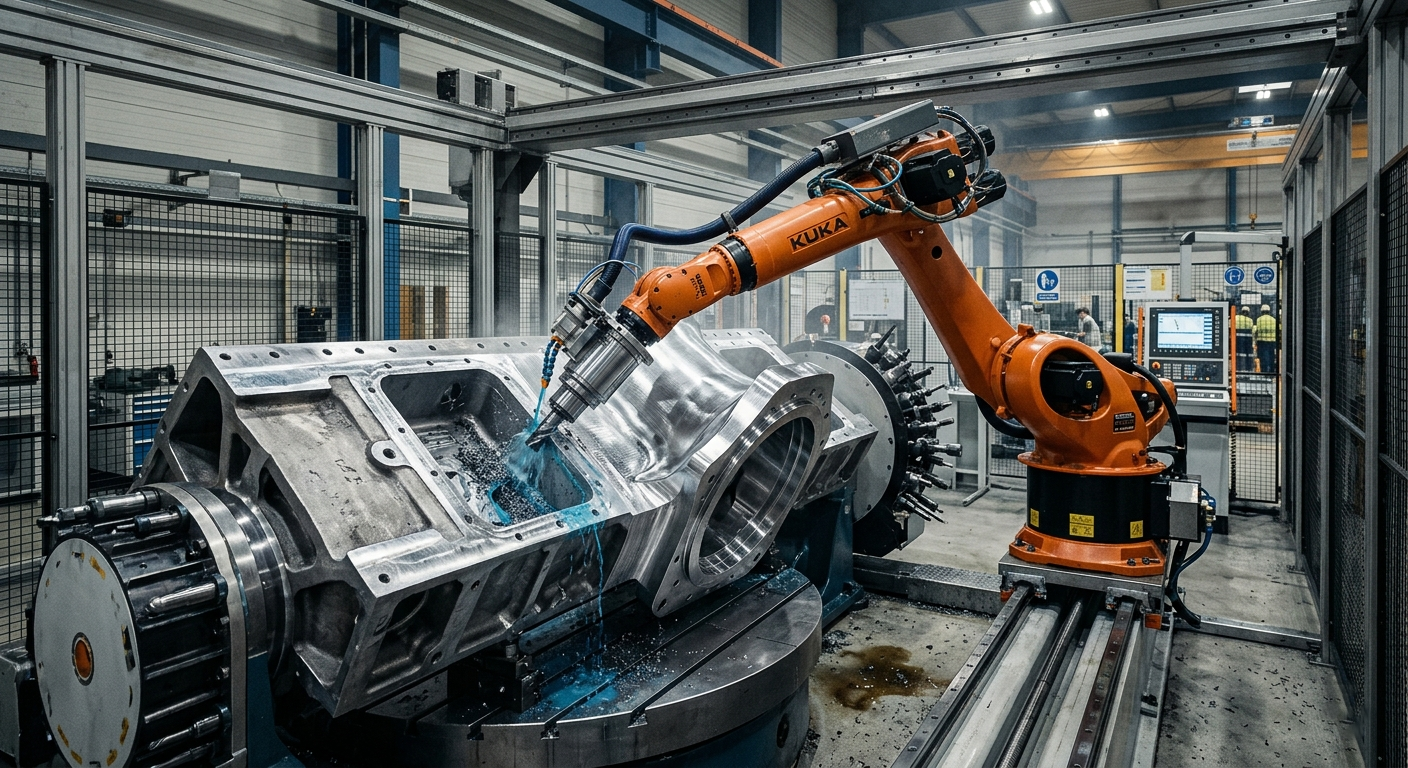

A Robotic Milling Cell can help manufacturers combine roughing and finishing operations in one automated machining workflow. Instead of moving a part between different machines or workstations, the robot can manage material removal, tool changes, and final surface finishing inside the same production cell.
Why are roughing and finishing usually separated
In machining, roughing is focused on removing material quickly and bringing the workpiece close to its final geometry. Finishing is focused on dimensional accuracy, surface quality, and detail. Milling itself is a subtractive process where a rotating cutting tool removes material from the workpiece.
The separation exists because roughing and finishing use different priorities:
Roughing uses more aggressive cutting parameters, larger tools, and higher material removal rates. Finishing uses smaller stepovers, refined toolpaths, sharper tools, and more controlled motion to achieve the final detail. In robotic milling, this separation can still exist as different operations, but they do not need to exist as different production stations.
Combining Roughing and Finishing in One Robotic Milling Cell: What Changes?
Combining Roughing and Finishing in One Robotic Milling Cell means the robot, spindle, tool changer, software, fixtures, and safety system are planned as one integrated machining environment. The robot can rough the part, change tools, run a semi-finishing pass, verify reachability, and complete the finishing operation without moving the workpiece to another machine.
Robotic Hi-Tech Solutions already presents robotic milling systems with key elements such as industrial robots, high-speed spindles, automatic tool stations, SprutCAM software, training, and post-processing support. These are exactly the types of components needed to build a cell where roughing and finishing are managed as a continuous process.
Main benefits of a single-cell workflow
The first advantage is fewer setups. Every time a large part is moved, re-clamped, or re-referenced, the process adds risk. A single robotic cell helps maintain the same coordinate logic from the first heavy cut to the last finishing pass.
The second advantage is better workflow continuity. Robotic milling cells can be designed with rotary tables, linear tracks, or both, giving the robot more access to complex geometry and large parts. Robotic Hi-Tech Solutions describes configurations with rotating tables for 360-degree access and linear tracks for extended work areas.
The third advantage is automation efficiency. A relevant example from the site describes a KUKA-based robotic system mounted on a rail with a rotary table, where roughing was performed before the delicate sculptural phase. Another article about Kern Studios explains how a robotic arm used different tool sizes for roughing runs before switching to finishing runs.
Key technical requirements
To make Combining Roughing and Finishing in One Robotic Milling Cell work reliably, the cell should be designed around process stability, not only robot reach.
Important requirements include:
- A rigid fixture or vacuum table suitable for the material.
- A spindle matched to the cutting load.
- Automatic or semi-automatic tool changing.
- CAM programming for roughing, semi-finishing, and finishing.
- Collision checking and reachability validation.
- Calibration between robot, workpiece, tool, and external axes.
- Dust or chip extraction, especially for foam, wood, composites, and stone.
Offline programming is also critical. SprutCAM X Robot, described on the Robotic Hi-Tech Solutions milling page, supports simulation, collision detection, singularity checks, robot-specific code generation, and digital twin workflows. These capabilities help engineers validate the complete machining sequence before sending it to the robot.
Where this approach delivers the most value
This strategy is especially useful when the part is large, expensive, irregular, or difficult to reposition. Typical applications include:
- Foam sculpting for themed environments and large models.
- Wood and resin patterns for molds.
- Carbon fiber trimming and composite tooling.
- Marble and stone machining.
- Architectural panels and complex decorative surfaces.
- Artistic sculptures with high-detail finishing.
Robotic Hi-Tech Solutions lists applications such as contour milling, drilling, trimming, surface finishing, architecture, art, carbon fiber trimming, foam sculpting, and marble machining. That makes the topic highly aligned with the existing service pages and blog ecosystem.
Process example: from block to finished surface
A typical workflow starts with a digital 3D model. The CAM programmer defines the stock, tool orientation, work zones, and safe limits. The first operation removes the largest volume of material. A second pass leaves a more consistent allowance. Then the finishing strategy follows the final surface with smaller stepovers and more precise motion.
In this context, Combining Roughing and finishing in One Robotic Milling Cell is not about using one tool for everything. It is about using one robotic production environment intelligently: one cell, multiple tools, multiple strategies, one controlled workflow.
Business impact
For companies working with large-scale fabrication, the benefit is not only machining speed. The bigger value is reducing non-cutting time: fewer transfers, fewer manual alignments, fewer interruptions, and fewer chances for accumulated error.
A robotic milling cell can also help small and medium manufacturers access flexible machining capacity without relying only on traditional CNC machines. For creative production, it preserves artistic complexity while adding industrial repeatability.
Milling is a subtractive manufacturing process where a rotating cutting tool removes material from a workpiece, which makes it essential to define the correct roughing and finishing strategy before programming a robotic workflow. You can learn more about the basics of milling in this external guide from Xometry: What Is Milling in Machining?
You may also be interested in
Milling Robots
Milling Applications
Kern Studios Designs Bodies with State-of-the-Art Technology
Creation of Allegoric Sculptures with Robot
Milling Stability for Large Parts
Combining Roughing and Finishing in One Robotic Milling Cell gives manufacturers and creative fabricators a more efficient way to move from raw material to final surface. With the right robot, spindle, tooling, software, calibration, and cell architecture, roughing and finishing can become part of one controlled robotic workflow.
For projects involving foam, wood, stone, composites, molds, sculptures, or architectural components, this approach can reduce handling, improve consistency, and make complex parts easier to produce at scale.
Contact Robotic Hi-Tech Solutions to evaluate a custom robotic milling cell for your material, part size, spindle requirements, and production goals.