English
 Italiano
 Українська
 Русский
 Español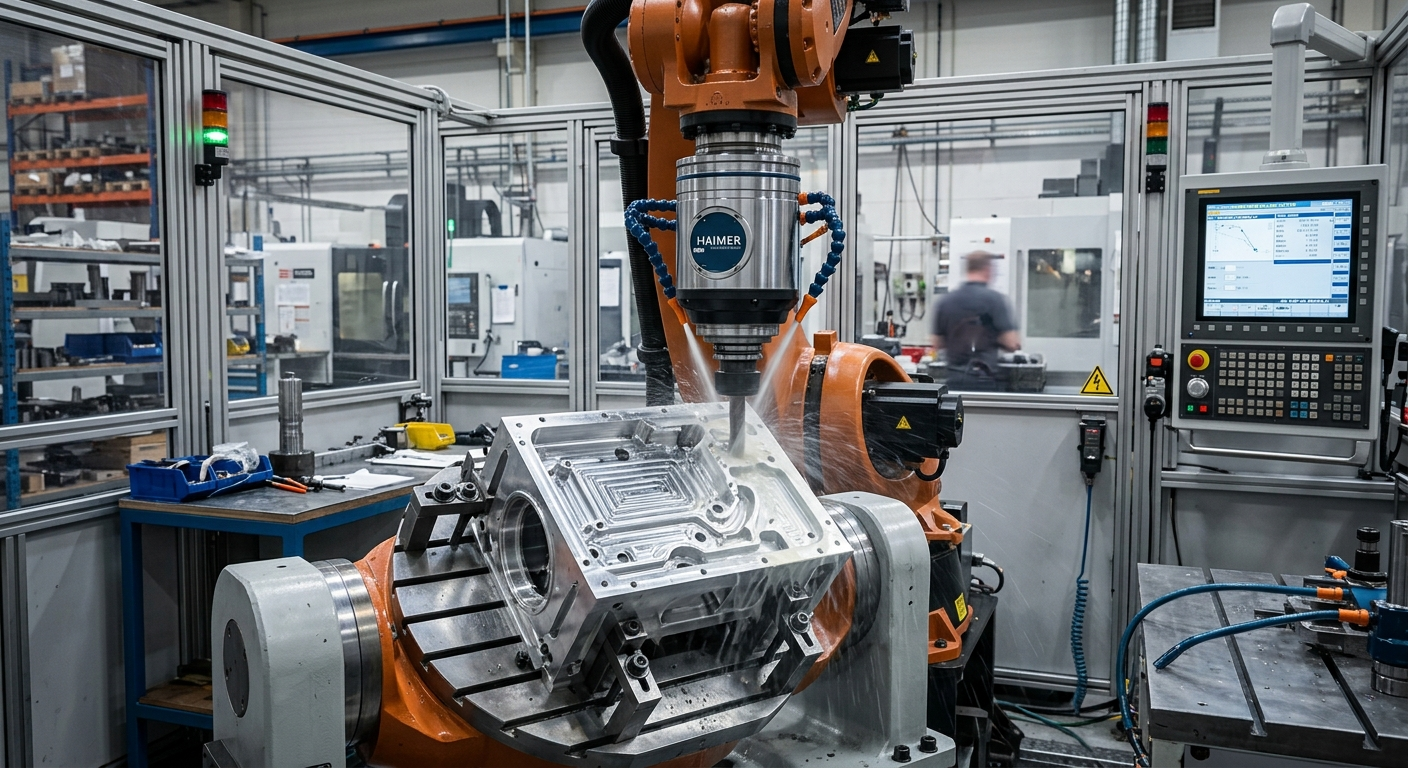

Thermal Drift Is Often a Process Problem Before It Becomes a Precision Problem
Spindle thermal drift is rarely noticed during the first few machining cycles…is rarely noticed during the first few machining cycles. As the spindle, robot structure, tooling, and surrounding environment accumulate heat, dimensional changes can gradually affect robotic milling accuracy and surface quality.
In robotic milling, thermal behavior deserves particular attention because the spindle is only one part of a larger machining system. The robot arm, spindle mount, tooling, fixtures, workpiece, and production environment all contribute to the final machining accuracy. Improving spindle performance alone cannot eliminate dimensional errors if the rest of the process experiences uncontrolled thermal expansion.
The practical question is therefore not whether thermal drift exists—it always does to some extent—but whether it remains predictable enough for the process to maintain the required tolerances throughout production.
Why High-Speed Robotic Milling Is Especially Sensitive to Thermal Drift
Control Strategies That Reduce Spindle Thermal Drift. Higher spindle speeds increase heat generation through bearings, motors, lubrication systems, and the cutting process itself. Continuous machining cycles further increase thermal loading, especially when little recovery time exists between operations.
Unlike many conventional machining centers, robotic milling systems introduce additional variables. The robot structure experiences changing loads and positions throughout the machining cycle, while the spindle experiences varying cutting forces depending on tool engagement and workpiece geometry.
The resulting thermal expansion may not occur uniformly. Small positional changes in the spindle assembly or tool holder can influence dimensional accuracy even when the robot’s programmed path remains unchanged.
Heat Sources Inside the Machining System
Several mechanisms contribute simultaneously to thermal drift:
- Motor-generated heat within the spindle.
- Bearing friction during continuous operation.
- Heat is generated at the cutting interface.
- Tool friction caused by unsuitable cutting parameters.
- Ambient temperature variation throughout production shifts.
- Heat transfer between the spindle, mounting structures, and robot flange.
The combined effect is cumulative rather than isolated, making thermal behavior difficult to evaluate by considering the spindle alone.
Production Conditions That Increase Thermal Variation
Not every robotic milling application experiences the same level of thermal instability. Several production conditions tend to increase the likelihood of measurable drift.
Long Continuous Production Runs
Extended machining cycles allow temperatures to stabilize at higher operating levels than those reached during prototype production or occasional machining. A process that appears stable during initial testing may behave differently after several hours of uninterrupted production.
Frequent Changes in Material Removal Rate
A program alternating between aggressive roughing operations and light finishing passes produces fluctuating spindle loads. These changing loads generate varying amounts of heat, making thermal behavior less predictable.
Variable Ambient Conditions
Facilities without stable environmental control may experience noticeable temperature differences between morning and afternoon production. Although these variations appear small, they can influence precision machining processes that depend on repeatable thermal conditions.
Control Strategies That Reduce Spindle Thermal Drift
Thermal drift cannot usually be eliminated completely. The objective is to reduce variability and maintain predictable operating conditions.
Maintaining consistent operating conditions helps minimize spindle thermal drift and improves machining repeatability throughout extended production runs.
Controlled Warm-Up Procedures
Many precision machining processes benefit from a structured spindle warm-up before production begins. Gradually bringing the spindle to operating temperature helps stabilize thermal expansion before machining critical components.
Stable Cutting Parameters
Frequent adjustments to spindle speed, feed rate, or engagement depth alter heat generation. Where production requirements permit, maintaining consistent cutting conditions reduces thermal fluctuations throughout the shift.
Appropriate Tool Management
Worn cutting tools increase friction, generating additional heat while reducing machining stability. Tool condition should therefore be considered part of thermal management rather than solely a tooling issue.
Environmental Temperature Control
Maintaining relatively stable workshop temperatures improves process repeatability. While perfect climate control is not always practical, minimizing large daily temperature swings reduces one source of dimensional variation.
Thermal Compensation Within Process Planning
Some machining strategies account for predictable thermal growth after the process has reached steady-state operating conditions. This approach depends on a repeatable production environment and should always be validated through production measurements rather than assumptions.
Monitoring Instead of Guessing
Monitoring spindle thermal drift over time helps separate real thermal behavior from unrelated machining instability. One of the most effective improvements comes from measuring thermal behavior instead of relying on operator perception.
Continuous monitoring of spindle thermal drift allows manufacturers to identify temperature-related trends before they affect dimensional accuracy or surface finish.
Production teams commonly monitor:
- Dimensional consistency over time.
- Spindle operating temperature trends.
- Tool wear progression.
- Surface finish consistency.
- Cycle-to-cycle variation.
- Machine stoppages associated with overheating.
Trend analysis often reveals gradual changes long before components begin falling outside specification.
When Thermal Drift Indicates a Larger Process Issue
Thermal expansion is sometimes blamed for problems originating elsewhere in the robotic cell. Poor fixturing, unstable workholding, excessive tool deflection, spindle maintenance issues, or inconsistent material presentation can all produce dimensional variation that resembles thermal drift.
For this reason, investigations should consider the complete machining system rather than focusing exclusively on spindle temperature. Evaluating robot rigidity, fixture repeatability, tooling condition, and process stability provides a more reliable diagnosis than replacing spindle components prematurely.
Similarly, robotic milling should not be expected to compensate for an unstable upstream process. If workpieces arrive with inconsistent geometry or fixtures allow movement during machining, thermal compensation alone will not restore dimensional consistency.
What to Verify Before Implementing Thermal Control Measures
Before investing in additional monitoring or compensation strategies, production teams should evaluate the overall process systematically.
- Determine whether dimensional variation follows a repeatable thermal pattern.
- Review spindle maintenance history.
- Verify tooling condition and replacement practices.
- Assess fixture rigidity and repeatability.
- Monitor ambient temperature throughout production.
- Compare results after warm-up and during steady-state operation.
- Confirm that cutting parameters remain consistent between production batches.
This structured evaluation helps distinguish genuine thermal effects from unrelated machining instability.
For additional safety context around robotic systems, see OSHA’s robotics guidance.
FAQ
Does every high-speed spindle experience thermal drift?
Yes. Every spindle generates heat during operation. The practical objective is to keep thermal expansion predictable and within acceptable process limits rather than attempting to eliminate it completely.
Can thermal drift reduce machining accuracy?
It can contribute to dimensional variation, particularly during precision machining, but overall accuracy also depends on tooling, fixturing, robot stiffness, process stability, and programming.
Should thermal compensation replace process optimization?
No. Compensation strategies are most effective after the machining process itself has been stabilized. They should not be used to compensate for inconsistent fixtures, unstable workpieces, or poor machining practices.
Is a warm-up always necessary before robotic milling?
Many precision applications benefit from controlled warm-up procedures because they help establish more consistent operating temperatures before critical machining begins. The appropriate procedure depends on the production process and equipment.
How can manufacturers reduce spindle thermal drift?
Reducing spindle thermal drift requires a combination of controlled warm-up procedures, stable cutting parameters, proper tool maintenance, and consistent environmental conditions. Monitoring thermal behavior over time also helps identify opportunities for process improvement.
Can cooling systems completely eliminate spindle thermal drift?
No. Cooling systems can significantly reduce temperature fluctuations and improve thermal stability, but they cannot eliminate thermal expansion. Effective thermal management combines cooling with stable machining parameters, proper maintenance, and process monitoring.
Does thermal drift affect tool life as well as dimensional accuracy?
Yes. As thermal conditions change, cutting forces and tool engagement may also vary, potentially increasing tool wear. Maintaining stable operating temperatures can help achieve more consistent tool performance and reduce unexpected variations in tool life.
Should thermal drift be considered when selecting a spindle for robotic milling?
Yes. Spindle selection should consider more than speed and power. Factors such as thermal stability, cooling design, duty cycle, maintenance requirements, and compatibility with the intended robotic milling process all influence long-term machining performance.
Talk to RHS About Robotic Milling Process Stability
If you are evaluating robotic milling process stability or high-speed spindle performance, contact RHS. We will give you a direct, technical answer based on your actual production requirements.