English
 Italiano
 Українська
 Русский
 Español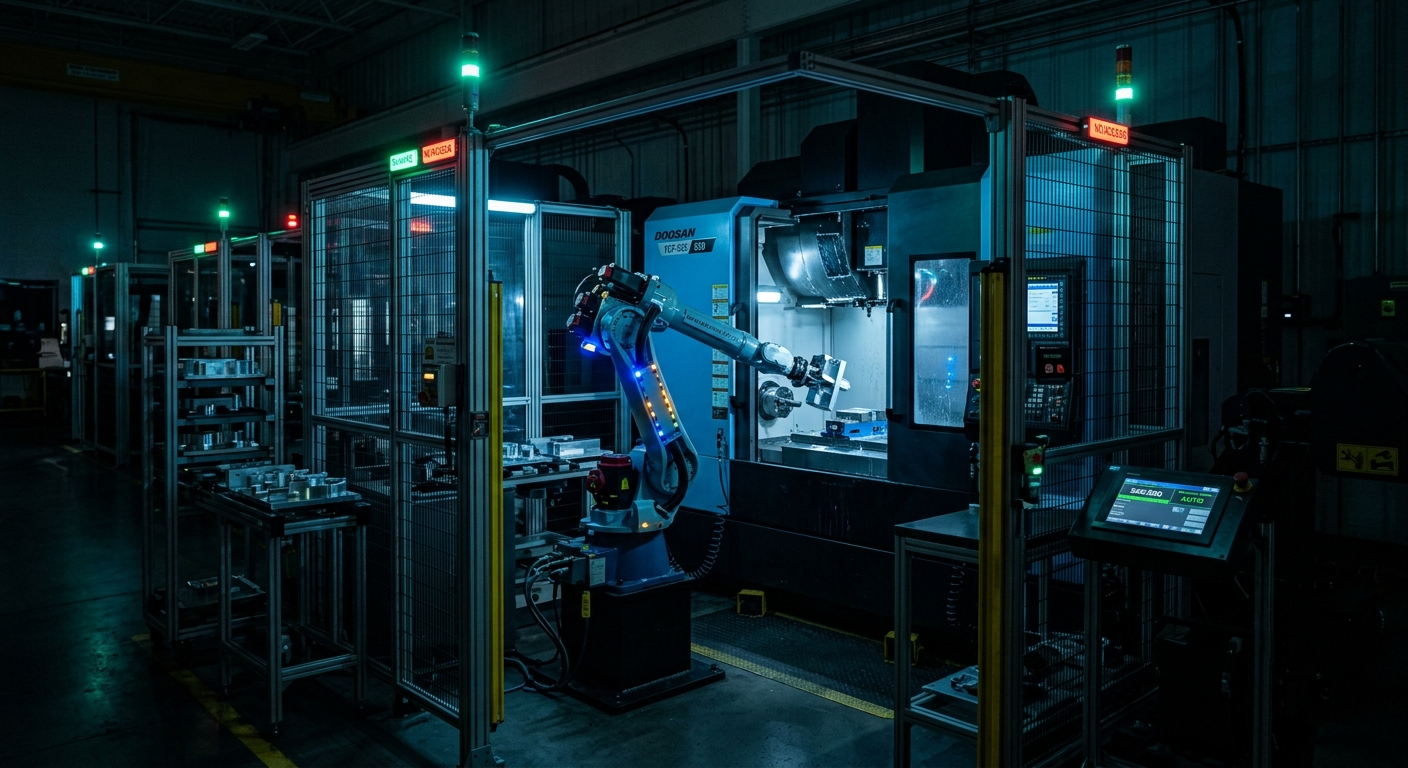

What Lights-Out CNC Automation Actually Requires
Lights-out CNC automation means operating a machining cell for a planned period without an operator continuously present at the machine. It may cover an unattended night shift, several hours between inspections, or a longer weekend production window. Reliable operation depends on more than adding a robot to load and unload the CNC machine.
A dependable system must control part presentation, workholding, tool condition, chip evacuation, coolant, inspection, alarms, and recovery from predictable faults. The machining process must already be stable because automation cannot correct inconsistent fixtures, uncertain cutting parameters, damaged tools, or variable raw material by itself.
This guide explains the main technical requirements for lights-out CNC automation, including process validation, robotic handling, tooling, monitoring, safety, and fault management. The objective is not to remove people from production completely. It is to reduce routine attendance while ensuring that operators, maintenance staff, and engineers can supervise and support the cell safely.
Unattended Does Not Mean Unsupervised
A lights-out cell still requires defined production ownership. Someone must review alarms, replace consumables, maintain equipment, verify quality results, and decide when production can restart after a failure. Remote monitoring may provide status information, but it does not replace physical inspection or authorized intervention.
Start With a Defined Unattended Window
The required autonomy should be stated in hours and parts, not described only as “24/7 production.” A cell designed for four unattended hours may need less material capacity, tool redundancy, and fault recovery than one expected to continue through an entire weekend.
Process Stability Comes Before Automation
Machining must produce acceptable parts consistently before unattended operation is introduced. Cycle time, tool life, clamping, dimensional results, chip formation, coolant delivery, and machine alarms should be recorded across representative production runs.
A process that depends on frequent manual adjustment is not ready for lights-out operation. Examples include repositioning coolant nozzles, clearing chip nests, modifying work offsets, tightening fixtures, or visually deciding when a tool should be replaced.
Validate Every Part Family Separately
One proven component does not validate every product assigned to the cell. Different materials, geometries, tools, tolerances, fixtures, and machining programs create different failure modes. Each approved part family needs documented setup conditions, expected tool consumption, inspection requirements, and alarm limits.
Automated Part Flow Must Remain Predictable
The robot or gantry must receive parts in a repeatable position, grip them securely, load them without collision, and place completed parts in a controlled location. The system also needs a reliable method for distinguishing raw parts, finished parts, rejected parts, and empty storage positions.
Part presentation may use trays, pallets, drawers, conveyors, racks, or flexible feeding equipment. The appropriate method depends on geometry, batch size, orientation requirements, available space, and the number of parts required during the unattended period.
Workholding Must Confirm Correct Loading
The CNC should not begin machining only because the robot completed its movement. Sensors, machine signals, pressure monitoring, position checks, or other validated methods should confirm that the fixture is closed and the part is seated as intended. The exact verification method depends on the machine, fixture, and risk assessment.
Tooling, Chips, and Coolant Determine Runtime
Cutting tools are a common limit on unattended duration. Tool-life values should be established from production evidence rather than catalogue values alone. Tool wear may vary with material condition, engagement, runout, chip recutting, coolant delivery, and differences between machining programs.
The CNC may use sister tools, remaining-life counters, spindle-load monitoring, probing, broken-tool detection, or automatic tool measurement. These functions should stop or redirect production when the result is uncertain instead of allowing the machine to continue producing potentially defective parts.
Control Chips Before Extending Production
Chips must leave the cutting area, fixture, machine enclosure, and conveyor without accumulating around critical surfaces. Chip nests can interfere with loading, prevent correct clamping, obstruct coolant flow, damage finished surfaces, or trigger conveyor faults.
Coolant concentration, level, temperature, filtration, pressure, and nozzle position may also affect process stability. The system needs enough coolant and waste capacity for the planned production window, together with alarms that stop the process before an unsafe or damaging condition develops.
Monitoring and Fault Recovery Need Clear Rules
Monitoring should report information that supports a decision. Useful signals may include machine state, active program, alarm code, cycle completion, robot status, tool-life warnings, part count, inspection result, coolant condition, and whether a safety device has been activated.
Remote access should be controlled according to the company’s cybersecurity and authorization policies. Viewing production status is different from resetting machinery or commanding motion. Restart authority should remain limited to trained personnel following an approved procedure.
Design Recovery Around Expected Failures
Fault recovery should begin with a list of credible stoppages. These may include a missing part, failed grip, misloaded component, tool alarm, probe failure, full output location, machine communication loss, chip conveyor fault, or interrupted utility supply.
Some conditions can be handled automatically, such as retrying a verified grip or selecting a sister tool. Others should place the cell in a controlled stop and require human inspection. Automatic retries should be limited so that the system does not repeat a harmful action indefinitely.
Safety Requirements for Lights-Out CNC Automation
Unattended operation does not reduce the need for guarding, interlocks, emergency stops, safe access procedures, risk assessment, or hazardous-energy control. The complete cell must consider the CNC machine, robot, gripper, part storage, conveyors, fixtures, auxiliary equipment, and foreseeable human interaction.
Safeguarding must protect people during normal production. Servicing, maintenance, jam clearing, tool intervention, and entry into hazardous areas may require energy-isolation procedures. OSHA explains these distinctions in its technical guidance for industrial robot systems. Applicable requirements vary by jurisdiction, equipment, and application, so the final architecture requires a project-specific risk assessment.
Safety circuits should not be treated as production-control shortcuts. A remote alarm acknowledgement, for example, must not bypass the checks required before motion resumes. After an interrupted cycle, the system should verify machine state, robot position, part status, tooling condition, and access-zone safety.
Eight Checks Before Running Unattended
Before extending production beyond attended shifts, verify the following points under realistic operating conditions:
- Process capability: Confirm that the machining process repeatedly produces acceptable parts without informal operator adjustments.
- Material capacity: Calculate how many correctly presented raw parts are available for the complete unattended window.
- Finished-part capacity: Provide enough organized storage for good parts, rejected parts, and any parts awaiting inspection.
- Tool coverage: Compare expected tool consumption with available tool life, sister tools, and automatic detection functions.
- Fixture verification: Confirm that the control system detects incomplete seating, incorrect orientation, or failed clamping.
- Chip and coolant capacity: Test conveyors, filters, tanks, extraction equipment, and alarms during extended production.
- Fault response: Document which faults can recover automatically and which require the cell to stop for inspection.
- Quality control: Define when parts are measured, how results are recorded, and what happens when a result exceeds its limit.
FAQ’s
Can Any CNC Machine Be Used for Lights-Out Production?
No. Suitability depends on machine condition, automatic interfaces, tooling capacity, chip control, process stability, alarm functions, and compatibility with the selected loading system.
Does Lights-Out CNC Automation Require a Robot?
Not always. Pallet pools, bar feeders, gantry loaders, automatic part changers, and other equipment can support unattended production. The handling method should match the part and process.
How Long Should the First Unattended Run Be?
Begin with a controlled period supported by validated tests. Extend the duration only after reviewing stops, tool wear, quality results, chip accumulation, consumable use, and recovery performance.
Can Machine Vision Guarantee Correct Loading?
No. Vision can verify defined features or positions, but reliability depends on lighting, calibration, part presentation, contamination, software logic, and the limits of the inspection task.
Should Every Alarm Send a Remote Notification?
Not necessarily. Notifications should be prioritized so that production-stopping, safety-related, quality-related, and maintenance alarms can be distinguished from routine status messages.
Can Operators Restart the Cell Remotely?
Only when the system design, risk assessment, company procedures, and applicable requirements permit it. Many faults require physical inspection before a safe restart can be authorized.
How Is Part Quality Controlled During Unattended Machining?
Quality may be supported by probing, tool measurement, in-process checks, post-process inspection, statistical review, and controlled sampling. The method must match the tolerance and failure risk.
Does Lights-Out Production Always Reduce Manufacturing Cost?
No. Financial results depend on demand, good-part output, installed cost, maintenance, tooling, staffing, downtime, and utilization. The analysis of robot ROI in a CNC milling cell explains why the complete cell must be evaluated rather than the robot alone.
Plan Lights-Out CNC Automation as a Complete System
Reliable lights-out CNC automation is achieved by removing uncertainty from the complete production sequence. The machine must cut consistently, the handling system must present and transfer parts correctly, and the control architecture must detect conditions that could affect safety, equipment, or quality.
The strongest implementation path is progressive. Validate the process while attended, test every automatic function, simulate faults, run limited unattended periods, and extend the production window only when recorded results support the change.
Manufacturers evaluating robotic machine tending, automated machining, or a complete unattended cell can contact Robotic Hi-Tech Solutions to discuss the application, production requirements, equipment interfaces, and integration scope.