English
 Italiano
 Українська
 Русский
 Español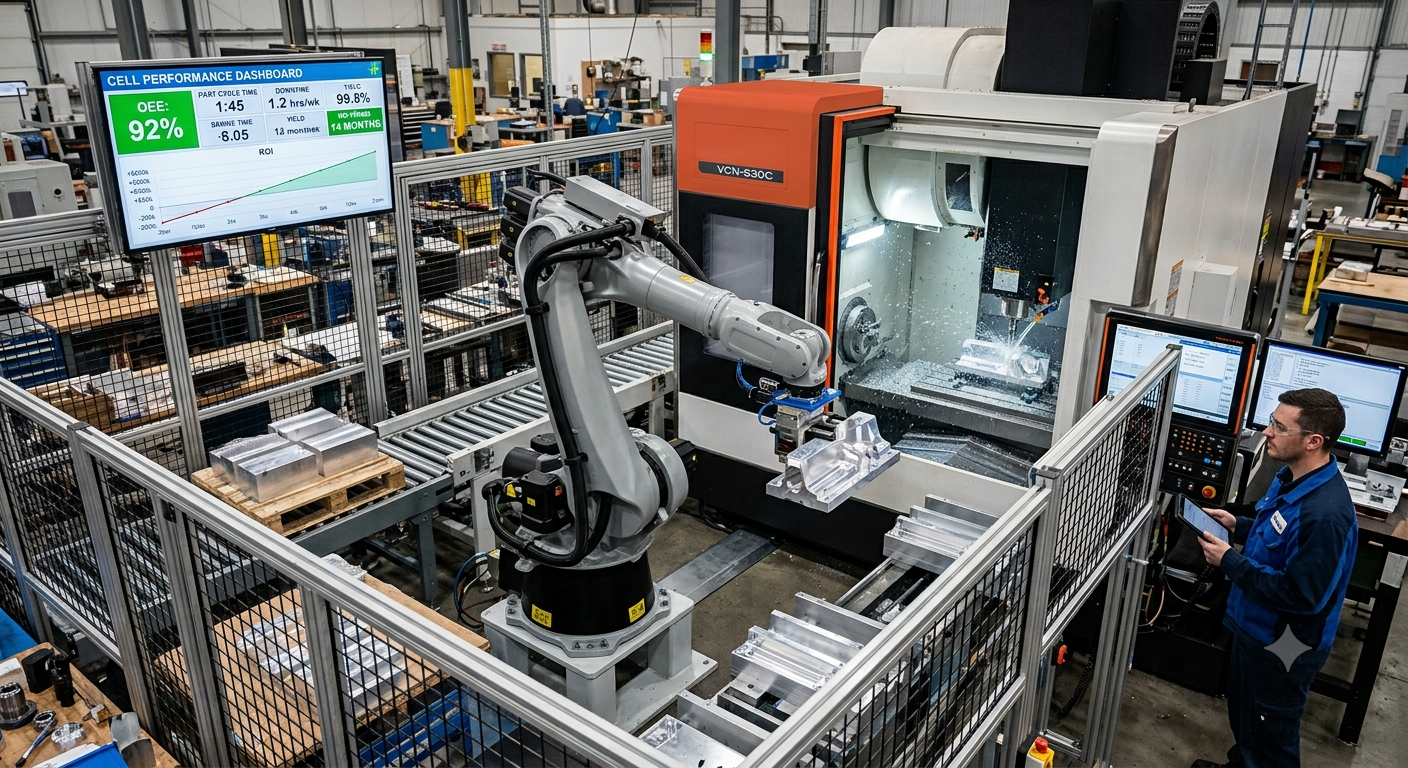

Robot ROI in a CNC milling cell depends on much more than the number of operator hours that automation can remove. Labor costs, spindle utilization, unattended production, scrap, changeovers, maintenance, and good-part output all influence the financial result. A low-cost robot that frequently leaves the CNC waiting may produce a weaker return than a properly integrated cell with a higher initial investment.
Robot ROI in a CNC milling cell must therefore be calculated at the cell level. Include the robot, gripper, guarding, part presentation, software, integration, commissioning, training, and process changes. After installation, measure productive hours gained, labor reassigned, and quality achieved.
This guide explains how to calculate robotic CNC cell ROI, estimate payback, and use Overall Equipment Effectiveness, or OEE, to verify results. The aim is to determine when the numbers support automation and which losses could prevent the cell from reaching its target.
What Robot ROI in a CNC Milling Cell Really Measures
ROI Is Based on Net Annual Benefit
Return on investment compares annual net benefit with total capital invested: ROI = annual net benefit ÷ total project cost × 100. If a complete cell costs €250,000 and generates €75,000 in verified annual benefit, the simple annual ROI is 30%. The result is useful only when its assumptions are documented.
Annual benefit may include labor savings, extra machine hours, lower overtime, fewer handling errors, and reduced work-in-process. Value additional output through contribution margin, not full sales revenue, because variable costs still apply.
The Complete Cell Defines the Investment
The investment base should cover everything required for stable production: robot, controller, tooling, guarding, fixtures, feeding, vision, interfaces, programming, installation, validation, and training. Omitting these costs distorts ROI.
Build the Business Case From the Current Process
Start With a Measured Baseline
Record the current process across representative periods. Include planned time, CNC run time, handling, changeovers, operator attendance, scrap, rework, stoppages, and output by part number. One strong shift is not a reliable baseline.
Separate operator time from machine time. If one operator already supports several machines, counting a full position as savings will overstate the return. The real benefit may be avoided hiring, lower overtime, or reassignment.
A review of robotic milling cell design can reveal utilization factors such as reach, fixture access, simulation, and validation. These determine whether the cell can sustain production.
How to Calculate the Payback Period
Simple Payback Uses Net Cash Benefit
Simple payback estimates the recovery time: payback period = total project cost ÷ annual net cash benefit. A €250,000 cell generating €75,000 per year has a simple payback of 3.33 years. The method is easy to explain, but it ignores financing cost, taxes, residual value, and the time value of money.
When evaluating robot ROI in a CNC milling cell over several years, the finance team should also review discounted cash flow, net present value, and internal rate of return. These methods account for the timing of future benefits more accurately than simple payback alone.
Test payback under conservative, expected, and high-utilization cases. If the project works only in the optimistic case, revise the design or assumptions.
Why OEE Matters More Than Robot Cycle Time
OEE Combines Three Production Factors
According to the standard OEE calculation methodology, OEE is calculated as Availability × Performance × Quality. Availability measures how much planned production time the cell runs. Performance compares actual production speed with the ideal rate, while Quality measures the proportion of good parts. Fast robot handling cannot compensate for frequent stops, slow machining, or rework. OEE is calculated as Availability × Performance × Quality. Availability measures how much planned time the cell runs. Performance compares actual speed with the ideal rate. Quality measures the proportion of good parts. Fast robot handling cannot compensate for frequent stops, slow machining, or rework.
A cell with 90% availability, 92% performance, and 98% quality has an OEE of about 81.1%. This is more informative than robot cycle time because it combines downtime, speed loss, and defects. It also shows whether the main loss is mechanical, operational, or process-related.
Measure the Entire Production Boundary
If the robot, CNC, fixture, feeder, and inspection station operate as one dependent system, measuring only the CNC may hide losses elsewhere. Use the same definitions of planned production time, ideal cycle, and good count before and after automation.
OEE is not a universal target. High-mix work, prototypes, long setups, and low demand can reduce it even when the cell remains profitable. Use it to identify losses and verify improvement.
Include Costs That Are Commonly Missed
Operating Costs Change After Installation
Automation can reduce labor per part, but it adds maintenance, spare grippers, software, utilities, calibration, fixture wear, and engineering time. Tooling costs may also rise during unattended production.
A realistic calculation of robot ROI in a CNC milling cell must include ramp-up losses. Output may remain below target while gripping, feeding, programs, and fault recovery are refined. Assuming full performance from the first day shortens the estimated payback artificially.
Downtime risk also changes. A failed feeder, gripper, safety device, or communication interface can stop the whole cell. Spare-parts strategy and recovery procedures, therefore, affect both OEE and financial return.
Eight Inputs Required for a Credible ROI Model
A useful model should use measured production data and confirmed project costs. At minimum, include:
- Total installed cost, including integration and commissioning.
- Annual planned production hours and realistic demand.
- Current and projected direct labor hours per part.
- Expected unattended hours by shift or weekend.
- Current and projected cycle time, including handling.
- Scrap, rework, inspection, and quality costs.
- Maintenance, tooling, utilities, and support costs.
- Ramp-up, downtime, and residual-value assumptions.
Assign every input an owner and source. Production validates cycle data, engineering confirms technical assumptions, finance approves cost treatment, and operations verifies staffing changes.
A Practical Robot ROI in a CNC Milling Cell Example
Compare Annual Benefit With Installed Cost
To calculate robot ROI in a CNC milling cell, consider a project with an installed automation cost of €220,000. The system is expected to avoid €42,000 in annual labor and overtime, generate €38,000 in contribution from additional spindle hours, and reduce scrap and handling losses by €9,000. New maintenance, software, and utility costs total €11,000.
The annual net benefit is €78,000. Simple ROI is about 35.5%, and simple payback is about 2.82 years. These results still depend on demand, availability, quality, staffing, and the cell reaching its planned rate.
Suppose target OEE is 78%, based on 88% availability, 91% performance, and 97% quality. If actual OEE stabilizes at 65%, the expected capacity may not appear. Door faults, slow part presentation, tool alarms, and long restart procedures can reduce output even when the robot is reliable.
Link the financial model to measurable acceptance criteria: handling time, availability, good-part rate, unattended duration, changeover time, and fault recovery. The decision then rests on operating evidence.
FAQ’s
What Is a Good Payback Period for a CNC Robot?
There is no universal threshold. Manufacturers set limits according to capital cost, risk, demand stability, and financing. A longer project may still be justified when it solves labor, safety, capacity, or quality constraints.
Should Labor Savings Include a Full Operator Salary?
Only when the cost is genuinely removed or avoided. If the operator is reassigned, count the value created by that reassignment. Otherwise, ROI can be overstated.
Can Higher OEE Guarantee Higher Profit?
No. OEE measures productive use of planned time, not demand or margin. Interpret it together with contribution margin, lead time, inventory, and operating cost.
How Often Should Robotic Cell OEE Be Reviewed?
Review it daily or by shift during ramp-up. After stabilization, weekly and monthly reviews are usually sufficient, provided detailed loss data remains available.
When Is a Robot a Poor CNC Milling Investment?
Automation may be unsuitable when demand is too low, parts cannot be presented consistently, changeovers dominate production, tolerances exceed cell capability, or the machining process is unstable.
Use ROI, Payback, and OEE as One Decision System
Robot ROI in a CNC milling cell is determined by the number of good parts produced at a sustainable cost, not by robot speed alone. Build the model from the complete installed cost, realistic financial benefits, ramp-up losses, and continuing operating expenses. Then connect the forecast to OEE and measurable acceptance criteria. For a project-specific assessment, contact Robotic Hi-Tech Solutions.