English
 Italiano
 Українська
 Русский
 Español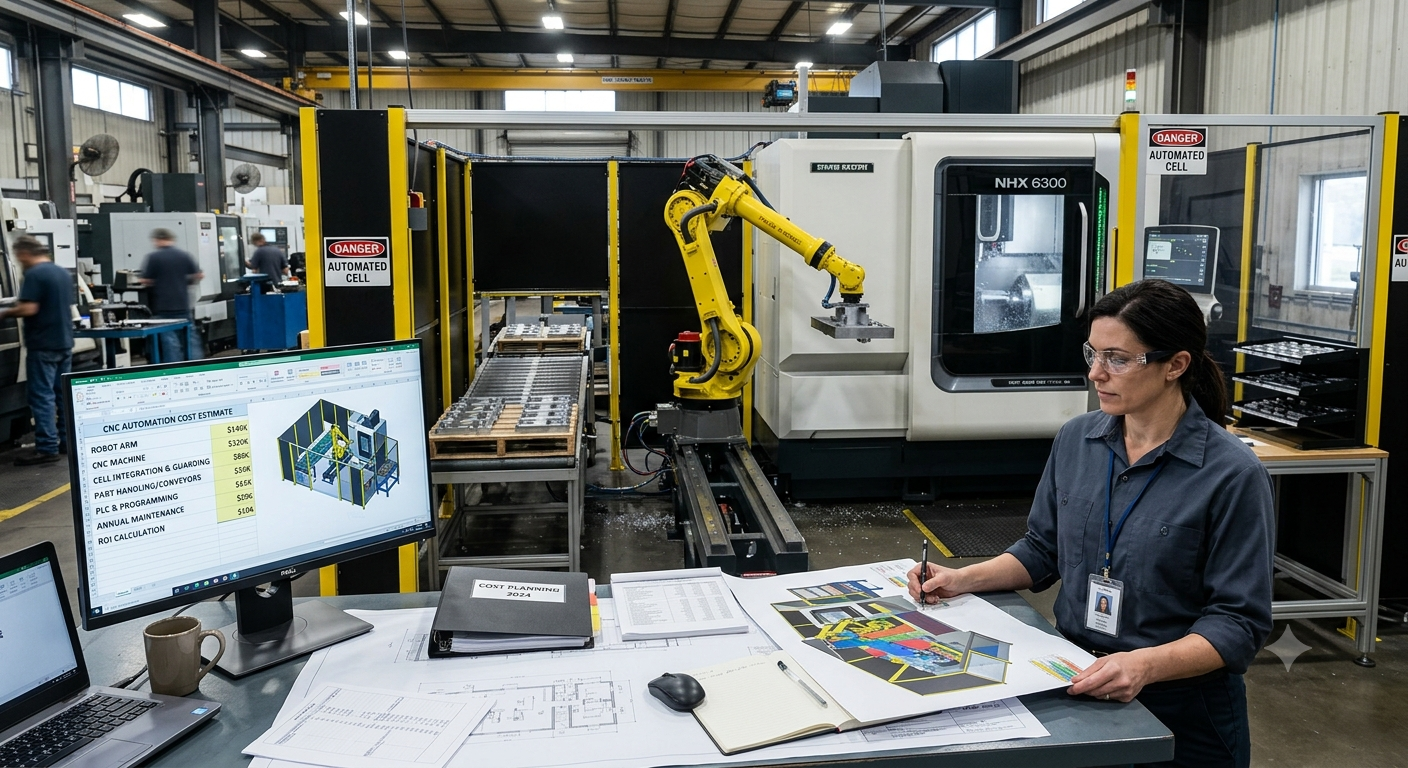

What CNC Automation Cost Really Includes
CNC automation cost is the total amount required to turn a machining process into a stable, safe, and supportable production system. It is not simply the purchase price of a robot, CNC machine, loader, or pallet system. The real budget includes hardware, engineering, tooling, safety, software, installation, validation, training, and the operating changes needed after launch.
This article explains how to divide that budget into practical cost groups, identify commonly omitted items, compare alternative cell concepts, and build a quotation that finance and engineering can evaluate together. It does not provide a universal price because cell cost depends on the process, workpiece, production volume, required autonomy, existing equipment, and site conditions.
A credible budget begins with a defined production requirement. The company must know which parts will run, how they will be presented, which operations will remain manual, how long the cell must operate unattended, and what acceptance criteria will prove that the system works.
Why Equipment Price Is Only the Starting Point
Core Production Equipment
The visible equipment usually includes the CNC machine, industrial robot or gantry loader, controller, gripper, part storage, fixtures, and any inspection or marking station. A project using an existing CNC machine may reduce capital expenditure, but compatibility, available interfaces, door automation, and machine condition still require verification.
Supporting hardware can include guarding, safety doors, light curtains, scanners, conveyors, pallets, blow-off devices, chip management, coolant handling, electrical cabinets, and network components. These items support reliable cell operation.
Engineering and Integration Costs
Engineering and integration can account for a significant part of the CNC automation cost because the cell must operate as one coordinated production system.
Mechanical and Electrical Design
Mechanical engineering defines the layout, reach, access, gripper arrangement, fixture interfaces, service zones, and maintenance access. Electrical engineering covers power distribution, control panels, safety circuits, field devices, and communication between the automation equipment and the CNC.
Controls, Software, and Communication
Controls work may include PLC programming, robot programming, CNC interface logic, HMI development, alarms, recipes, data exchange, and recovery sequences. The budget should also identify required software licenses, post-processors, simulation tools, database connections, and future license renewals.
Integration cost rises when the cell must handle many part variants, automatic tool or gripper changes, inspection feedback, production scheduling, or traceability. Price complexity through defined functions rather than an undefined engineering allowance.
Tooling, Workholding, and Part Presentation
Grippers and Fixtures
A robot can move accurately and still fail to load a part consistently if the gripper, fixture, or datum strategy is unsuitable. Budget items may include gripper fingers, quick-change devices, fixture plates, locating elements, clamps, sensors, and spare wear components.
Part presentation can use trays, drawers, pallets, conveyors, bins, or operator-loaded stations. The correct method depends on geometry, orientation, surface sensitivity, batch size, and the required unattended period. Randomly oriented parts may require vision or additional feeding equipment.
Tooling should be evaluated across the expected product mix. A cell that works for one reference may need additional fingers, nests, programs, and storage capacity before it can process the full family of parts.
Safety, Compliance, and Site Preparation
Risk Reduction Measures
Industrial automation projects should include a risk assessment based on the machinery, tasks, hazards, access points, and applicable regulations. The ISO 12100 machinery risk assessment principles provide a recognized framework for identifying hazards, evaluating risks, and planning appropriate risk-reduction measures. The budget can also include protective fencing, interlocked access, safe motion functions, emergency stops, enabling devices, signage, validation, and documentation.
Site preparation may include foundations, floor repairs, lifting access, electrical supply, compressed air, extraction, coolant services, drainage, network connections, lighting, and relocation of nearby equipment. Accurate site information helps control these costs before the final quotation.
Installation can also affect production. Planned shutdowns, temporary manual processes, weekend work, transport restrictions, and access permits should be included when they create real project expense or operational risk.
Commissioning, Validation, and Ramp-Up
From Factory Test to Production Acceptance
Commissioning covers installation checks, communication tests, robot mastering where required, safety validation, program debugging, dry cycles, loaded trials, and production testing. Factory acceptance and site acceptance should use agreed criteria rather than a general statement that the cell is operational.
Acceptance criteria may include cycle time, changeover time, good-part output, loading consistency, fault recovery, unattended duration, and repeatability across representative parts. Measuring only the robot movement time can hide delays in machining, clamping, inspection, or material supply.
Ramp-up should have its own budget and schedule. During this period, programs, gripping, alarms, maintenance routines, and operator procedures may need adjustment before stable production.
A complete CNC automation cost estimate should connect every budget item to a defined technical or production requirement.
Eight Budget Checks Before Approving a CNC Cell
- Define the production scope: List part families, annual demand, batch sizes, machining routes, materials, and required changeovers.
- Confirm the automation boundary: State which loading, inspection, cleaning, marking, and material movements are included or remain manual.
- Separate equipment from integration: Identify hardware prices independently from design, programming, installation, and commissioning.
- Verify CNC interfaces: Confirm door control, chuck or fixture signals, cycle start, program selection, alarms, and safe communication.
- Price tooling by part family: Include grippers, fingers, fixtures, nests, sensors, change devices, and expected spare components.
- Include site work: Check power, air, floor loading, extraction, coolant, network access, transport routes, and shutdown requirements.
- Budget validation and training: Define acceptance trials, documentation, operator instruction, maintenance instruction, and recovery practice.
- Model continuing costs: Include maintenance, software, utilities, consumables, tooling wear, technical support, and future product changes.
How to Compare Quotations and Financial Impact
Compare the Same Technical Scope
Two quotations are comparable only when they cover the same production boundary and acceptance conditions. A lower offer may exclude fixtures, safety validation, programming for all parts, site installation, training, spares, or production support. Each exclusion should be assigned a cost owner before approval.
For a complementary financial view, the article on robot ROI in a CNC milling cell explains why payback should be calculated from complete installed cost, verified annual benefit, and actual cell performance rather than robot speed alone.
Separate Capital Cost From Operating Cost
Capital cost covers the assets and project work needed to install the cell. Operating cost includes maintenance, utilities, software, consumables, tooling, calibration, technical support, and labor that remains after automation. Finance may also need to evaluate depreciation, financing, tax treatment, and residual value under the company’s own accounting rules.
The business case should test several production scenarios. Demand, staffing, scrap, cycle time, uptime, and unattended operation can differ from the initial estimate. Conservative assumptions make it easier to see whether the project remains acceptable when performance is below the target case.
CNC automation cost becomes more predictable when the project is defined as a production system rather than an equipment purchase. The budget should connect every technical function to a required result, identify exclusions, and distinguish one-time capital expenditures from recurring operating costs.
Before approval, engineering, production, maintenance, safety, and finance should review the same scope. Their combined review can expose missing interfaces, unrealistic staffing assumptions, unsupported cycle targets, and costs that would otherwise appear after installation.
When comparing proposals, the CNC automation cost should be evaluated against the same scope, production assumptions, and acceptance criteria.
Manufacturers preparing a specific machining-cell project can contact Robotic Hi-Tech Solutions to discuss the workpiece, process, automation boundary, and integration requirements needed for a project-specific assessment.
Frequently Asked Questions
Can CNC Automation Cost Be Estimated From the Robot’s Price?
No. The robot price does not include the full cell, tooling, safety equipment, software, integration, commissioning, site work, or continuing operating expenses.
Is Automating an Existing CNC Machine Always Cheaper?
Not always. Reusing a machine can reduce equipment purchases, but interface limitations, door modifications, reliability issues, or missing signals may increase engineering and retrofit work.
Which Cost Is Most Often Missed?
There is no single cost missed in every project. Common omissions include part presentation, fixture changes, site preparation, ramp-up support, spare tooling, training, and production disruption.
Should Training Be Included in the Initial Budget?
Yes. Operators and maintenance personnel need instruction on normal operation, changeovers, alarms, recovery, inspection, and preventive maintenance appropriate to their responsibilities.
How Should a Company Request a Reliable Quotation?
Provide representative parts, process data, required output, current cycle information, layout constraints, utility details, operating shifts, safety expectations, and clear acceptance criteria.