English
 Italiano
 Українська
 Русский
 Español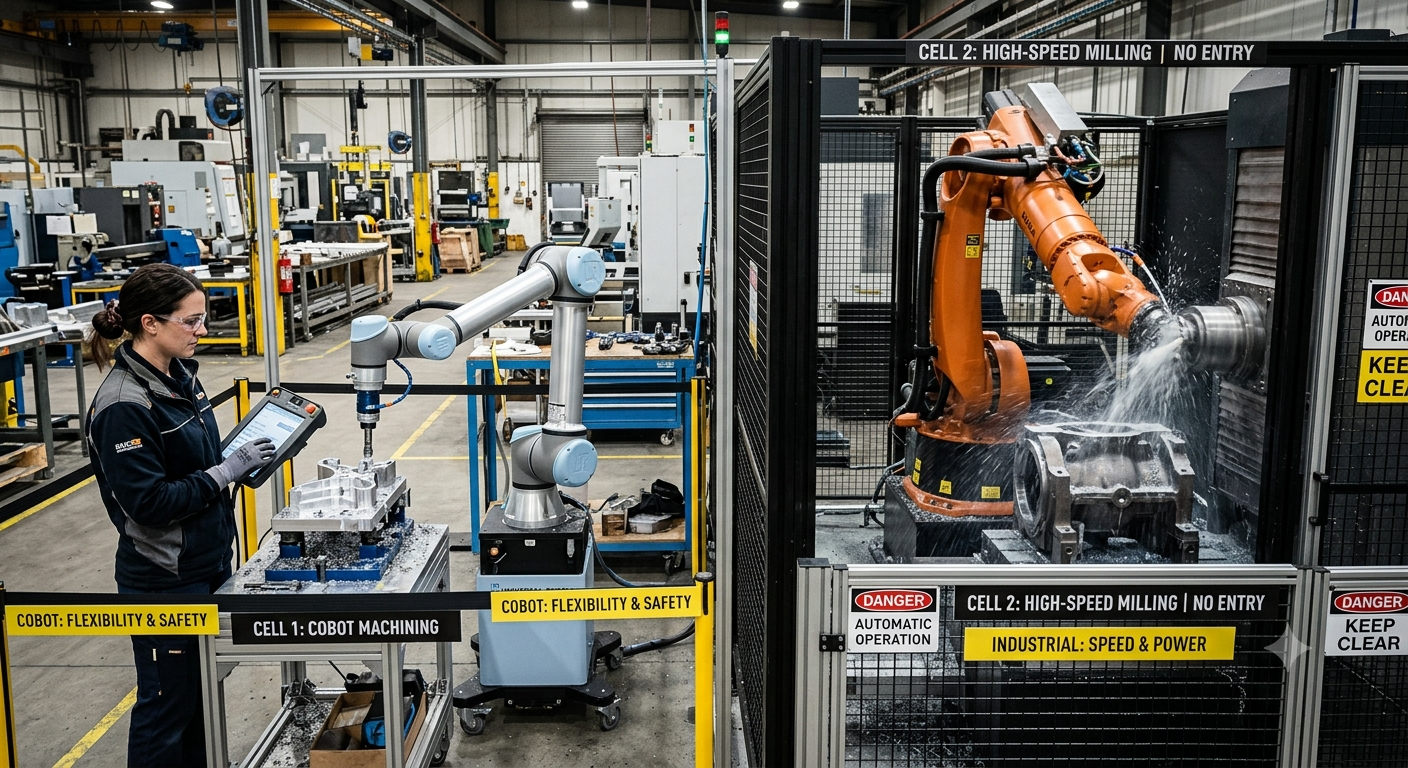

Cobots vs. industrial robots is not simply a choice between a safer robot and a more powerful one. Both can carry a spindle, trimming tool, drill, deburring tool, or workpiece, but their practical performance depends on the complete system. Robot structure, payload, reach, spindle, tooling, fixture, cutting conditions, calibration, programming, and safety design.
For light cutting, finishing, drilling, deburring, or machine tending, a collaborative robot may provide useful flexibility and easier operator access. For sustained milling, larger tools, greater cutting forces, long reach, or demanding production cycles, a conventional industrial robot is usually the stronger starting point.
This article explains what each type can realistically do, where its limitations appear, and how to compare them without relying on product labels. The correct decision comes from validating the machining process and the complete cell rather than selecting a robot only because it is described as collaborative or industrial.
Cobots vs Industrial Robots: The Core Machining Differences
Collaborative capability describes an application
A cobot is designed with functions that can support collaborative applications, such as monitored stopping, speed and separation monitoring, hand guiding, or power and force limiting. However, safe collaboration is not guaranteed by the robot alone. The tool, workpiece, programmed movement, foreseeable contact, and surrounding process must also be evaluated.
Industrial robots prioritize production capability
Conventional industrial robots are generally selected when an application requires greater payload, longer reach, faster movement, or a structure suited to heavier process loads. They normally operate inside an engineered safeguarded cell, although the necessary protective measures depend on the application risk assessment.
What Machining Tasks Can a Cobot Perform?
The practical comparison between cobots vs industrial robots becomes clearer when the cutting forces, tooling weight, reach, and required production rate are defined.
Light material removal and finishing
Cobots can be suitable for deburring, sanding, polishing, edge finishing, light routing, drilling, and trimming when process forces remain within the limits of the robot and tooling. They can also move a component against a fixed tool, reducing the equipment carried at the wrist.
The main question is not whether the robot can follow a programmed path. It is whether the arm can maintain that path while cutting forces, vibration, wrist loading, and changing tool orientations affect the system.
A successful demonstration on foam, plastic, or a lightly engaged tool does not prove that the same system can machine harder materials, use larger tools, or maintain the required surface quality under heavier cutting conditions.
What Machining Tasks Favor an Industrial Robot?
Higher-load and large-format operations
Industrial robots are generally better suited to large-format milling, heavier roughing, composite trimming with demanding production rates, stone or wood machining, and applications that require a larger spindle or extended reach.
They can also be integrated with rotary positioners or linear tracks when the workpiece exceeds the robot’s normal working envelope. These external axes can improve access, but they also increase calibration, programming, synchronization, and safety requirements.
An industrial robot is still not equivalent to a CNC machining center. An articulated arm changes stiffness across its workspace, so machining performance can vary with robot pose, reach, tool direction, joint configuration, and cutting load.
Why Rigidity and Cutting Force Matter
Robot compliance affects the tool path
Machining produces forces that can deflect the robot, spindle mount, tool, fixture, or workpiece. Deflection may appear as dimensional error, vibration, visible tool marks, excessive tool wear, or inconsistent edge quality.
When comparing cobots vs industrial robots, structural stiffness must be evaluated throughout the entire toolpath rather than at one favorable robot position.
A cobot may complete a low-force operation successfully but lose process stability when tool engagement increases. An industrial robot may tolerate greater loads, but it can still vibrate if the tool is too long, the fixture is weak, or the arm operates in an unfavorable position.
The machining trial must therefore reproduce the intended material, cutting direction, tool engagement, spindle configuration, robot poses, and quality requirements. A no-load movement test cannot confirm machining performance.
How Payload, Reach, and Speed Affect the Process
Payload calculations must include more than the spindle. Engineers should account for the spindle mount, tool holder, cutting tool, cables, extraction hose, sensors, and the distance between the load’s center of gravity and the robot flange.
Wrist torque and inertia limits may become restrictive before the robot reaches its published payload limit. A spindle that appears acceptable by mass alone may still impose an unsuitable load because of its length or mounting position.
Reach also requires careful interpretation. A long reach provides access to larger parts, but extended arm positions may reduce structural stiffness. Similarly, high available robot speed does not mean the machining operation should run at that speed.
Actual cutting speed must be selected according to the material, tool, spindle, fixture, robot response, surface requirements, and safety system. In collaborative operation, safety functions may impose additional speed or separation restrictions.
Safety Changes When a Machining Tool Is Added
Machining introduces hazards that do not disappear because the robot supports collaborative functions. Rotating cutters, sharp tools, chips, dust, broken tools, noise, hot surfaces, workpiece ejection, and unexpected movement may require guarding, extraction, interlocks, safe stopping functions, or controlled access.
The safety assessment for cobots vs industrial robots must include the rotating tool, workpiece, chips, dust, fixtures, and every operating mode of the machining cell.
The ISO 10218-1 industrial robot safety standard addresses safety requirements for industrial robots. Integration and application hazards must still be evaluated at the system level, including hazards created by machining equipment and tooling.
The risk assessment should cover automatic production, loading, setup, tool changes, teaching, cleaning, maintenance, fault recovery, and reasonably foreseeable misuse. These operating modes may expose workers to different hazards.
A cobot used for machining may therefore require a guarded enclosure. In other cases, controlled human access may be possible when hazards have been reduced and the selected collaborative application has been properly validated.
Eight Checks Before Selecting a Machining Robot
When evaluating cobots vs industrial robots for a machining project, use the following checks to compare both options against the real process:
- Define the material and operation: specify whether the process involves trimming, drilling, deburring, sanding, roughing, or finishing because each produces different forces and hazards.
- Calculate the complete wrist load: include the spindle, bracket, tool holder, cutting tool, cables, extraction equipment, sensors, center-of-gravity offset, and rotational inertia.
- Test representative cutting forces: reproduce the intended tool engagement, feed direction, tool diameter, cutting depth, and material instead of testing only free-space movement.
- Check stiffness throughout the path: examine extended positions, wrist reversals, singularities, joint changes, and areas where robot deflection may increase.
- Define measurable quality targets: establish acceptable dimensions, surface condition, burr level, edge quality, and process consistency for the actual component.
- Validate the complete cycle time: include cutting, approach movements, tool changes, extraction delays, loading, inspection, and safety-related speed reductions.
- Assess every operating mode: evaluate production, setup, teaching, cleaning, maintenance, troubleshooting, and access to tools and fixtures.
- Run a representative machining trial: use the intended material, tooling, spindle, fixture, robot positions, and difficult part features before approving the architecture.
How to Choose the Right Cell Architecture
Comparing cobots vs industrial robots requires examining the actual machining load, required reach, production cycle, access conditions, and safety architecture.
A cobot-based cell may be appropriate when the operation is light, the work area is compact, frequent changeovers are required, and operators need regular access. It may also suit laboratories, prototyping, low-volume finishing, or processes where the robot handles the component rather than carrying a heavy spindle.
An industrial robot is usually more appropriate when the process requires sustained material removal, larger tools, broad reach, external axes, or demanding production cycles. The article about combining roughing and finishing in one robotic milling cell provides related information about spindle selection, fixtures, calibration, simulation, tooling, and external-axis planning.
Neither architecture should be approved from a robot data sheet alone. A suitable concept must connect the robot, spindle, process forces, part geometry, fixture, CAM strategy, extraction equipment, and safety measures to measurable production requirements.
Choosing between cobots vs industrial robots also requires checking whether the planned tooling, workspace, and operator access remain practical during normal production and maintenance.
The final decision between cobots vs industrial robots should be based on representative machining tests, process forces, required quality, cycle time, and the safety design of the complete cell.
FAQ’s
Can a cobot mill metal?
A cobot may perform limited, low-force metal cutting under suitable conditions. Feasibility depends on the material, spindle, tool engagement, robot stiffness, fixture, cutting direction, and required part quality.
Are cobots accurate enough for machining?
They may be accurate enough for some processes, but robot accuracy alone does not determine part accuracy. Calibration, compliance, cutting forces, tool runout, fixture stability, and robot pose also affect the result.
Does a cobot eliminate the need for guarding?
No. The cutting tool and machining process may create hazards that require an enclosure, interlocks, extraction, or controlled access even when the robot includes collaborative safety functions.
Are industrial robots always faster than cobots?
Not in every application. Available robot speed may be higher, but actual cycle time also depends on cutting conditions, toolpaths, loading, inspection, tool changes, and safety controls.
Which robot is better for composite trimming?
Either may be suitable. Light trimming with moderate forces may fit a cobot, while larger parts, heavier tooling, longer reach, or demanding throughput may favor an industrial robot.
Can the same CAM software program both robot types?
Some robot-oriented CAM and offline programming systems support multiple brands and robot models. Compatibility with the controller, post-processor, external axes, and complete cell configuration must be confirmed.
Is robot repeatability the same as machining accuracy?
No. Repeatability describes how consistently a robot returns to a position under specified conditions. Machining accuracy also depends on calibration, load, process forces, tooling, fixtures, trajectories, and measurement methods.
How should a manufacturer make the final choice?
Start with the material, part geometry, quality requirement, cycle time, process forces, access needs, and safety assessment. Manufacturers can contact Robotic Hi-Tech Solutions to discuss a feasibility review using representative part and process information.