English
 Italiano
 Українська
 Русский
 Español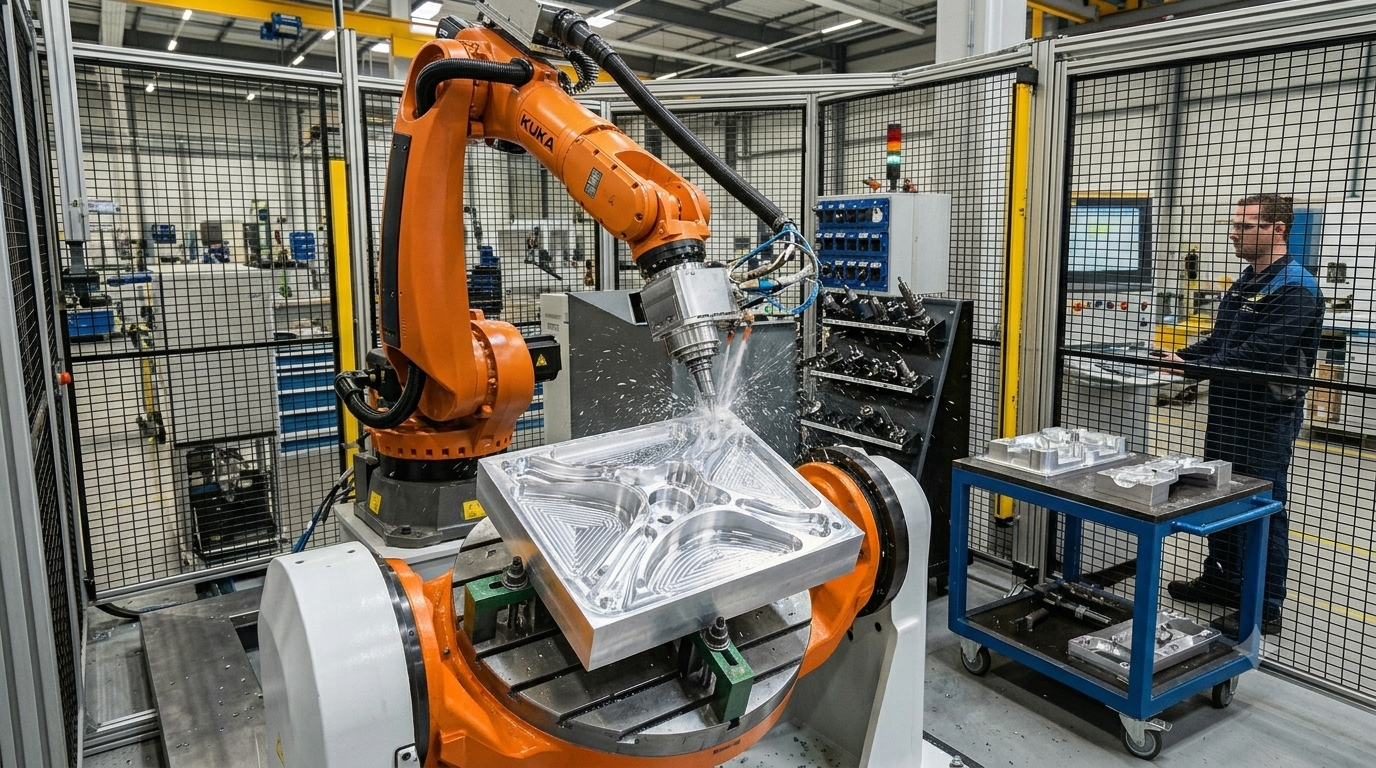

Repeatability Is Often the Real Question, Not Whether the Robot Can Machine the Part
The challenge in robotic machining of custom geometries is rarely whether a robot can physically reach the workpiece or follow a programmed path. The more important question is whether the system can repeat that path consistently enough to meet dimensional, surface finish, and process requirements over hundreds or thousands of cycles.
This is where many machining automation projects become more complex than expected. A custom geometry may be machined successfully during a proof-of-concept trial, yet struggle during production because repeatability was evaluated only at the robot level rather than across the entire machining cell.
The focus of robotic machining repeatability should therefore extend beyond the robot arm itself. Fixture stability, tool wear, spindle behavior, thermal effects, calibration procedures, workpiece variation, and programming strategy all influence whether the same result can be achieved repeatedly.
For manufacturers evaluating robotic machining, the key decision is not whether a robot can machine a custom part once. The decision is whether the entire process can produce acceptable results consistently under real production conditions.
Why Custom Geometries Create Unique Repeatability Challenges
Custom geometries introduce variability that standardized machining operations often avoid. Complex contours, free-form surfaces, deep cavities, and multi-angle features require the robot to maintain consistent positioning throughout a wider range of motion.
As the robot moves through different orientations, structural compliance can influence machining behavior. The same cutting force applied in one area of the work envelope may produce a different result in another area because the robot’s mechanical stiffness changes depending on arm position.
This does not automatically make robotic machining unsuitable. However, it means repeatability validation must occur across the full machining path rather than at a single reference point.
In many applications, acceptable results depend on understanding where geometric complexity introduces risk and whether the machining process can tolerate that variation.
Repeatability Must Be Evaluated at the Cell Level
A common mistake is treating robot repeatability as the sole indicator of machining performance. In reality, machining quality is determined by the interaction of multiple systems.
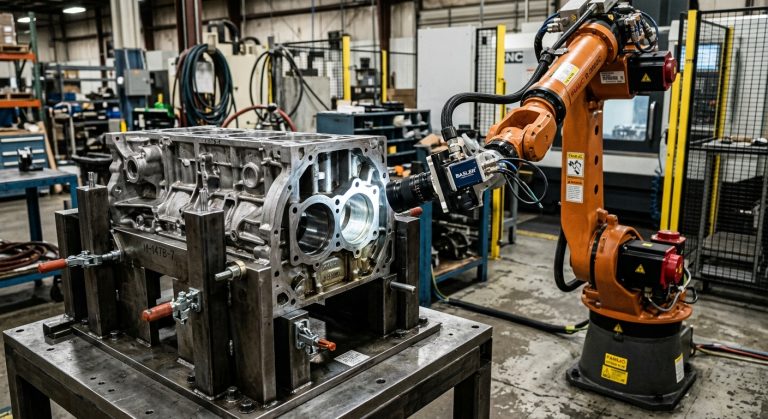
The robot provides positioning capability, but the fixture determines part location. The spindle influences cutting behavior. The tooling affects material removal. Calibration routines establish coordinate relationships. The workpiece itself introduces manufacturing tolerances.
If any of these elements shift, the robot may execute the programmed path perfectly while the final machined result still falls outside acceptable limits.
When validating repeatability, manufacturers should examine:
- Fixture location consistency between cycles
- Tool holder and spindle runout conditions
- Robot-to-tool calibration stability
- Part presentation repeatability
- Thermal expansion effects
- Tool wear progression
- Material variation between batches
- Cell vibration and structural rigidity
Evaluating the entire process often reveals sources of variation that cannot be detected by examining robot performance alone.
Process Stability Before Repeatability Testing
Repeatability validation should begin only after the machining process itself has been stabilized. Testing an unstable process rarely produces useful conclusions because the source of variation becomes difficult to isolate.
If incoming parts vary significantly, fixture clamping forces change between cycles, or tooling wear is not controlled, repeatability measurements may reflect process instability rather than robotic performance.
This principle applies across many automation projects. Manufacturers considering robotic machining should first determine whether the process is sufficiently stable to automate. Similar evaluation criteria are discussed in IMPORTANCE OF THE MACHINE TOOL
Only after process variables are controlled can repeatability testing produce meaningful data.
Validation Methods That Reflect Real Production Conditions
One of the biggest risks in robotic machining projects is validating performance under ideal laboratory conditions that do not reflect actual production requirements.
A more reliable approach is to replicate production conditions as closely as possible during testing.
Multi-Part Validation
Instead of evaluating a single component, machine multiple parts across different shifts or production periods. This helps identify gradual variation that may not appear during short demonstrations.
Tool Life Validation
New cutting tools often produce excellent initial results. Repeatability testing should continue throughout realistic tool life cycles to determine how machining quality changes as wear progresses.
Full Work Envelope Testing
Complex geometries frequently require machining operations throughout a large portion of the robot’s work envelope. Validation should include all critical positions rather than only the most favorable ones.
Thermal Stability Evaluation
Production environments introduce temperature changes that affect both equipment and workpieces. Repeatability testing should account for operating conditions encountered during normal production.
Programming Strategy Can Influence Repeatability
Many manufacturers view programming primarily as a path-generation exercise. In robotic machining, programming strategy can directly influence repeatability outcomes.
Tool orientation choices, approach paths, acceleration settings, transition movements, and cutting sequence decisions affect how forces are applied throughout the machining process.
A theoretically correct toolpath may still create inconsistent results if it generates excessive vibration or places cutting loads in less rigid robot configurations.
Programming efficiency also affects commissioning timelines and process refinement efforts. Manufacturers planning complex robotic machining projects may benefit from understanding strategies discussed in ARTIFICIAL INTELLIGENCE, ROBOTS AND ARCHITECTURE DFAB HOUSE
Successful validation, therefore, evaluates not only the programmed path but also the process behavior created by that path.
When Robotic Machining May Not Be the Right Choice
Robotic machining offers flexibility advantages for many custom geometry applications, but it is not automatically the best solution for every machining requirement.
Processes demanding extremely tight tolerances, exceptionally high material removal rates, or highly rigid cutting conditions may require careful comparison against alternative manufacturing approaches.
The decision should be based on production objectives rather than assumptions about automation.
In some cases, the flexibility of robotic machining justifies a moderate reduction in process rigidity. In other cases, machining performance requirements may outweigh the benefits of robotic flexibility.
This evaluation becomes particularly important when comparing robotic machining investments with traditional machine-tool approaches. Manufacturers considering both options may also review VALUE OF ROBOT ADOPTION IN MANUFACTURING INDUSTRIES
What Should Be Verified Before Production Approval?
Before approving a robotic machining cell for the production of custom geometries, decision-makers should validate more than dimensional measurements from a sample part.
The following checklist can help structure the evaluation process.
- Has repeatability been measured across multiple production cycles?
- Have fixture and part-location variations been quantified?
- Has tooling wear been included in validation testing?
- Have all critical robot positions been evaluated?
- Has thermal behavior been considered?
- Have calibration procedures been documented?
- Can operators reproduce the setup consistently?
- Have acceptable process limits been defined?
- Has the impact of material variation been evaluated?
- Are measurement methods capable of detecting critical deviations?
Production approval should be based on evidence gathered under realistic operating conditions rather than isolated demonstration results.
FAQ
What is the difference between robot repeatability and machining repeatability?
Robot repeatability refers to the robot’s ability to return to the same programmed position repeatedly. Machining repeatability includes the combined effects of the robot, tooling, fixtures, spindle, calibration, workpiece variation, and process conditions.
Why are custom geometries more difficult to validate?
Custom geometries often require complex movements and varying tool orientations throughout the work envelope. These conditions can expose variations that may not appear in simpler machining operations.
Can a successful prototype prove production repeatability?
Not necessarily. A prototype demonstrates feasibility, but repeatability validation requires testing over multiple parts, production cycles, and operating conditions.
Does better robot accuracy automatically improve machining quality?
No. Machining quality depends on the entire process. Fixture quality, tool condition, spindle performance, calibration, and material consistency often influence results as much as robot positioning capability.
How many parts should be included in repeatability validation?
The required quantity depends on the application, risk level, and quality requirements. Validation should continue long enough to capture realistic process variation rather than relying on a small sample set.
Should repeatability testing include worn tools?
Yes. Production conditions rarely involve only new tools. Validation should account for performance throughout the expected tool life cycle.
Talk to URT About Robotic Machining Validation
If you are evaluating robotic machining of custom geometries, contact us . We will give you a direct, technical answer based on your actual production requirements.