English
 Italiano
 Українська
 Русский
 Español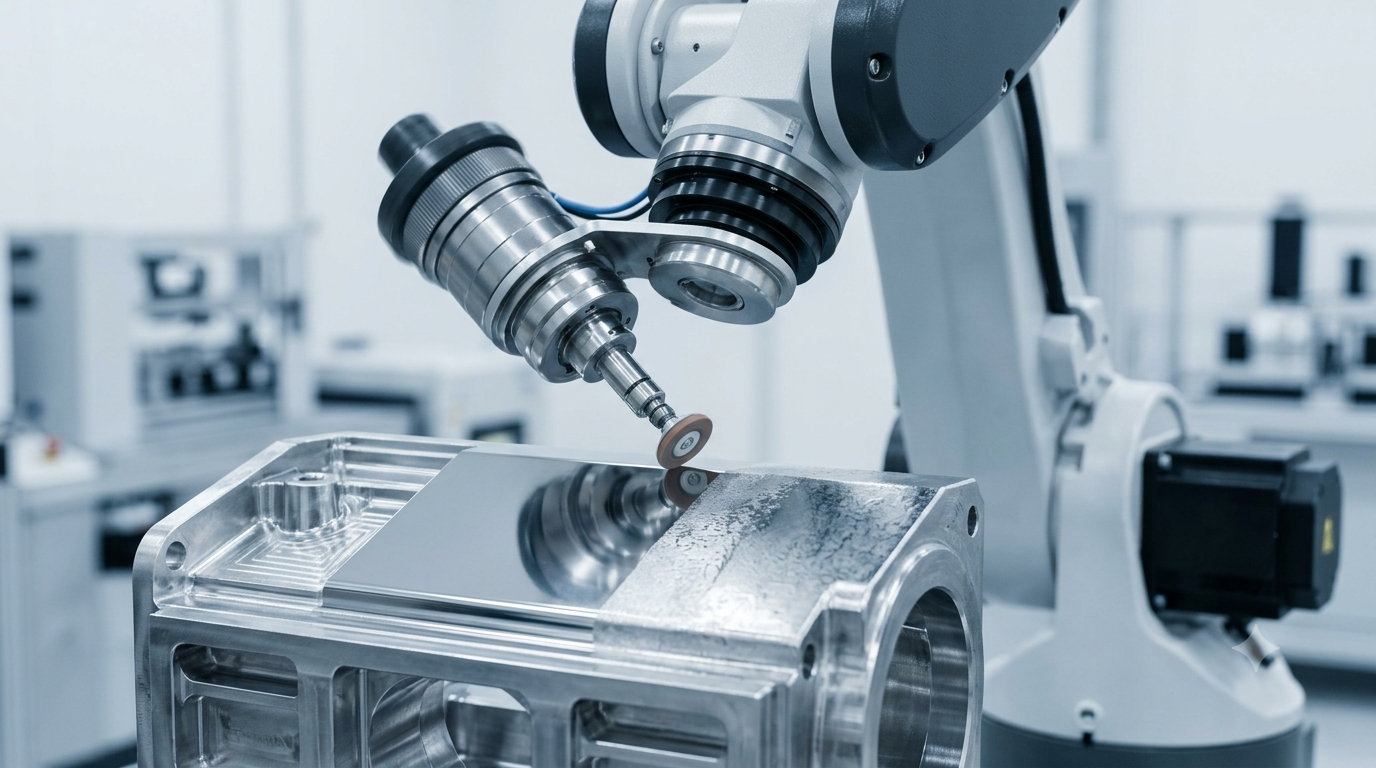

Robot Arm Flexibility Is Often Invisible Until Surface Quality Starts to Vary
Robot arm flexibility is rarely the first concern when manufacturers evaluate robotic finishing applications. Most attention is typically focused on tooling, cycle time, programming, and throughput. However, when fine finishing operations require consistent surface quality, even small amounts of structural movement can influence the final result.
A robotic finishing cell may perform well during initial trials and still struggle to maintain consistent quality during production. The reason is often not a programming error or tooling problem. Instead, the finishing process may be exposing flexibility within the robotic system that was not significant during simpler operations.
The key decision is not whether flexibility exists. Every robotic system exhibits some degree of structural compliance. The real question is whether that flexibility affects the finishing requirements enough to justify compensation strategies.
Understanding how robot arm flexibility influences fine finishing performance helps manufacturers evaluate both process suitability and long-term production stability.
Why Fine Finishing Is More Sensitive Than Material Removal Operations
Many machining and handling applications can tolerate small variations in tool position without affecting production outcomes. Fine finishing processes typically provide much less margin for error.
Operations such as polishing, sanding, deburring, buffing, composite finishing, and surface preparation often rely on maintaining controlled contact conditions between the tool and the workpiece.
If flexibility causes slight changes in tool position, tool angle, or contact pressure, the resulting surface may exhibit inconsistent texture, visible marks, uneven material removal, or variation in surface quality.
As surface finish requirements become more demanding, the influence of robot arm flexibility becomes increasingly important.
How Robot Arm Flexibility Affects Surface Finish Quality
Robot arm flexibility affects finishing quality because external forces generated during processing can create small structural deflections throughout the robotic system.
When a finishing tool contacts a workpiece, forces travel through the end effector, wrist assembly, robot joints, arm structure, base mounting system, and supporting equipment.
Under changing loads, the robot may not maintain the exact tool position originally programmed. While these movements are often small, they can become significant in applications requiring highly consistent surface quality.
Common effects include:
- Variation in contact pressure
- Changes in tool orientation
- Uneven material removal rates
- Surface waviness or texture variation
- Inconsistent edge finishing
- Differences between work envelope locations
The impact is often greatest when finishing forces vary significantly throughout the process.
Why Work Envelope Position Matters
One of the most overlooked characteristics of robotic finishing is that structural stiffness is not necessarily constant throughout the work envelope.
A robot may respond differently to the same finishing force depending on arm extension, joint configuration, and tool orientation.
This means a finishing process that performs well in one region of the work envelope may produce different results elsewhere. Manufacturers sometimes discover this issue during production when surface quality varies between part features requiring different robot positions.
For this reason, process validation should always include testing across all critical finishing locations rather than evaluating only a limited portion of the robot’s operating range.
Process Validation Before Compensation Strategies
Before implementing compensation methods, manufacturers should first determine whether flexibility is actually the root cause of the observed variation.
Many finishing problems that appear to be robot-related originate elsewhere in the process.
Tool wear, fixture movement, spindle variation, calibration drift, inconsistent part presentation, and unstable process parameters can produce symptoms that resemble flexibility-related issues.
A structured validation process helps isolate the source of variation before corrective action begins.
Similar principles apply to broader automation projects where process stability must be verified before optimization efforts begin. Manufacturers evaluating process readiness may benefit from reviewing Why Repeatability Becomes the Critical Risk in Robotic Machining of Custom Geometries
Common Compensation Approaches
Once flexibility-related effects have been identified, several compensation strategies may be considered depending on the application.
Tool Force Control
Force-control systems can help maintain more consistent contact conditions during finishing operations. Rather than relying solely on programmed position, the system responds to actual process forces.
Path Optimization
Programming adjustments may reduce the influence of flexibility by minimizing force changes or avoiding less rigid robot configurations.
Tool Orientation Optimization
Changing the orientation of the finishing tool can alter force direction and reduce structural deflection during critical portions of the process.
Process Parameter Adjustment
In some cases, modifying speeds, feeds, contact pressures, or finishing strategies can reduce the forces that contribute to flexibility-related variation.
Mechanical Improvements
Fixtures, tooling systems, mounting structures, and support equipment may be strengthened to improve overall process stability.
The correct solution depends on identifying the dominant source of variation rather than applying compensation techniques indiscriminately.
When Compensation Has Limits
Compensation strategies can improve process performance, but they cannot eliminate every limitation.
Applications requiring extremely tight finishing tolerances may eventually reach a point where compensation alone is insufficient. At that stage, manufacturers must evaluate whether the process requirements align with the capabilities of the selected robotic system.
The goal should not be to force every finishing application into a robotic solution. The goal should be to determine where robotic finishing provides a practical balance between flexibility, quality, productivity, and investment cost.
Understanding these limitations early can prevent costly redesign efforts later in the project.
Why Repeatability Remains Critical
Compensation methods are only effective when the underlying process remains repeatable.
If fixtures shift, calibration changes, tooling wears unpredictably, or incoming parts vary significantly, compensation systems may struggle to maintain consistent results.
Successful finishing automation depends on controlling process variation before relying on advanced correction strategies.
This relationship between process stability and quality performance is similar to the repeatability challenges discussed in Robotic Milling vs CNC: 5 Key Thin-Wall Machining Limits where consistent process conditions simplify optimization efforts.
Repeatability should therefore be treated as the foundation upon which compensation methods are built.
What Should Be Verified Before Approving a Robotic Finishing Process?
Before approving a robotic finishing cell for production, manufacturers should verify whether flexibility-related effects have been fully evaluated.
For broader industrial robotics context, the International Federation of Robotics provides industry-wide information on manufacturing automation and robotics adoption. While industry trends do not determine finishing quality, they help illustrate how robotic technologies continue to expand into increasingly demanding production applications.
The following checklist can help guide the evaluation process.
- Have finishing quality requirements been clearly defined?
- Has robot arm flexibility been evaluated throughout the work envelope?
- Have process forces been measured?
- Has tool wear been considered?
- Have fixture stability and mounting rigidity been verified?
- Have compensation methods been validated under production conditions?
- Has repeatability been measured over multiple production cycles?
- Have critical tool orientations been evaluated?
- Can operators reproduce setup conditions consistently?
- Have acceptance criteria been documented?
The objective is to determine whether robot arm flexibility will remain within acceptable limits throughout normal production operations.
FAQ
What is robot arm flexibility?
Robot arm flexibility refers to the small structural movements or deflections that occur when external forces act on the robotic system. All robots exhibit some degree of flexibility under load.
Does robot arm flexibility always affect finishing quality?
No. The impact depends on process requirements, finishing forces, tooling configuration, and quality tolerances. Some applications can tolerate small amounts of movement without measurable effects.
Why is fine finishing more sensitive to flexibility?
Fine finishing often requires consistent tool position, orientation, and contact pressure. Small variations can influence surface appearance and finishing consistency.
Can software compensation eliminate flexibility completely?
No. Compensation methods can reduce the effects of flexibility, but they cannot completely remove physical limitations within the robotic system.
How can manufacturers determine whether flexibility is causing quality problems?
Process validation should isolate variables systematically. Tool wear, fixturing issues, calibration drift, and process instability should be ruled out before flexibility is identified as the primary cause.
Should flexibility be evaluated during proof-of-concept testing?
Yes. Early validation helps identify potential limitations before production implementation and reduces the risk of unexpected quality issues later in the project.
Talk to URT About Robotic Fine Finishing Applications
If you are evaluating robotic finishing processes where robot arm flexibility may influence surface quality, contact us. We will give you a direct, technical answer based on your actual production requirements.