English
 Italiano
 Українська
 Русский
 Español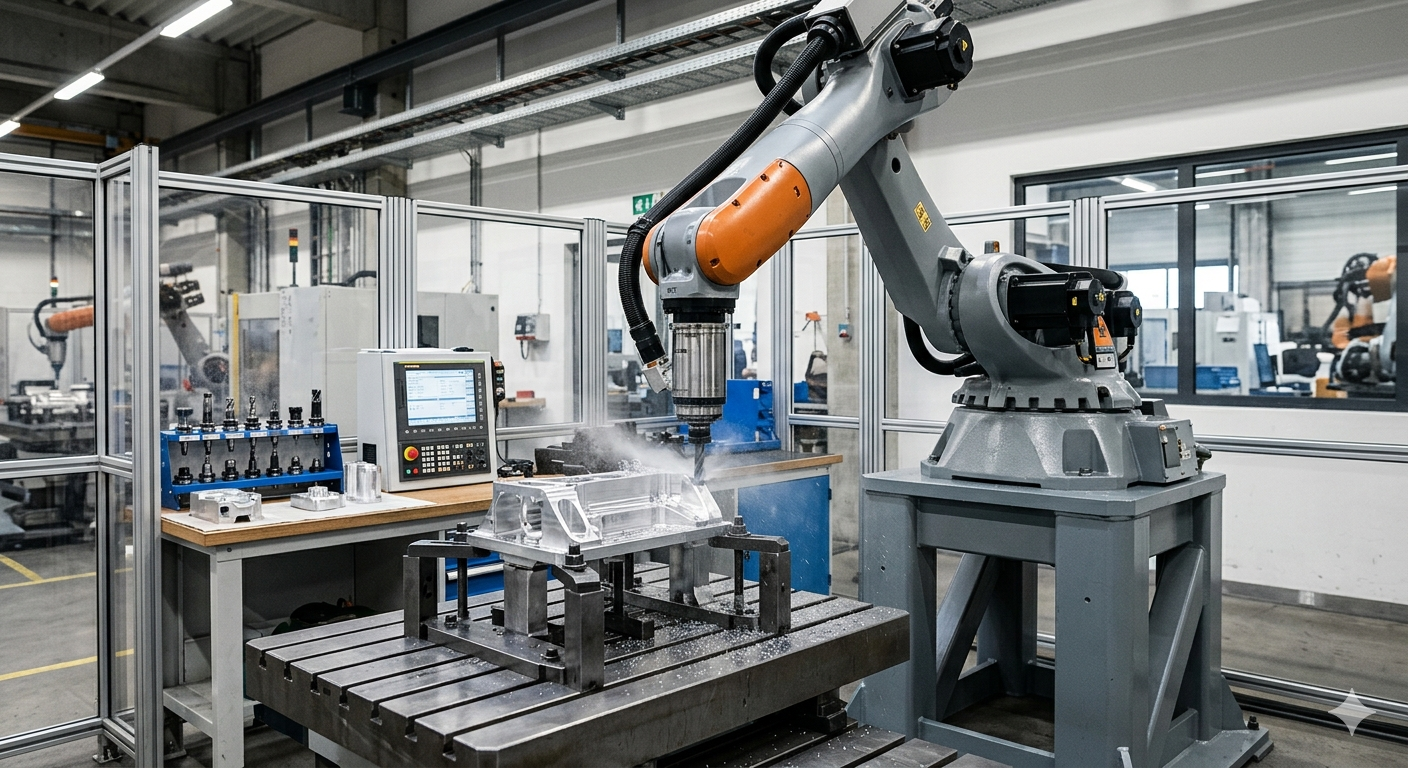

The Precision Problem Often Starts Below the robot.
When a robotic milling project produces inconsistent results, the first reaction is often to question the robot. Buyers compare repeatability figures, controller capabilities, and programming strategies in search of the source of the problem. In many cases, however, the limiting factor is not the robot itself. It is the structure supporting the robot, the workpiece, or both.
The relationship between a robotic milling support structure and machining precision is frequently underestimated during project planning. A robotic milling support structure also affects vibration behavior, fixture stability, and the ability to maintain consistent tool paths during cutting.
In many cases, however, the limiting factor is not the robot itself. It is the structure supporting the robot. Why Robotic Milling Vibration Problems Usually Start Before the First Cut
A robot may follow the programmed path correctly while the surrounding structure introduces movement, vibration, or deflection that affects the finished part. The result is a gap between theoretical robot performance and actual production results.
This distinction matters because robotic milling is fundamentally different from many handling applications. During milling, cutting forces interact continuously with the robot, the fixture, and the supporting structure. Every element in the cell contributes to the final machining outcome.
The question is not simply whether the robot is accurate enough. The question is whether the entire mechanical system is rigid and stable enough to maintain precision under real production conditions.
Why a Robotic Milling Support Structure Becomes Critical During Milling
In pick-and-place applications, the robot’s primary task is positioning. Milling introduces a different challenge because the cutting tool generates forces that push against the robot and the workpiece throughout the process. Robotic Milling Vibration Control
Even relatively small cutting forces can create measurable movement if the support structure lacks sufficient rigidity. The robot base may experience slight displacement. The workpiece fixture may flex. Support frames may vibrate. Individually, these movements may appear insignificant, but together they can influence dimensional accuracy, surface quality, and process consistency.
Unlike traditional CNC machines, which are designed around highly rigid machine frames, robotic milling cells often involve customized installations. The quality of those supporting structures becomes a major determinant of achievable precision.
A rigid structure helps maintain predictable tool paths. A flexible structure allows movement that the robot program cannot fully compensate for. In many cells, the robotic milling support structure is the difference between repeatable test cuts and stable production results.
Robot Base Stability
The robot foundation is one of the first areas that should be evaluated. If the base plate, pedestal, or mounting structure moves under load, the robot’s programmed coordinates no longer correspond perfectly to the intended machining path. If the base plate, pedestal, or mounting structure moves under load. Milling Stability for Large Parts
For this reason, robotic milling cells frequently require more substantial mounting solutions than handling applications with similar robot models. The structural demands come from the process forces rather than the robot’s payload alone.
Fixture Stability
The workpiece fixture is equally important. A rigid robot mounted to a stable base can still produce poor machining results if the fixture allows part movement during cutting.
Fixture design should account for clamping forces, workpiece geometry, material characteristics, and the expected cutting loads generated by the process. A fixture that performs adequately during manual operations may not provide sufficient stability for automated milling.
How a Robotic Milling Support Structure Influences Vibration and Surface Quality
One of the most visible consequences of an inadequate robotic milling support structure is vibration
Vibration can affect dimensional accuracy, tool life, and surface finish simultaneously. The challenge is that vibration often originates from multiple sources rather than a single component. The robot, support frame, tooling, fixture, and workpiece can all contribute to the problem.
When vibration develops, increasing robot accuracy specifications does not solve the issue. The underlying mechanical instability remains present.
In practice, vibration frequently appears as inconsistent surface quality, variations between production runs, premature tool wear, or difficulties maintaining tight tolerances. These symptoms may initially appear to be programming issues when the real cause lies in the mechanical design of the cell.
Successful robotic milling projects therefore evaluate structural dynamics early in the design phase rather than treating vibration as a commissioning problem.
The support structure must match the application.
There is no universal support structure design that works for every robotic milling project.
The required rigidity depends on several production variables, including material type, workpiece size, cutting strategy, tooling configuration, and production requirements. A structure suitable for trimming composite materials may not be appropriate for more demanding machining operations.
This is why cell design should begin with the process rather than the robot model alone. The cutting forces expected during production help determine the structural requirements needed to support the application.
Companies evaluating automation often focus on robot selection first. In many milling applications, however, the support structure deserves equal attention because it directly influences the conditions under which the robot must operate.
Support Structure Design Affects Long-Term Process Stability
Precision is not only about achieving acceptable results during initial testing. The real challenge is maintaining those results over months and years of production.
A marginally adequate support structure may appear acceptable during commissioning but become problematic as tooling changes, production volumes increase, or maintenance conditions evolve.
Long-term stability depends on the ability of the structure to maintain alignment and rigidity under continuous operating conditions. Wear, thermal effects, repeated loading cycles, and environmental influences can all affect performance over time.
This is one reason why robotic milling projects should be evaluated as complete systems rather than collections of individual components. The robot, tooling, fixture, support frame, and programming strategy all contribute to sustained precision. Robotic Milling
Common Mistakes When Evaluating Precision in Robotic Milling
Several recurring assumptions create avoidable problems during robotic milling projects.
Assuming Robot Specifications Define Cell Performance
A robot’s published capabilities describe the robot itself, not the complete machining system. Cell performance depends on structural rigidity, tooling, fixturing, process parameters, and integration quality.
Underestimating Fixture Design
Fixture design is sometimes treated as a secondary engineering task. In reality, fixture stability directly affects machining accuracy and repeatability.
Treating Vibration as a Programming Issue
Programming adjustments can sometimes reduce symptoms, but they rarely eliminate structural instability. Mechanical causes should be investigated before extensive software modifications are attempted.
Focusing Only on Initial Results
A milling cell that performs well during acceptance testing must also maintain performance during normal production. Long-term structural stability deserves as much attention as initial accuracy measurements.
When Structural Improvements May Deliver More Value Than Robot Changes
There are situations where investing in a more rigid support structure produces greater benefits than upgrading the robot itself.
If precision limitations originate from vibration, fixture movement, or structural deflection, changing robot models may produce only marginal improvements. The mechanical environment remains unchanged.
By contrast, improving structural rigidity can enhance the performance of the entire machining system. The robot, tooling, and process all benefit from a more stable operating platform.
This does not mean structural improvements are always the answer. The correct approach depends on identifying the actual source of variation. The key point is that precision should be evaluated at the cell level rather than through robot specifications alone.
What to Check in a Robotic Milling Support Structure Before Investing
Before finalizing a robotic milling project, it is useful to evaluate the complete mechanical environment rather than focusing exclusively on the robot. The robotic milling support structure should be reviewed as a core precision factor, not as a secondary fabrication detail.
- Expected cutting forces throughout the process
- Robot mounting method and foundation stability
- Support frame rigidity under operational loads
- Fixture design and workpiece clamping strategy
- Potential vibration sources within the cell
- Long-term alignment and structural stability requirements
- Tooling and spindle integration requirements
- Production tolerances and surface finish expectations
- Maintenance accessibility and inspection requirements
- Future process changes that may alter loading conditions
Evaluating these factors early helps prevent situations where the robot is expected to compensate for limitations elsewhere in the system.
For a broader industrial robotics context, the International Federation of Robotics provides industry information on robotic manufacturing applications and automation technologies.
FAQ
Why does support structure design affect robotic milling precision?
Support structures influence how the robot and workpiece respond to cutting forces. Insufficient rigidity can introduce movement, vibration, or deflection that affects machining accuracy and surface quality.
Can a highly accurate robot compensate for a weak support structure?
No. The robot can only follow its programmed path. If the robot base, fixture, or workpiece moves during machining, the robot cannot fully compensate for that mechanical movement.
Is fixture design as important as robot selection in robotic milling?
In many cases, yes. A poorly designed fixture can allow part movement that reduces precision, regardless of the robot’s capabilities.
How does vibration affect robotic milling results?
Vibration can influence dimensional accuracy, surface finish, and tool life. It often originates from multiple elements within the cell, including support structures, fixtures, tooling, and workpieces.
When should structural rigidity be evaluated during a robotic milling project?
Structural considerations should be addressed during the design phase. Waiting until commissioning can make corrections more expensive and more difficult to implement.
Talk to RHS About Robotic Milling Precision
If you are evaluating robotic milling precision, contact RHS. We will give you a direct, technical answer based on your actual production requirements.