English
 Italiano
 Українська
 Русский
 Español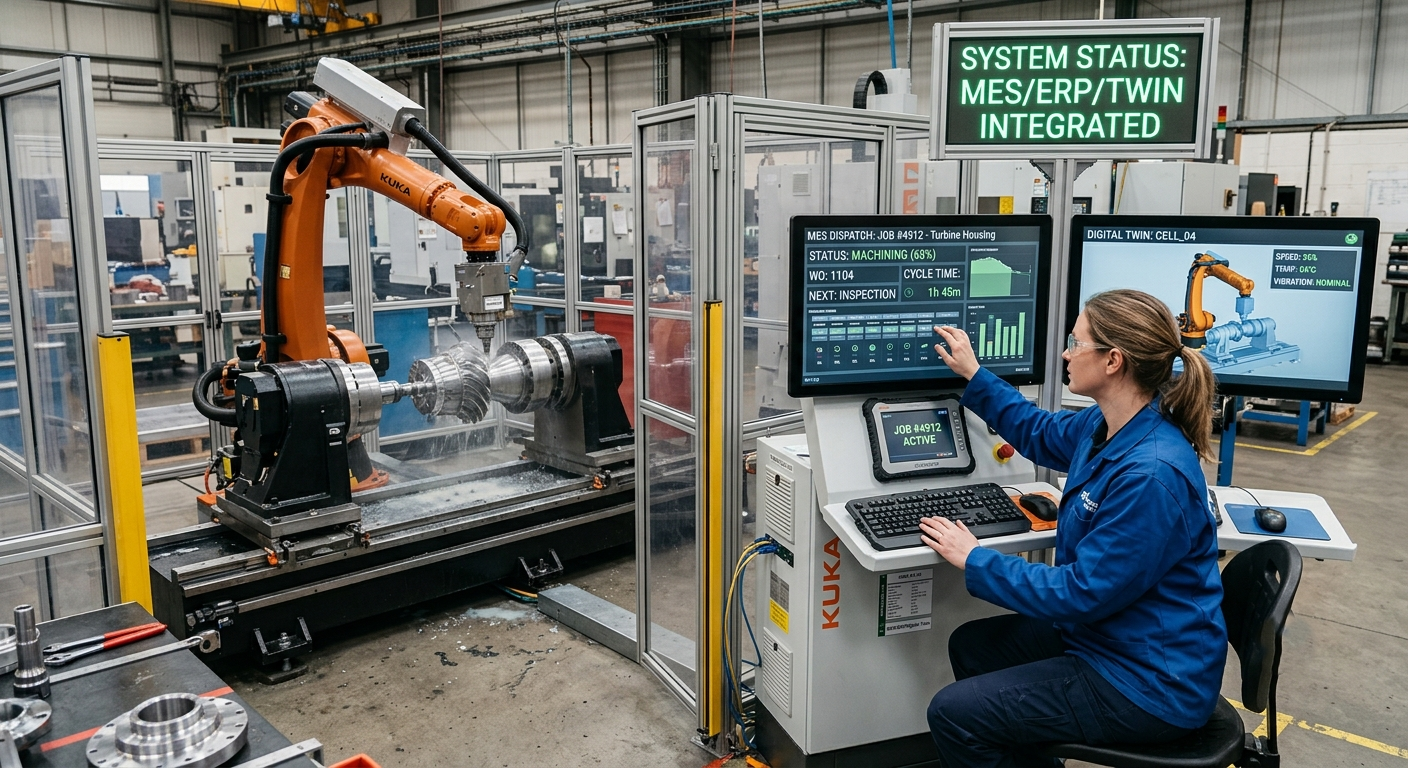

Why a Robotic Milling Cell Is No Longer Just a Machine Tool
The decision to deploy a robotic milling cell is often driven by flexibility, workspace size, material handling requirements, or the ability to machine large and complex parts. However, many projects underestimate how much value depends on robotic milling integration rather than on the robot itself.
A robotic milling cell that operates in isolation may still remove material successfully. The challenge appears when production teams need visibility into scheduling, quality records, tool usage, program revisions, maintenance status, and production performance. At that point, the robotic cell becomes part of a broader manufacturing information system.
This is where MES platforms, ERP systems, and digital twins become important. The question is not whether the robot can machine a part. The question is whether the organization can connect that machining process to the data, planning, and decision-making systems that support production.
Why Robotic Milling Integration Is Becoming a Strategic Requirement
Many manufacturers initially evaluate robotic milling through technical criteria such as reach, spindle selection, work envelope, and programming capability. These factors matter, but they do not address how information moves through the business.
As production environments become increasingly connected, robotic milling integration often determines whether managers can track orders, monitor performance, manage quality records, and make informed operational decisions.
A robotic cell may generate valuable production data, but that information has limited value if it remains trapped within the robot controller or programming environment.
The goal of robotic milling integration is to transform operational data into actionable information that supports planning, quality assurance, maintenance, and continuous improvement.
7 Critical Robotic Milling Integration Challenges
Data Existing in Multiple Systems
Robotic milling environments often include robot controllers, spindle systems, PLCs, CAM software, quality platforms, MES software, and ERP databases. Without a structured integration strategy, information becomes fragmented across multiple locations.
Different Communication Standards
Equipment from different vendors may use different communication protocols, creating additional integration complexity during deployment.
Version Control Problems
Engineering teams must maintain control of machining programs, post-processors, and production releases. Weak governance can create confusion regarding which version was used for production.
Digital Twin Accuracy
A digital twin only provides value when it accurately reflects the physical cell. If production changes are not synchronized, the digital model can become unreliable.
MES Data Quality
MES platforms depend on accurate production information. Poor data collection can reduce the value of reporting and performance analysis.
ERP Synchronization Issues
Production schedules, inventory status, and order information must remain aligned between manufacturing operations and business systems.
Ownership and Governance
Many integration projects struggle because no single team owns data governance, system maintenance, and long-term integration management.
How MES Supports Robotic Milling Operations
A Manufacturing Execution System serves as a bridge between production activities and business-level decision-making.
In a robotic milling environment, MES platforms can help track production status, machine utilization, quality information, work orders, and process history. This visibility becomes increasingly important as production complexity grows.
Effective robotic milling integration allows production teams to understand not only what is happening in the cell but also why it is happening.
Production Visibility
MES systems can provide real-time insight into operational performance. This allows supervisors to identify bottlenecks, production interruptions, and quality concerns more quickly.
Traceability Benefits
Traceability requirements often increase when robotic machining replaces traditional equipment. A properly integrated MES environment can help maintain production records and support investigations when issues occur.
Where ERP Systems Fit Into the Integration Strategy
ERP systems focus on planning, inventory, purchasing, scheduling, and broader business operations.
Without ERP connectivity, robotic milling cells may operate effectively while remaining disconnected from production planning activities.
Successful robotic milling integration helps ensure that manufacturing data supports business decisions rather than remaining isolated at the shop-floor level.
Production scheduling, material availability, and order status can all benefit from reliable information exchange between ERP systems and manufacturing assets.
Why Digital Twins Are More Than Simulation Tools
Digital twins are often associated with engineering simulation. In practice, their value extends far beyond offline programming.
A digital twin can support process validation, change management, production analysis, and long-term optimization. However, these benefits depend on maintaining alignment between the digital model and the physical cell.
Robotic milling integration becomes especially important because the digital twin may rely on data originating from MES platforms, ERP systems, controllers, and engineering software.
Without reliable information flow, the digital twin becomes a static engineering model rather than a useful operational asset.
Common Mistakes During Robotic Milling Integration Projects
Many organizations focus heavily on the robot and the machining process while treating integration as a secondary activity.
Assuming Connectivity Can Be Added Later
Retrofitting integration after commissioning is often more expensive than designing for connectivity from the beginning.
Prioritizing Hardware Over Data Architecture
Some projects invest significant effort in equipment selection while spending little time defining information requirements.
Treating Digital Twins as Engineering Tools Only
A digital twin can support operational decision-making, but only when integration requirements are addressed properly.
Ignoring Long-Term Governance
Integration is not a one-time project. Systems require maintenance, updates, ownership, and ongoing validation.
Manufacturers evaluating robotic machining often encounter similar planning challenges when assessing the real ROI when replacing a CNC machine with a robot, especially when exploring different robotic milling applications and performance considerations Robotic Milling vs CNC: 5 Key Thin-Wall Machining Limits
When Full Integration May Not Yet Be Justified
Not every robotic milling application requires extensive MES, ERP, and digital twin connectivity.
Smaller operations with simple production requirements may achieve acceptable results with limited integration. However, as product complexity, traceability requirements, and production volumes increase, information management typically becomes more important.
The objective is not to connect systems simply because the technology exists. The objective is to support measurable operational requirements.
What to Verify Before Starting a Robotic Milling Integration Project
Before investing in robotic milling integration, manufacturers should evaluate the following areas:
- Define production data requirements.
- Identify which systems require connectivity.
- Review communication standards and compatibility.
- Establish ownership of integration governance.
- Verify digital twin maintenance procedures.
- Assess traceability requirements.
- Review cybersecurity considerations.
- Validate long-term support responsibilities.
For a broader manufacturing digitization context, the International Federation of Robotics provides useful information regarding industrial robotics adoption and connected manufacturing trends.
FAQ
What is robotic milling integration?
Robotic milling integration refers to connecting robotic machining cells with manufacturing, planning, quality, and engineering systems such as MES platforms, ERP software, and digital twins.
Why is robotic milling integration important?
Robotic milling integration helps manufacturers improve visibility, traceability, planning, and decision-making across production operations.
Can a robotic milling cell operate without MES integration?
Yes. However, organizations may lose visibility into production performance, traceability, and process management if the cell remains isolated.
What role does an ERP system play in robotic machining?
ERP systems help connect manufacturing activity with business functions such as scheduling, inventory management, purchasing, and order planning.
Are digital twins only useful for simulation?
No. Digital twins can support validation, optimization, change management, and operational analysis when connected to reliable production data.
Talk to URT About Robotic Milling Integration
If you are evaluating robotic milling integration with MES, ERP, or digital twin technologies, contact RHS. We will give you a direct, technical answer based on your actual production requirements.