English
 Italiano
 Українська
 Русский
 Español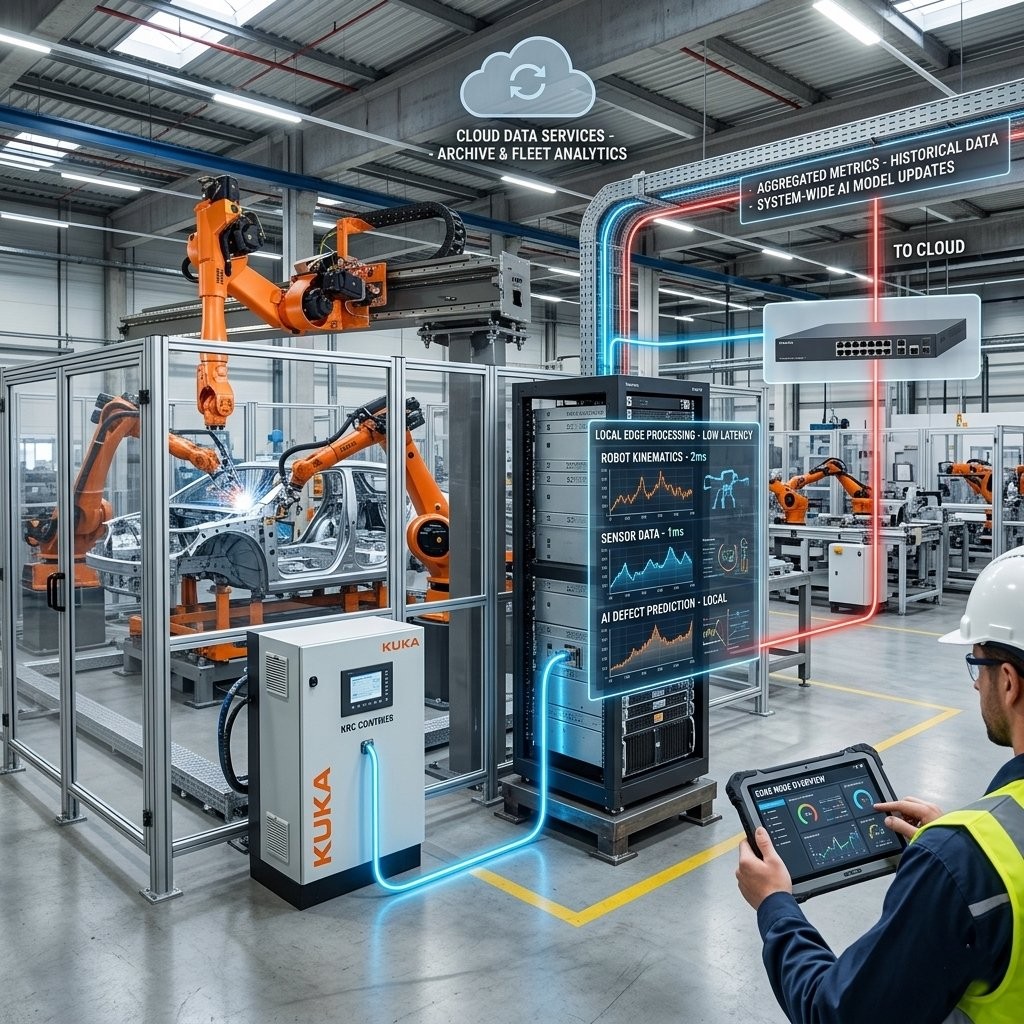

What Is the Difference Between Edge and Cloud Computing?
Industrial robot cells can generate operational data from robot controllers, PLCs, sensors, vision systems, drives, process equipment, and production software. Deciding where that information should be processed is an architectural question. Edge computing handles selected data close to the machine or production cell, while cloud computing moves information to centralized remote computing infrastructure.
Neither approach is automatically better. Edge computing is generally appropriate when applications depend on fast local processing, temporary buffering, protocol conversion, or continued operation during external network interruptions. Cloud platforms are useful when manufacturers need centralized storage, fleet-level analysis, reporting, scalable computing resources, or access to information from several sites.
For many industrial robot applications, the practical answer is therefore a hybrid architecture. Operational functions remain close to the cell while selected production data is sent to higher-level or cloud services. This article explains how latency, connectivity, cybersecurity, data volume, maintenance requirements, and application objectives affect that choice.
Why Does Processing Location Matter for Robot Data?
Operational Data Has Different Timing Requirements
Not all robot data should be treated in the same way. Signals used for equipment coordination, machine interlocks, or immediate process responses have different timing and availability requirements from information used for monthly reports, maintenance analysis, production history, or management dashboards.
An industrial robot data architecture should therefore define which systems create information, which systems consume it, how quickly it is needed, and what happens if communication fails. Processing location should follow those requirements rather than a general preference for either local or cloud technology.
When Is Edge Computing Better for Industrial Robots?
Local Processing Can Reduce External Dependencies
Edge computing is useful when data must be processed close to the robot cell. An industrial edge computer or gateway can collect controller information, normalize data from different devices, add timestamps, filter unnecessary values, temporarily buffer records, and forward selected information to other systems.
Latency Matters for Some Applications
Processing data locally can also avoid the communication delay and uncertainty involved in sending information through external networks. This does not mean every fast robot function should run on a general-purpose edge computer. Motion control, safety functions, and deterministic machine coordination should remain within systems designed and validated for those tasks.
When Does Cloud Computing Make More Sense?
Centralized Analysis Across Machines and Plants
Cloud computing becomes useful when information from many robot cells, production lines, or facilities must be collected and analyzed centrally. Historical data can support cross-site reporting, maintenance analysis, production comparisons, application monitoring, and other functions that do not require an immediate response at the robot controller.
Cloud resources can also simplify access to computing and storage capacity that would otherwise need to be installed and maintained locally. However, manufacturers still need rules for data ownership, retention, access permissions, network failure, software updates, and integration with existing plant systems.
How Do Connectivity and Data Volume Affect the Choice?
Sending Every Robot Variable Is Usually Unnecessary
A robot controller can expose many variables, but collecting everything continuously may create unnecessary storage, network traffic, and analysis work. The useful dataset depends on the application. Production teams may need cycle states, alarms, active programs, process parameters, quality results, or selected condition indicators rather than every internal controller value.
Edge systems can reduce the amount of information sent upstream by filtering, aggregating, or contextualizing data locally. Cloud services can then receive information that already has useful structure. This division is especially helpful when network bandwidth is limited or several production systems share the same infrastructure.
What Are the Cybersecurity and Governance Considerations?
More Connections Create More Interfaces to Manage
Connecting robot cells to edge and cloud systems introduces additional devices, accounts, network paths, software services, and data interfaces. Each one requires appropriate configuration, access control, updates, backups, documentation, and monitoring. The architecture should define which systems can read information and which are permitted to change production-related configuration.
Manufacturers can consult ISO/IEC 24392:2023 when examining cybersecurity for industrial internet platforms. The standard addresses areas including industrial data collection, transmission, cloud platform security, and collaboration between organizations involved in industrial internet environments.
Why Is a Hybrid Edge-Cloud Architecture Often Practical?
A hybrid design separates functions according to their operational requirements. The robot controller and PLC can continue handling machine operation, while an edge layer collects and prepares selected information. Cloud or centralized applications can then perform longer-term storage, reporting, comparison, or computational analysis.
This separation also supports traceability. Robot software versions, process changes, and configuration states should remain identifiable when data is analyzed outside the cell. The RHS guide to robot program version control explains why approved programs, parameters, backups, and related configurations need controlled identification rather than informal file copies.
AI applications may create another reason for combining local and centralized systems. A vision application may make predictions locally while performance records are analyzed elsewhere. The article on model drift in robot vision provides additional context on linking model behavior with production data, versions, and changing operating conditions.
Eight Questions to Answer Before Choosing Edge or Cloud
Before selecting an architecture, define the actual information flow and operational requirements. The following eight checks help identify which functions should stay near the robot and which can operate centrally.
- Required response time: Determine whether the application requires an immediate local response or whether seconds, minutes, or longer delays are acceptable.
- Network dependency: Decide what the cell must continue doing if access to an external network or cloud service becomes unavailable.
- Data volume: Identify which robot, PLC, sensor, vision, and process values are actually required instead of transmitting every available variable.
- Data retention: Define how long production information must remain available and whether it needs local, centralized, or combined storage.
- System ownership: Establish who maintains the edge devices, cloud services, software interfaces, user accounts, backups, and updates.
- Access requirements: Identify which operators, engineers, maintenance personnel, applications, or external services require access to each data set.
- Failure behavior: Define what happens when an edge device, database, network connection, or cloud service becomes unavailable.
- Integration scope: Check whether the system connects one robot cell, an entire production line, multiple plants, MES software, analytics tools, or AI applications.
How Should Manufacturers Implement the Architecture?
Start by mapping the existing automation systems and their data relationships. Identify the robot controller, PLC, process equipment, sensors, vision systems, supervisory software, databases, and business systems involved. Then classify each required information flow according to timing, availability, storage, security, and recovery requirements.
Avoid adding an edge computer or cloud service without a defined function. Every additional component becomes another system that needs configuration and lifecycle management. A smaller architecture with clear responsibilities is generally easier to troubleshoot than one containing several overlapping data services.
Manufacturers evaluating edge computing, cloud integration, robot connectivity, or production-data architecture for a specific application can contact Robotic Hi-Tech Solutions with details about the robot platform, production systems, required data, and intended use so the integration requirements can be reviewed in context.
Frequently Asked Questions
What is edge computing in industrial robotics?
Edge computing means processing selected information on computing equipment located close to the robot, machine, or production cell instead of sending all data to a remote computing platform.
Does edge computing replace a robot controller?
No. An edge computer normally complements the robot controller. Robot motion, controller functions, and machine-specific logic remain on systems designed for those responsibilities.
Does cloud computing create too much latency for robot applications?
It depends on the function. Cloud processing may be unsuitable for operations requiring tightly controlled local response times, but it can be appropriate for reporting, historical analysis, fleet monitoring, and other non-real-time tasks.
Can a robot cell continue running if the cloud connection fails?
It can if the cell architecture is designed so essential production functions do not depend on continuous cloud connectivity. Failure behavior should be defined before deployment.
Should all robot data be stored in the cloud?
No. Data should be collected because it supports a defined production, maintenance, quality, traceability, or analytical requirement. Storing every available signal can add cost and complexity without improving decisions.
Can edge computing reduce the amount of transmitted data?
Yes. An edge layer can filter, aggregate, contextualize, or temporarily buffer information before forwarding selected records to centralized systems.
Is a hybrid architecture more complex than using only cloud computing?
It can involve more components, but the architecture may provide clearer separation between operational and analytical functions. Complexity should be justified by requirements such as availability, latency, connectivity, or data processing.
How should a company choose between edge and cloud computing?
Choose based on required response time, network availability, data volume, cybersecurity, retention, system ownership, integration scope, and failure behavior. Many industrial robot applications use both rather than treating them as mutually exclusive alternatives.