English
 Italiano
 Українська
 Русский
 Español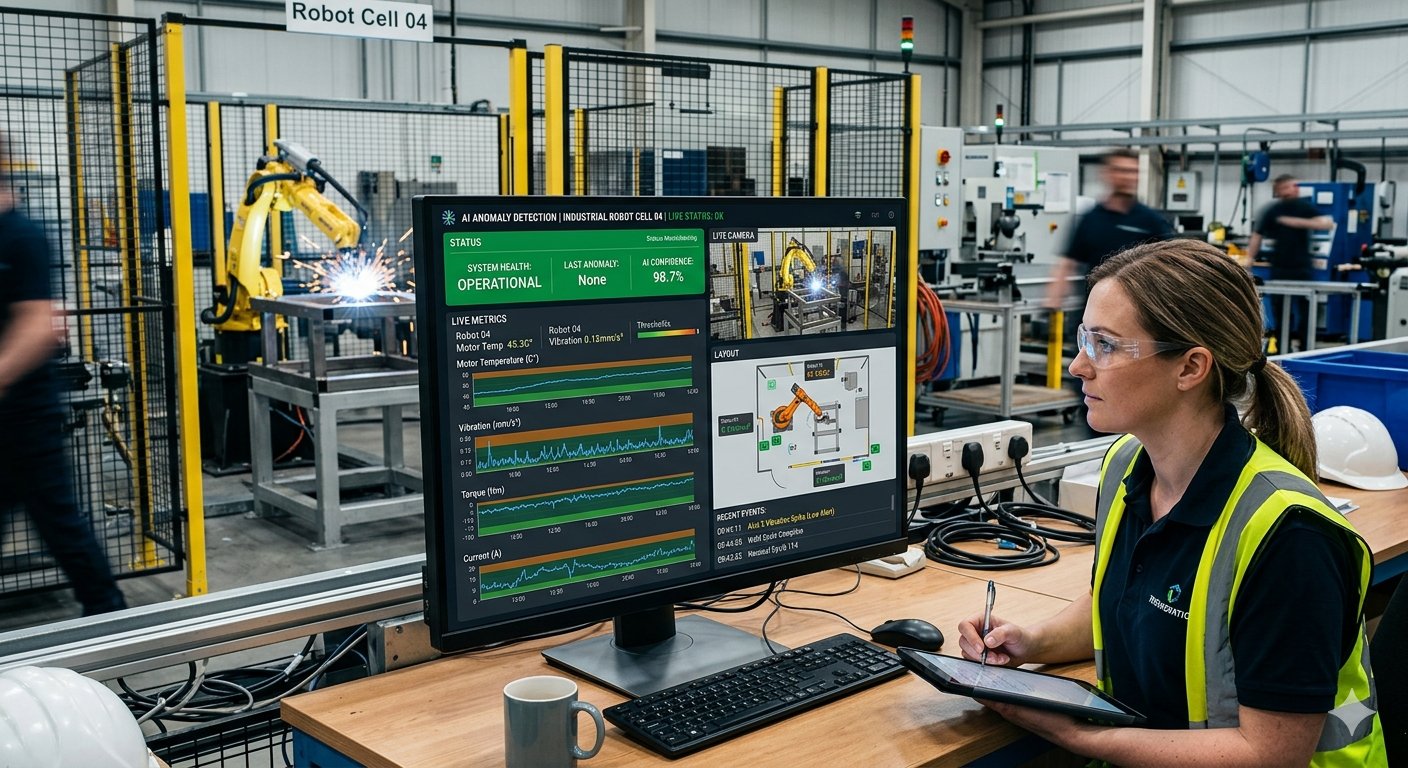

Industrial robot cells rarely move directly from normal operation to complete failure without producing any observable change. Alarms, cycle-time variation, unusual sensor values, communication events, process deviations, or changes in equipment behavior may appear first. AI anomaly detection can analyze these signals and identify patterns that differ from established operating conditions.
The objective is not to predict every failure. AI anomaly detection indicates that current behavior differs from what the monitoring system considers normal. Engineers and maintenance teams must still determine whether the deviation comes from mechanical wear, process variation, tooling, sensors, software, material changes, or another cause.
Used correctly, AI anomaly detection gives manufacturers another way to prioritize investigation before an abnormal condition develops into a larger production problem. This article explains what the technology monitors, how models establish normal behavior, which robot cell problems may become visible, and what should be checked before deployment.
How Does AI Anomaly Detection Work in a Robot Cell?
Normal behavior becomes the reference
AI anomaly detection begins with data representing the equipment or process under known operating conditions. Depending on the application, the system may examine robot states, process variables, sensor measurements, cycle information, alarms, controller events, or combinations of several signals.
The model then evaluates new observations against that reference. A deviation can be identified when individual values, combinations of variables, or time-dependent patterns behave differently from conditions represented by the reference data.
An anomaly is not automatically a fault
An unusual pattern does not prove that equipment is failing. A new product, changed robot program, different material, maintenance intervention, tooling replacement, environmental condition, or production schedule can also alter the data. AI anomaly detection therefore works best as an investigation trigger rather than an automatic diagnosis.
What Robot Cell Data Can Be Monitored?
Controller and production information
Useful sources can include robot alarms, operating modes, program states, cycle events, PLC states, process measurements, vision results, equipment status, and selected sensor data. The appropriate signals depend on the specific failure modes or production problems that engineers want to investigate.
Data also needs context. A change in cycle duration is difficult to interpret without knowing which program, product, machine state, or operating condition was active. A structured industrial robot data architecture helps define where information originates, how it is timestamped, and which systems consume it.
Additional sensors can add diagnostic information
Where justified by the application, monitoring can include vibration, temperature, electrical, pneumatic, process-quality, or other measurements provided by suitable equipment. Additional sensors should address a defined diagnostic requirement rather than simply increasing the amount of data collected.
How Does AI Anomaly Detection Learn Normal Behavior?
Training data must represent real operation
An AI anomaly detection model is useful only when its reference data covers the operating conditions it is expected to evaluate. Production may contain different recipes, payloads, speeds, programs, shifts, products, and process states. Treating all these conditions as one identical operating mode can create misleading alerts.
Engineers should therefore decide whether separate baselines are needed for different operating states. A robot moving slowly during setup should not necessarily be compared directly with the same robot performing a high-speed automatic production cycle.
Production changes can affect the reference
The reference should be reviewed when the process changes. AI models can lose relevance when incoming production conditions differ from the data used during development. A related example is model drift in AI-powered robot vision, where changing operating data can affect model performance even when the deployed software itself has not been modified.
What Problems Can AI Anomaly Detection Reveal?
Gradual changes can become visible
AI anomaly detection can help expose gradual or intermittent changes that conventional fixed alarm thresholds may not isolate easily. Examples include increasing cycle variation, recurring controller warnings, changing sensor relationships, abnormal process trends, communication interruptions, or equipment behavior that appears unusual only when several signals are examined together.
Mechanical symptoms still require diagnosis
Mechanical degradation may influence measurable behavior before a component stops functioning, but the useful indicators depend on the robot, tooling, process, sensor arrangement, and failure mechanism. A detected deviation should therefore lead to appropriate diagnostics rather than an unsupported conclusion about which component is damaged.
This distinction is important because similar data patterns can have different causes. For example, increased cycle time may originate in robot motion, a waiting machine, a sensor delay, process changes, operator interaction, or communication between devices.
Eight Checks Before Implementing AI Anomaly Detection
A practical AI anomaly detection project should begin with a specific production or maintenance question. The following checks help prevent the implementation from becoming an uncontrolled data-collection exercise.
- Define the problem to detect. Identify the failures, process deviations, or abnormal states that justify monitoring.
- Identify relevant data sources. Document robot, PLC, tooling, machine, sensor, vision, and process variables that may provide useful evidence.
- Separate operating states. Determine whether different programs, products, speeds, or production modes require different normal baselines.
- Verify timestamps. Events from different controllers must be placed in the correct sequence if relationships between signals will be analyzed.
- Review data quality. Check for missing values, communication gaps, inconsistent units, sensor faults, and values that become stale after equipment disconnects.
- Define alert criteria. Decide how anomaly scores will be reviewed and what level of deviation requires investigation rather than immediate intervention.
- Test known abnormal conditions. Compare model output with documented faults, controlled tests, or other verified abnormal events when these are safely available.
- Document change management. Record software, tooling, process, robot-program, sensor, and product changes that may require the model baseline to be reviewed.
How Should False Alarms and Model Limitations Be Managed?
Alert quality matters
An AI anomaly detection system that generates frequent irrelevant alerts can lose operational value because engineers may begin ignoring its output. Alert thresholds and anomaly scores should therefore be evaluated against real production conditions, with a documented method for classifying useful alerts and false positives.
Anomalies also need operational context. If an alert consistently appears during a legitimate product change or setup procedure, the issue may be the model definition rather than the equipment itself.
Process changes require review
A newly introduced part, updated robot path, replacement tool, or process adjustment can legitimately change observed data. Retraining should not be automatic simply because an anomaly appears. Engineers should first determine whether the deviation reflects a fault, an intentional change, poor data quality, or an outdated baseline.
How Should Anomaly Detection Fit With Maintenance and Safety?
AI supports rather than replaces diagnostics
AI-based monitoring should complement preventive maintenance, inspections, controller diagnostics, condition monitoring, and troubleshooting procedures. An alert becomes more useful when maintenance personnel can connect it to equipment history, recent interventions, alarms, process states, and other technical evidence.
AI anomaly detection can help teams decide what deserves closer examination, but it does not remove the need for technicians to verify the actual equipment condition before maintenance decisions are made.
Safety functions need separate treatment
Monitoring software must remain separate from assumptions about machinery safety. OSHA guidance on industrial robot systems and robot safety addresses hazards, safeguarding, installation, programming, maintenance, and related considerations. An AI anomaly score should not be treated as a substitute for the protective functions required by the cell’s risk assessment.
When Does AI Anomaly Detection Make Practical Sense?
Start where abnormal behavior has consequences
The strongest use cases are generally cells where relevant operational data is available, abnormal behavior has meaningful production consequences, and personnel can act on the findings. Highly automated or unattended processes can particularly benefit from structured monitoring because operators are not continuously observing every machine interaction.
For that type of environment, monitoring must be considered together with recovery procedures and defined responses to abnormal conditions. The requirements are discussed further in this guide to reliable lights-out CNC automation.
Begin with a defined use case
Implementation should begin with a narrow objective rather than an attempt to monitor every available variable. A defined use case makes it easier to select relevant signals, establish useful baselines, evaluate alerts, and determine whether AI anomaly detection is providing actionable information.
For projects requiring evaluation of robot, PLC, sensing, data collection, and supervisory architecture together, manufacturers can contact Robotic Hi-Tech Solutions to discuss the actual cell configuration and integration requirements.
Frequently Asked Questions
What is AI anomaly detection in industrial robotics?
AI anomaly detection uses data-driven models to identify robot cell behavior that differs from an established reference or expected operating pattern.
Does anomaly detection predict the exact component that will fail?
Not necessarily. It can identify unusual behavior, but determining the physical cause usually requires engineering analysis, inspection, controller diagnostics, or additional measurements.
Can existing robot controller data be used?
Often yes, when the controller provides relevant operational information. Available variables and communication methods depend on the robot, controller, configuration, and integration architecture.
Does every anomaly require maintenance?
No. Anomalies may result from legitimate production changes, different products, altered programs, environmental conditions, data problems, or actual equipment deterioration.
Can anomaly detection replace controller alarms?
No. Controller alarms identify defined conditions recognized by the control system. Anomaly detection provides an additional analytical layer for unusual behavior that may not cross a conventional alarm threshold.
How much historical data is required?
There is no universal quantity. The available data must adequately represent the operating modes and variations that the model is expected to encounter in the intended application.
Can AI anomaly detection be used for safety functions?
A general anomaly model should not be assumed to provide a safety-rated protective function. Machinery safety requires appropriate risk assessment, equipment, architecture, and validation.
Should an anomaly model be retrained after process changes?
Significant changes should trigger a review. Retraining is appropriate when engineers determine that the existing reference no longer represents legitimate production conditions.