English
 Italiano
 Українська
 Русский
 Español
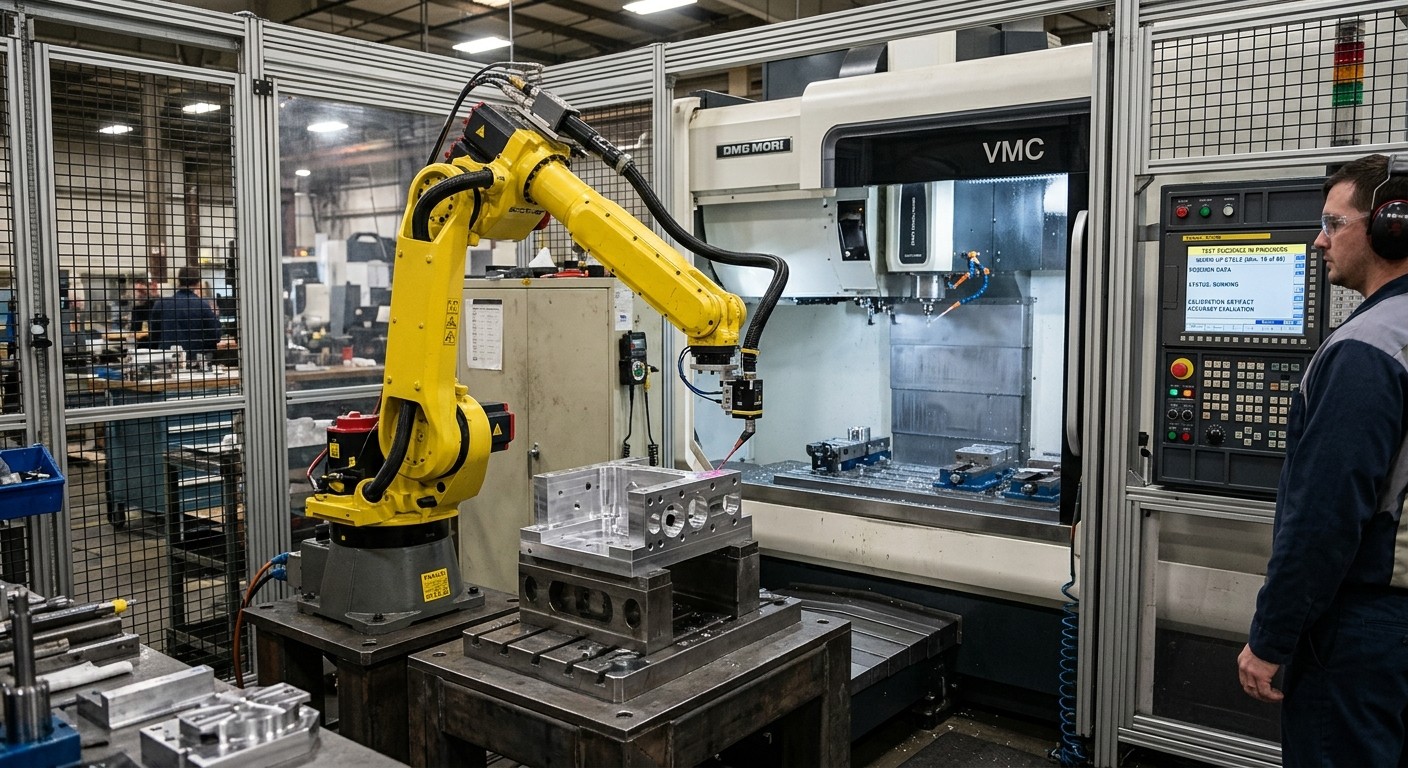

Robot accuracy can change as an industrial robot warms up because temperature affects its mechanical components and the geometry of the complete system. Heat generated by motors, gearboxes, and repeated joint movements can produce small dimensional changes. These changes may alter the position reached by the tool, even when the robot executes an unchanged program.
The effect is known as thermal drift. It does not mean that every robot becomes less accurate as its temperature rises. Some systems show measurable positioning changes during startup and then become more stable as operating temperatures approach a consistent range. The direction and magnitude of these changes depend on the robot, its configuration, operating conditions, and measurement location.
Understanding robot accuracy during warm-up helps engineers distinguish normal thermal behavior from calibration problems or mechanical faults. This article explains the main causes of thermal drift, how temperature influences positioning and repeatability, and which measurements help determine whether a warm-up procedure is necessary before precision operations begin.
Why robot accuracy changes during warm-up
Thermal expansion inside the robot
Industrial robots contain metal structures, bearings, transmissions, and other components that respond to temperature changes. As their temperatures rise, their dimensions can change slightly. These changes affect the geometric relationships between joints and may shift the actual tool position relative to the position calculated by the controller.
Temperature differences between components
Not every part of a robot heats at the same rate. Motors and transmissions may warm faster than surrounding structural components. Consequently, the robot can experience uneven temperature distribution during startup, creating positioning changes that depend on joint configuration and operating history.
How motors and gearboxes influence robot accuracy
Heat generated by repeated movement
Servo motors generate heat during operation, while mechanical transmissions experience friction and other energy losses. Repeated acceleration, deceleration, and load changes influence the resulting temperature distribution. A robot performing continuous production movements may therefore experience different thermal conditions from one operating intermittently.
Changes in transmission behavior
Temperature can affect lubricant viscosity, bearing clearances, and transmission behavior. These changes may influence friction and positioning response. However, temperature-related behavior should not automatically be classified as mechanical wear. Persistent backlash, abnormal noise, or irregular motion requires separate inspection.
How thermal drift affects robot positioning and repeatability
Absolute accuracy versus repeatability
Absolute positioning accuracy describes how closely a robot reaches a commanded position. Repeatability describes how consistently it returns to the same position under defined conditions. Thermal drift may change the mean position reached without producing an equally large increase in variation between repeated measurements.
For this reason, engineers should measure both the position offset and the spread of repeated results. Understanding these differences is important when evaluating robot accuracy in machining applications. The distinction is also examined in the RHTS article on robot position accuracy and contour error, which explains why positioning and path-following performance require different evaluations.
Why robot posture matters
A temperature-related geometric change may produce different tool-position errors across the working envelope. Joint angles, tool orientation, and distance from the robot base influence how individual deviations combine. A measurement at one convenient reference position cannot establish thermal stability throughout the complete application.
When thermal drift becomes a production problem
Precision machining and drilling
In robotic machining, a small tool-position change can influence hole location, trimming boundaries, or dimensional consistency. Its practical significance depends on the permitted tolerance. Engineers must also distinguish robot thermal drift from spindle expansion, tool wear, fixture movement, and cutting-force deflection.
Inspection and automated assembly
Thermal positioning changes can also affect inspection measurements and component alignment. A robot carrying a measurement sensor may report different coordinates if its actual pose changes. In assembly, the consequences depend on component clearances, alignment requirements, and the ability of the process to accommodate positioning variation.
How to measure robot accuracy during warm-up
Establishing a cold-start reference
Begin with a defined initial condition and record the robot’s operating history, ambient temperature, payload, and active coordinate frames. Measure selected reference poses before substantial motion-generated heating occurs. A laser tracker or another suitable calibrated measurement system can provide independent position data when its uncertainty meets the application requirements.
Comparing measurements throughout operation
Repeat the same measurement sequence during a representative operating cycle. Record elapsed time, measured position, joint configuration, and available temperature information. Comparing results reveals whether positional offsets develop, stabilize, or continue changing. The measurement procedure itself must remain consistent to avoid introducing unrelated variation.
Measurement uncertainty should be considered before interpreting small changes in robot accuracy. A reported offset close to the measurement system’s uncertainty may not establish meaningful thermal drift. Engineers should also avoid changing calibration settings between measurement intervals because doing so prevents a reliable comparison.
How to establish a suitable robot warm-up procedure
Use representative robot movements
A warm-up routine should reflect the joints, speeds, payloads, and operating postures involved in production. Moving only one axis may not reproduce the thermal conditions of a complex machining program. The selected routine must remain within the robot manufacturer’s operating limits and the cell’s validated safety conditions.
Determine when positioning becomes stable
There is no universal warm-up duration suitable for every industrial robot. Instead, engineers should use repeated measurements to identify when positioning changes remain within the process’s acceptable limits. Stability should be evaluated across relevant poses, rather than inferred from motor temperature or elapsed time alone.
Eight checks for evaluating thermal positioning stability
A structured evaluation helps identify whether startup temperature changes affect robot accuracy and production quality. The following checks provide a practical starting point for engineering validation and maintenance planning.
- Record the initial condition: Document ambient temperature, previous operating time, robot configuration, and the duration of inactivity before testing.
- Verify the measurement system: Confirm calibration status, reference stability, and measurement uncertainty before comparing small positional changes.
- Measure multiple robot poses: Include representative working positions and tool orientations rather than relying on one reference point.
- Apply representative movements: Use approved motion sequences that reflect actual joint activity, payload, and production demands.
- Record measurements over time: Compare cold-start results with intermediate and later measurements under consistent conditions.
- Inspect external heat sources: Examine spindle operation, nearby equipment, fixtures, and environmental temperature changes that may influence results.
- Compare errors with tolerances: Evaluate measured offsets against application requirements while accounting for measurement uncertainty.
- Document acceptance criteria: Establish the conditions under which production may begin and when additional inspection becomes necessary.
How calibration and compensation affect thermal accuracy
Why calibration alone cannot eliminate thermal drift
Geometric calibration improves the relationship between the robot’s mathematical model and its physical configuration. However, calibration performed under one thermal condition may not describe the system equally well at another temperature. Temperature-dependent changes require separate evaluation when they affect the required positioning tolerance.
Tool center point errors can also resemble thermal positioning problems. Before changing calibration values, engineers should verify tool and workpiece coordinate systems. The article on TCP calibration errors in robotic machining explains how incorrect tool definitions can produce dimensional deviations.
When thermal compensation may help
Thermal compensation uses measured or modeled relationships between operating conditions and positioning changes. Its suitability depends on the robot controller, available sensors, calibration approach, and repeatability of the observed behavior. Compensation should be validated independently and should not conceal mechanical defects or unstable fixtures.
How to maintain robot accuracy during production
Production monitoring should consider the entire robotic cell. Spindles, tooling, fixtures, and workpieces can change temperature independently of the robot. The RHTS guide to robotic milling stability examines how these combined effects influence dimensional results during machining.
For applications with demanding tolerances, periodic reference measurements can help detect changes after startup, interruptions, or maintenance. Inspection frequency should reflect process risk and observed stability. A validated warm-up procedure should also be reviewed when payloads, motion programs, tooling, or operating conditions change substantially.
Warm-up movements must follow the cell’s established safeguarding and operating procedures. OSHA provides additional guidance on industrial robot safety and maintenance hazards, including considerations relevant to controlled robot operation and servicing.
Manufacturers evaluating thermal drift in precision robotic applications can contact Robotic Hi-Tech Solutions to discuss robot configuration, measurement requirements, and suitable validation approaches. The objective is to establish positioning performance under actual operating conditions before committing to production tolerances.
Frequently asked questions
Does robot accuracy always decrease as temperature increases?
No. Temperature changes can shift robot positioning in different directions. Some systems become more stable after warm-up, while others continue to show measurable drift under changing operating conditions.
How long should an industrial robot warm up?
There is no universal duration. The appropriate period depends on the robot, its operating history, movement sequence, environment, and required positioning tolerance.
Can a robot remain repeatable while experiencing thermal drift?
Yes. A robot may return consistently to a position that has shifted relative to its cold-start reference. Accuracy and repeatability should therefore be measured separately.
Does thermal drift affect every robot axis equally?
No. Joint activity, loading, transmission design, and temperature distribution differ between axes. Their combined influence on tool positioning also depends on robot posture.
Can thermal drift affect robotic milling accuracy?
Yes. Temperature-related tool-position changes can affect machining dimensions. However, spindle expansion, fixture movement, tool deflection, and other process variables must also be evaluated.
Can robot calibration correct thermal positioning errors?
Calibration can reduce certain geometric errors, but a fixed calibration does not necessarily account for changing temperatures. Thermal compensation requires appropriate measurement, modeling, and validation.
Should warm-up testing include the production payload?
Yes, when safe and practical. Payload influences joint loading and motor activity. Testing with representative loads makes the measured thermal behavior more relevant to production.
When should a warm-up procedure be reviewed?
Review it after significant changes to tooling, payload, robot motion, maintenance, or operating conditions. Unexpected dimensional drift or inconsistent startup results also justify reassessment.