English
 Italiano
 Українська
 Русский
 Español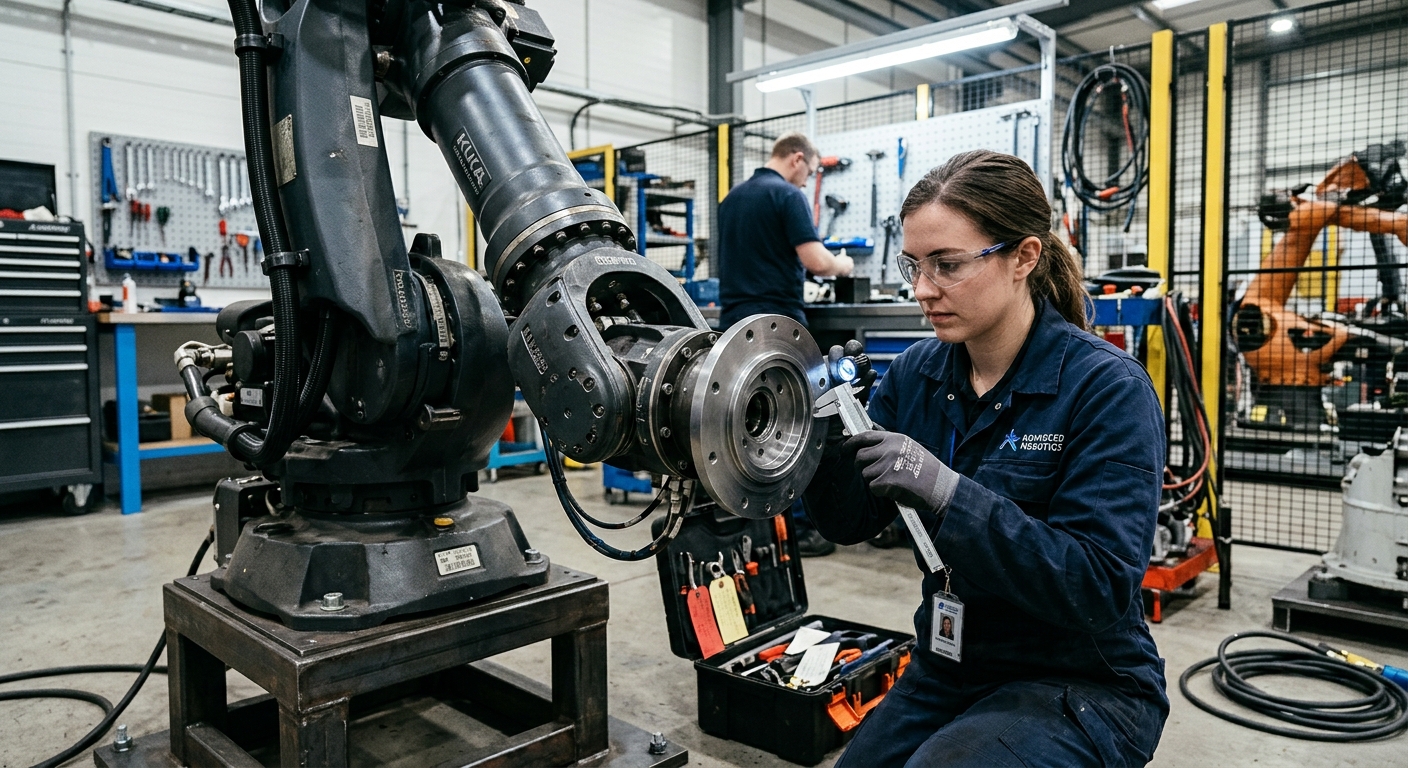

Evaluate a refurbished robot after a collision by reviewing the incident history, inspecting affected components, checking calibration, and testing against written acceptance criteria. A refurbished robot that powers up and completes a demonstration has shown basic operation. That demonstration alone does not establish whether its mechanical condition and positioning performance suit your application.
Start with the exact robot model, serial number, controller configuration, and refurbishment records. Ask what struck the robot, which components absorbed the impact, and what the repairer inspected or replaced. If the collision history is incomplete, record that uncertainty and request additional assessment before making a purchase or return-to-service decision.
This evaluation should separate physical damage from changes in robot references, tooling, or fixtures. It should also distinguish the robot’s condition from the safety of the complete installation. The following checks explain what evidence to request, how to structure controlled testing, and when specialist investigation is appropriate. Use the manufacturer’s procedures and application requirements to define the inspection scope; there is no universal post-collision pass value for every robot.
1. Establish what happened before refurbishment
Reconstruct the impact
Request available incident reports, photographs, alarm records, and repair orders. Identify the contact point, attached tool, operating mode, and affected axes. Avoid estimating impact severity from cosmetic damage alone. Distinguish information recorded at the time from later assumptions, and ask whether the robot continued operating after the incident.
The published guide to industrial robot collision inspection and recovery provides context for documenting the event and organizing subsequent checks.
Check the repair scope
Ask which components were inspected, replaced, or retained. Match repair records to the serial number. A repaint or general service description does not document the assessment of collision-related damage.
2. Inspect the structure and mounting interfaces
Follow the possible load path
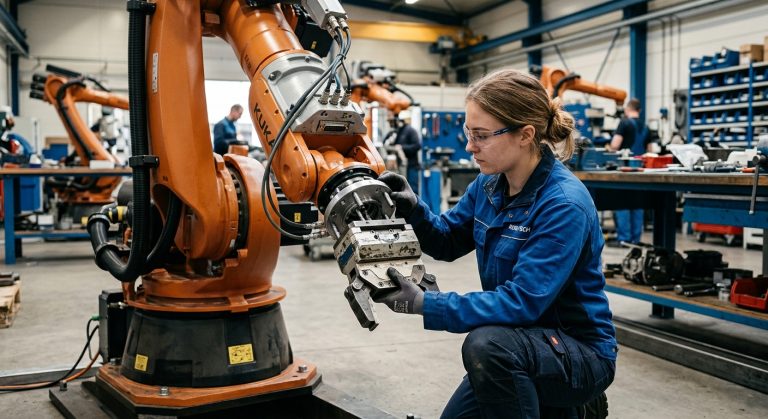
Have qualified personnel inspect the refurbished robot’s contact area, wrist, flange, adjacent structure, and mounting interfaces. Look for deformation, cracks, displaced components, damaged connectors, and leakage where applicable. Suspected structural damage requires further assessment before motion testing.
Include the base, tooling, and fixtures in the inspection. Do not tighten fasteners by guesswork; use the specified procedure and torque values for the exact assembly.
3. Assess joint movement and mechanical condition
Measure rather than judge by feel
For the refurbished robot, request manufacturer-approved checks for suspected joint play and brake problems. Record the axis, arm position, measurement method, and conditions. Compare results with the applicable service limits, rather than an unrelated robot’s readings. Keep the raw measurements with the report so another technician can review the basis for acceptance.
The guide to measuring gearbox backlash before buying a refurbished robot explains why a subjective push on the arm is insufficient evidence.
During authorized movement, document unusual noise, vibration, or inconsistent behavior. These observations justify investigation but do not, by themselves, identify a failed reducer or bearing.
4. Verify robot references and tool geometry
Separate mastering from TCP checks
Mastering establishes the relationship between joint position feedback and mechanical references. The tool center point, or TCP, defines the working tool reference. For the refurbished robot, ask for documented verification of each reference that the impact or repair could have affected.
ABB’s controller documentation identifies collisions as a possible cause of lost accuracy and gives controller-specific checks. Follow the manual for the supplied robot; do not apply another manufacturer’s calibration sequence.
A displaced tool can affect results even when joint references remain correct. The article on TCP calibration errors in robotic machining explains the geometric consequences. Verify fixtures and work frames before compensating through program edits.
5. Review controller records and configuration
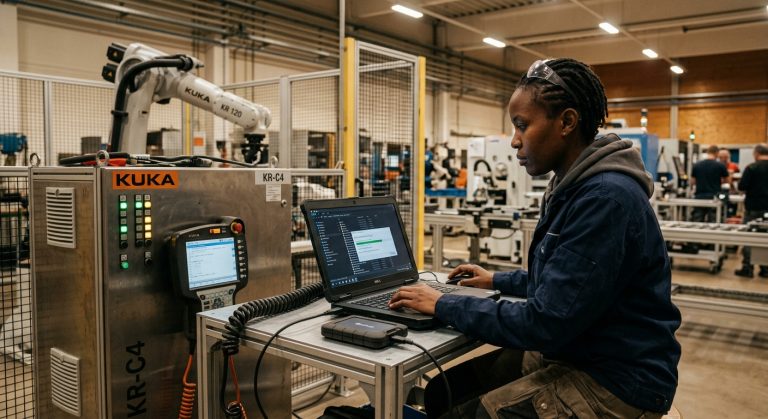
Preserve available event logs and compare the installed configuration with the repair records. Confirm the refurbished robot’s identity, software version, tool data, payload settings, and relevant options. Ask the repairer to explain unresolved alarms and configuration changes.
Request a current backup and a record of calibration work. A backup supports recovery and comparison; it does not establish mechanical condition or prove that its data matches the repaired hardware. Retain a separate record of settings changed during evaluation, including who changed them and why.
6. Use an eight-item acceptance checklist
Agree on evidence and acceptance conditions before testing the refurbished robot. Include these eight items in the inspection record:
- Confirm matching robot and controller identification against the supplied documents.
- Record known collision circumstances and explicitly identify missing incident information.
- List repairs, replaced parts, and retained components requiring further assessment.
- Document structural, mounting, tooling, cable, and connector inspection findings.
- Record joint and brake checks with methods and applicable manufacturer limits.
- Attach mastering, TCP, and work-frame verification results where relevant.
- Specify motion and application tests, including tooling and load conditions.
- Record failures, outstanding actions, retest results, and acceptance responsibility.
7. Plan controlled motion and application tests
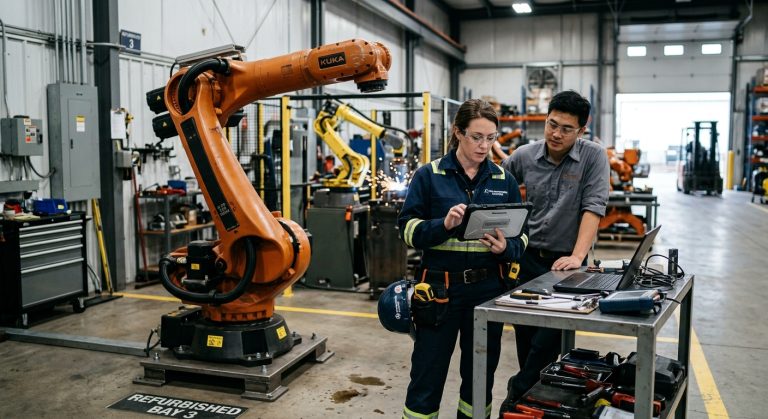
Inspection requiring hazardous-energy isolation and powered motion testing need separate procedures. Qualified personnel should establish the test area, safeguards, operating mode, and authorized recovery sequence before movement.
OSHA’s guidance on industrial robot system safety addresses maintenance hazards, risk assessment, and protective measures. Use it alongside manufacturer instructions and applicable local requirements.
Begin with controlled movements permitted by the service procedure. Check affected axes and clearances before progressing. Stop for unexpected movement, renewed interference, or unexplained faults.
Then test the refurbished robot under representative application conditions within rated limits. Define measurable results, such as placement error or machined dimensions. State the tested load, positions, and measurement method so a successful result has a clear scope. Where practical, compare repeated results with earlier traceable measurements. If no baseline exists, report compliance with the agreed criteria without claiming that original performance has been restored.
8. Decide whether the evidence supports acceptance
Accept the refurbished robot only against the agreed criteria. Repeated movement to one point cannot establish performance across every pose, load, or process. Document limitations and resolve unexplained deviations before approval.
If records or test results leave questions unresolved, contact Robotic Hi-Tech Solutions to discuss the assessment requirements. Provide the model, repair history, intended application, and available measurements.
Frequently Asked Questions
Does a collision automatically make a robot unsuitable?
No. Suitability depends on the damage, completed repairs, verified condition, and results under the intended application’s acceptance criteria.
Is a collision alarm a measure of damage?
No. Interpret the alarm using the controller documentation. It does not provide a complete mechanical damage assessment.
Must every robot be remastered after an impact?
Follow the manufacturer’s verification procedure. Remastering should address an identified requirement, rather than substitute for investigating physical damage.
Can fresh paint hide a problem?
Fresh paint provides no evidence of internal condition. Request inspection records and measurements regardless of appearance.
Should the test use the buyer’s tooling?
Use representative tooling where feasible. Document any substitute tool’s mass and geometry, and identify what the test cannot establish.
What if the seller has no collision records?
Treat the history as unknown. Agree on additional inspection and testing, or defer acceptance if the remaining uncertainty is unacceptable.
Can a video replace an acceptance test?
A video can support preliminary review. It rarely provides sufficient measurement detail, configuration evidence, or traceable conditions for final acceptance.
Does workshop acceptance approve the installed cell?
No. Installation requires its own assessment and validation, including interfaces, tooling, safeguards, and operating procedures for the complete application.