English
 Italiano
 Українська
 Русский
 Español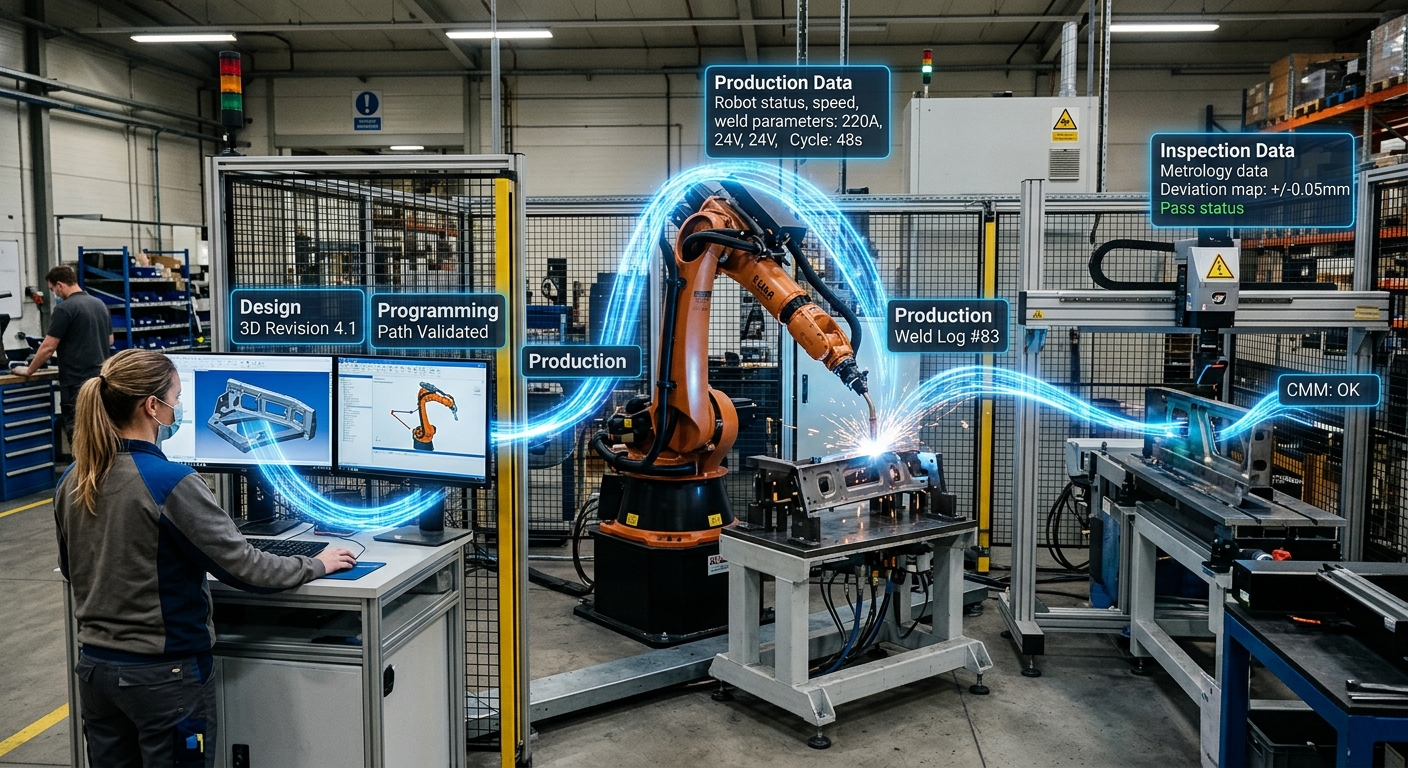

A digital thread connects information created during design, robot programming, production, and inspection so that teams can trace how a manufactured part relates to the digital information used to produce it. In robotic manufacturing, this can include CAD models, process plans, simulation files, robot programs, tool data, production records, and inspection results.
The objective is not to place every file in one database. A useful digital thread establishes identifiable relationships between information that may remain in different engineering and production systems. Those relationships help engineers determine which design revision, robot program, configuration, and process data correspond to a particular production state or manufactured item.
This article explains how a digital thread can be structured across a robotic workflow, where traceability can be lost, and which information should be connected. It also examines version control, production context, inspection feedback, system architecture, and practical implementation without assuming that every factory requires the same software platform.
What Is a Digital Thread in Robotic Manufacturing?
A digital thread is an information structure that connects related data across stages of a manufacturing lifecycle. In June 2026, ISO published ISO 23247-5:2026, which addresses digital threads for manufacturing digital twins and covers connectivity across lifecycle stages, including design, planning, production, and testing.
For a robotic cell, the thread may connect product geometry with manufacturing instructions, robot software, process parameters, production events, and quality records. The exact scope depends on the application and on which relationships must remain traceable.
A connected lifecycle model
The main requirement is identifiable continuity. If a robot program was generated from a particular design revision, that relationship should remain discoverable later. The same principle applies when inspection results must be associated with the part, process settings, or robot program that produced the measured condition.
How Design Data Starts the Digital Thread
Design information establishes much of the context used downstream. Depending on the process, relevant inputs may include CAD geometry, part identifiers, tolerances, reference systems, material information, and manufacturing requirements. Not every CAD attribute needs to move into production, but information required for process planning should remain identifiable.
Revision management matters because changing geometry after robot programming has started can invalidate paths, fixtures, process parameters, or inspection routines. The digital thread should therefore identify which design state was used to create downstream manufacturing information.
From CAD to process planning
Process planning translates design intent into manufacturing operations. For robotic machining, welding, additive manufacturing, or handling, this stage can define tooling, orientations, fixtures, sequences, and process-specific settings. A clear data relationship between these planning files and their source design reduces uncertainty when a program must later be reviewed or regenerated.
How Robot Programming Becomes Part of the Digital Thread
Robot programs are not isolated files. Their behavior can depend on tool definitions, coordinate frames, payload settings, process parameters, external-axis configurations, PLC logic, vision recipes and other controller data. A digital thread should identify the configuration associated with an approved program release.
This requirement is closely related to robot program version control. A controlled revision record helps distinguish an approved production configuration from temporary commissioning files, controller backups, or undocumented shop-floor modifications.
Controlling program versions
Program relationships should be explicit where compatibility matters. If a new robot program requires a different PLC sequence, inspection recipe, or post-processor, the compatible versions should be identifiable. They do not necessarily need to reside in one repository, but their relationship should not depend only on personal knowledge.
How Production Data Extends the Digital Thread
Once the cell begins manufacturing, the digital thread can connect engineering definitions with what actually occurred during production. Relevant records may include job or batch identifiers, active program revisions, timestamps, alarms, process states, and selected process values where those values are required for traceability or analysis.
A useful industrial robot data architecture separates information required for real-time cell control from data used for monitoring, historical analysis, and reporting. This distinction prevents traceability requirements from being confused with time-critical control functions.
Adding production context
Raw values have limited meaning without context. A temperature, robot position, or process state becomes more useful when it can be associated with the relevant product, operation, machine, recipe, or production order. The required level of detail should be based on the decisions the organization expects the data to support.
How Inspection Closes the Information Loop
Inspection adds evidence about whether the manufactured result meets defined requirements. Records may come from dimensional inspection, machine vision, process monitoring, manual checks, or other quality systems. The digital thread connects those results with the manufacturing information needed to interpret them.
This connection can support investigation when a deviation is detected. Engineers can compare inspection findings with the applicable design revision, program release, and production context instead of examining quality results as an isolated dataset.
Closing the feedback loop
Inspection should not automatically change robot programs or design definitions. Instead, measured results can provide evidence for controlled engineering decisions. When a corrective change is approved, the revised design, process plan, or program should receive its own identifiable revision so the history remains traceable.
Eight Checks Before Implementing a Digital Thread
Before connecting systems, define what must remain traceable and why. These eight checks help establish a manageable scope:
- Identify lifecycle stages: List the design, planning, programming, production, and inspection stages that generate information needed later.
- Define authoritative sources: Record which system owns each important design, program, process, or quality record.
- Assign identifiers: Use stable identifiers for parts, revisions, programs, jobs or other objects that must be connected.
- Map data relationships: Document which design revision generated each process plan and which program release belongs to that plan.
- Control revisions: Separate approved production information from development files, temporary edits, and superseded versions.
- Add production context: Determine how production records will be associated with the correct product, job, program, and equipment.
- Connect inspection results: Ensure quality records can be traced to the manufacturing state required to interpret the result.
- Test retrieval: Verify that an engineer can reconstruct the relevant information chain without relying on undocumented knowledge.
Data Architecture and Interoperability Requirements
A digital thread often crosses systems from different vendors. CAD, offline programming software, robot controllers, PLCs, manufacturing systems, databases and inspection platforms may use different formats and communication methods. Integration therefore requires explicit interface definitions rather than assuming that data will remain compatible automatically.
Where processing should occur also matters. The RHTS comparison of edge and cloud computing for industrial robot data explains how local and centralized processing serve different purposes. A digital thread may use both while keeping control functions separate from historical or analytical workloads.
Standards can provide a reference framework without prescribing one software product. ISO 23247-5:2026 specifically describes digital thread principles for connecting and maintaining manufacturing digital twins across lifecycle stages. Organizations should still define their own identifiers, governance, access rules and retention requirements for the application.
Implementing a Digital Thread Without Unnecessary Complexity
Implementation should begin with a defined traceability problem rather than with maximum data collection. For example, a manufacturer may first need to determine which design revision and robot program produced a specific part. That requirement establishes the minimum identifiers and relationships that must be preserved.
The next step is to test whether the information chain survives normal changes. Replace a program revision, update a process plan, or record a new inspection result, then verify that previous relationships remain accessible. A digital thread that works only while files remain unchanged does not provide useful lifecycle traceability.
For projects where design systems, robot programming, controllers, and production data must be integrated into a consistent architecture, manufacturers can contact Robotic Hi-Tech Solutions with details of the robot platform, process, and existing software environment for a technical assessment.
FAQ
What is a digital thread in manufacturing?
It is a structured connection between related digital information across manufacturing lifecycle stages, allowing data from design, planning, production, and inspection to remain traceable.
Is a digital thread the same as a digital twin?
No. A digital twin is a digital representation associated with a manufacturing element or process. A digital thread describes information connections that can link digital twins and lifecycle data.
Does a digital thread require one software platform?
No. Information can remain in different systems if identifiers, interfaces, and relationships allow the relevant records to be connected and retrieved reliably.
Which robot data should be included?
Include data needed to identify or reproduce the relevant manufacturing state, such as program revisions, configuration information, and process records. The exact scope depends on the application.
Should every robot variable be stored?
No. Data collection should follow defined traceability, quality, maintenance or analysis requirements. Recording variables without a defined use can add storage and management complexity.
How does version control support a digital thread?
Version control identifies which design, program, or configuration revision was valid at a specific point, making relationships between engineering changes and production states traceable.
Can inspection data be part of the digital thread?
Yes. Inspection results can be connected with the relevant part, design revision, production job, and manufacturing configuration when those relationships are needed for quality analysis.
Can older robotic cells support a digital thread?
Potentially. The practical scope depends on available controller interfaces, accessible data, surrounding PLC or supervisory systems, and whether additional integration layers are required.