English
 Italiano
 Українська
 Русский
 Español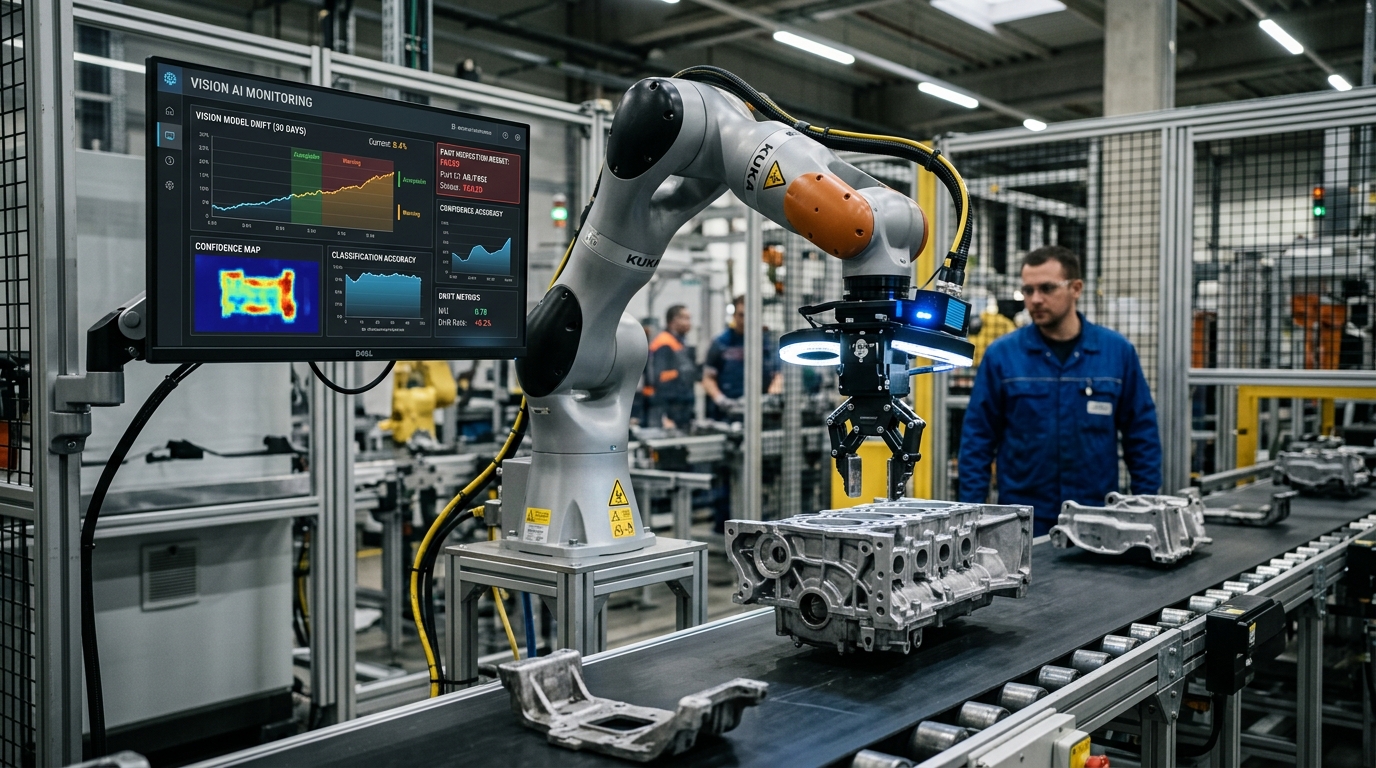

Model drift in robot vision occurs when an AI-based vision model no longer performs as expected under the conditions it encounters in production. The model itself may not have changed, but the images, objects, lighting, processes, or relationships represented by new data may differ from those used during development and validation.
This matters because a vision-guided robot can depend on AI outputs for object classification, localization, inspection, bin picking, sorting, or other decisions. A model that performed adequately during commissioning can become less reliable when production conditions change. The resulting problem may appear as missed detections, false classifications, unstable confidence scores, or incorrect robot actions.
Managing drift therefore requires more than installing an AI model and monitoring whether the camera remains online. Manufacturers need defined reference data, performance indicators, production context, change records, and a controlled method for reviewing or updating the model. The objective is to detect meaningful deterioration before unreliable predictions become accepted as normal process behavior.
What Does Model Drift in Robot Vision Mean?
Model drift is commonly used as an operational term for deterioration in model performance after deployment. Several different changes can produce that deterioration, so identifying the mechanism is important before deciding whether retraining is necessary.
Data Drift Changes What the Model Sees
Data drift occurs when the distribution of input data changes. In robot vision, this could involve different part finishes, camera exposure, background appearance, packaging, object orientation, contamination, shadows, or other visual characteristics. A model trained mainly on one set of conditions may respond differently when those conditions move outside its original data distribution.
Concept Drift Changes the Relationship With the Correct Output
Concept drift is different. It concerns a change in the relationship between the input and the desired prediction. For example, a manufacturer may change the criteria defining an acceptable surface defect. The images may remain similar, but the correct classification expected from the system has changed.
Why Does Drift Matter in an AI-Powered Robot Cell?
A conventional programmed vision rule may fail when a measurable threshold or geometric condition is no longer satisfied. AI-based models introduce another consideration: their behavior depends partly on patterns learned from training data. Production changes that appear minor to an operator can affect those patterns.
Prediction Errors Can Affect Robot Decisions
If vision output is used to guide robot motion, an incorrect detection can propagate into the automation sequence. Depending on the application, the consequence might be a rejected pick, an incorrectly sorted component, a failed inspection, or a request for operator intervention. The specific effect depends on how much authority the vision result has within the cell logic.
Model drift in robot vision does not necessarily produce an immediate or complete failure. Performance can deteriorate gradually, making the problem harder to distinguish from ordinary process variation. Monitoring therefore needs to look at trends and verified outcomes rather than waiting for the system to stop working.
What Causes Vision Models to Drift in Production?
Manufacturing environments change, and these changes can contribute to model drift in robot vision. Materials come from different batches, tooling is replaced, fixtures wear, suppliers change packaging, new product variants are introduced, and cameras or lighting equipment may be adjusted. Any of these changes can alter the data reaching a vision model.
Changes in the Imaging Environment
Lighting is especially relevant because computer vision operates on image data rather than on an operator’s interpretation of the physical object. Illumination angle, intensity, reflections, camera settings, lens contamination, and background conditions can modify the visual features available to the model.
Changes in Products and Processes
A new coating, label, component revision, surface texture, container, or orientation pattern can also alter the input distribution. This does not automatically mean the model must be retrained. It means the new condition should be tested against defined performance requirements rather than assumed to be equivalent to the original production condition.
How Can Manufacturers Detect Model Drift?
Detecting model drift in robot vision starts with a baseline. During validation, the manufacturer should retain information about the data and conditions under which the model achieved acceptable results. Future observations can then be compared against that reference.
Monitoring model drift in robot vision may include prediction distributions, confidence scores that are technically meaningful, class frequencies, rates of rejected or uncertain detections, manually verified outcomes, and changes in relevant image characteristics. None of these indicators should be interpreted alone. A changing confidence distribution, for example, is a signal for investigation rather than proof that the model is wrong.
Ground-truth verification remains important. If production personnel periodically confirm whether predictions are correct, those labelled examples provide direct evidence about operational performance. Without verified outcomes, a monitoring system may detect that inputs have changed without determining whether the change actually affects the required task.
Eight Checks for Managing AI Vision Model Drift
A practical monitoring plan should connect model behavior with the actual manufacturing process. These eight checks help define what should be reviewed after deployment:
- Record the validated operating conditions. Document relevant products, cameras, lighting arrangements, image settings, classes, and process conditions represented during acceptance testing.
- Track production changes. Record new product variants, materials, suppliers, fixtures, packaging, finishes, and other changes that could alter the images presented to the model.
- Preserve representative examples. Retain suitable samples of accepted, rejected, uncertain, and unusual cases so performance can be compared over time.
- Monitor prediction behavior. Review changes in class frequency, failed detections, uncertain outputs, and other model indicators that are relevant to the application.
- Verify predictions against known outcomes. Use inspected or manually labelled samples when practical to determine whether model performance has actually changed.
- Inspect the vision hardware. Check camera position, focus, lens condition, illumination, connections, and relevant settings before assuming that an AI model is responsible for deteriorating results.
- Define investigation thresholds. Establish conditions that trigger engineering review, such as repeated misclassification of defined cases or performance falling outside an approved acceptance criterion.
- Control model updates. Keep versions of models, datasets, configuration parameters, validation results, and deployment dates so an update can be traced and evaluated.
Does Every Drift Event Require Retraining?
No. Retraining should follow diagnosis rather than become an automatic response to every change in model behavior. If the real problem is a moved camera, dirty lens, damaged light, incorrect exposure, or unexpected product presentation, adding new training data may conceal the underlying process problem instead of correcting it.
Retraining becomes relevant when model drift in robot vision reflects a legitimate production-data change and the existing model no longer meets the required acceptance criteria. New training examples should represent the conditions the system is expected to handle. The revised model should then be validated before replacing the production version.
Keeping the previous approved model and its associated configuration also supports controlled rollback when a new version does not behave as expected. Model deployment should therefore be treated as a managed engineering change rather than an informal software replacement.
How Should Drift Monitoring Fit Into Robot Cell Data Management?
Vision results become more useful when they can be related to production context. A timestamp alone may not explain a failure. Engineers may also need the product variant, active robot program, vision recipe, model version, camera identifier, cell state, and relevant process conditions.
This is why the wider industrial robot data architecture matters. Defining authoritative data sources, timestamps, storage, interfaces, and failure behavior makes it easier to associate vision performance with events elsewhere in the production cell.
AI governance also extends beyond model accuracy. ISO/IEC 42001:2023 specifies requirements for establishing, implementing, maintaining, and continually improving an AI management system. Organizations using AI can consult the ISO/IEC 42001 AI management system standard when developing broader processes for AI governance, risk management, traceability, and continual improvement.
When Should a Robot Vision System Be Reassessed?
Reassessment of model drift in robot vision is appropriate after significant changes to the product, image acquisition system, manufacturing environment, model, decision thresholds, or automation logic that depends on the prediction. It is also appropriate when monitoring identifies unexplained changes in operational performance.
The review should consider the complete chain from image acquisition to robot action. Camera hardware, calibration, lighting, preprocessing, model version, software interfaces, PLC logic, robot programs, and physical process conditions can all influence the final result. Treating every problem as an AI problem can delay identification of a simpler integration or hardware fault.
For manufacturers evaluating how AI vision, robot control, sensing, and production data should be integrated within a specific application, contact Robotic Hi-Tech Solutions with information about the process, robot platform, vision task, product variation, and required outputs so the technical requirements can be reviewed in context.
FAQ
What is model drift in robot vision?
It is deterioration or change in an AI vision model’s operational performance as production data or the relationship between inputs and expected outputs changes after deployment.
Is model drift the same as data drift?
Not necessarily. Data drift describes changes in the input distribution. Operational model drift can result from data drift, concept drift, or other changes that affect model performance.
Can changing factory lighting cause apparent model drift?
Yes. Changes in illumination can alter image characteristics and therefore model inputs. Lighting, camera condition, and settings should be checked before concluding that the model itself requires modification.
How often should an AI vision model be checked?
There is no universal interval. Monitoring frequency should reflect application risk, production variability, process changes, available ground truth, and the consequences of an incorrect prediction.
Should low confidence automatically stop a robot?
Not by default. Confidence values must be interpreted according to the specific model and validation method. Any decision to stop, reject, retry, or request operator review should be defined and tested within the cell logic.
Does retraining always solve model drift?
No. Retraining will not correct issues such as poor illumination, camera movement, contamination, incorrect calibration, or process faults. The cause of deteriorating performance should be identified first.
What records should be kept when a vision model is updated?
Useful records include the model version, relevant dataset version, configuration, deployment date, validation conditions, acceptance results, and the reason for making the change.
Can model drift affect robot safety?
That depends on the system architecture. AI vision outputs should not be assumed to perform a safety function unless the complete safety-related system is specifically designed and validated for that purpose under the applicable requirements.