English
 Italiano
 Українська
 Русский
 Español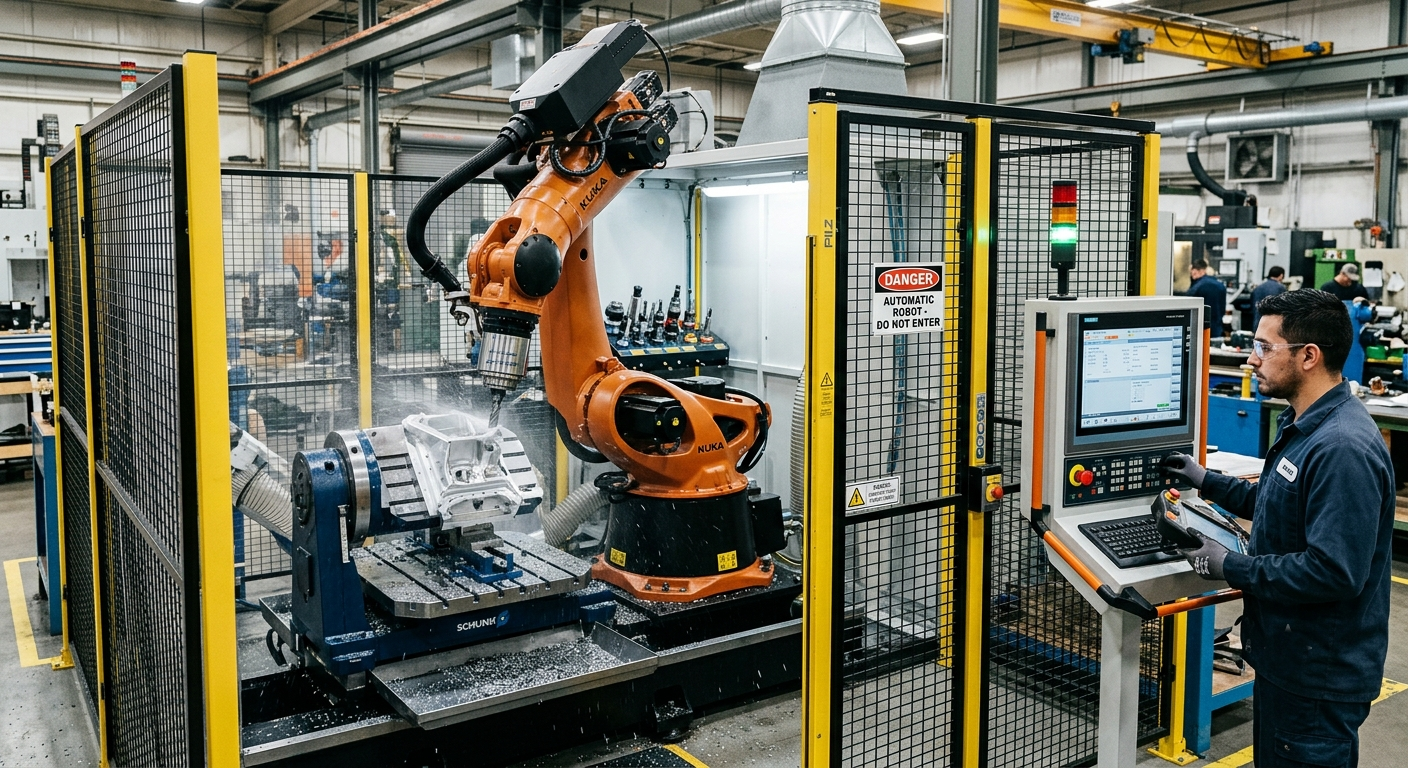

A Robotic Milling Cell Is Only as Safe as the System Around the Robot
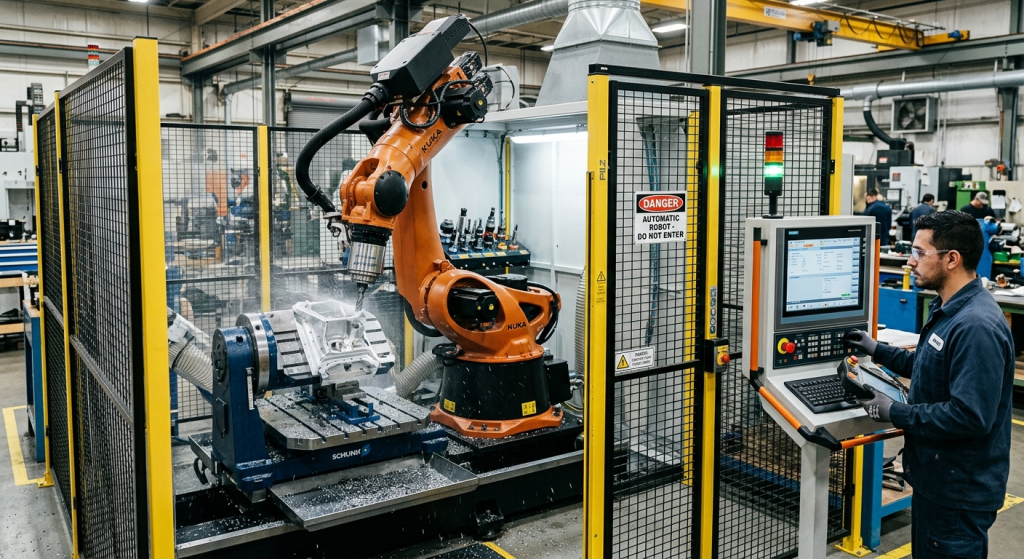
Choosing a robot for milling is rarely the highest safety risk in the project. The greater challenge is designing a robotic milling safety architecture that considers every source of hazardous motion, energy, and operator interaction before production begins. A robot that follows a programmed path consistently can still become part of an unsafe cell if guarding, access control, emergency stopping, and recovery procedures are treated as separate decisions instead of one integrated system.
Unlike many handling applications, robotic milling introduces additional hazards from rotating cutting tools, flying chips, dust, workpiece clamping, and process forces. The robot is only one element within a manufacturing cell that also includes the spindle, fixtures, tool changers, extraction systems, sensors, safety controllers, and operator interfaces. Every component contributes to the overall safety architecture.
For this reason, successful robotic milling projects begin with risk assessment rather than equipment selection. Safety measures should reflect the complete production process, not simply the robot manufacturer’s documentation.
Risk Assessment Should Drive the Safety Architecture
Every robotic milling cell requires a structured risk assessment before the mechanical layout is finalized. The objective is to identify reasonably foreseeable hazards during automatic production, manual intervention, maintenance, programming, and recovery after faults.
Potential hazards include:
- Unexpected robot movement during setup or recovery.
- Contact with rotating cutting tools.
- Ejection of chips or broken tooling.
- Movement of fixtures or automatic clamps.
- Stored pneumatic, hydraulic, or electrical energy.
- Dust accumulation and extraction failures.
- Manual intervention inside the safeguarded space.
Many companies assume production mode represents the highest risk. In practice, maintenance, teaching, troubleshooting, and restart operations frequently expose personnel to situations that require carefully designed operating modes and access procedures.
For a broader industrial safety context, OSHA’s robotics guidance emphasizes that robotic systems include the robot together with associated equipment, controls, end effectors, and supporting machinery rather than the robot arm alone.
The Main Safety Components of a Robotic Milling Cell
A compliant safety architecture is built from multiple coordinated protective measures instead of relying on one protective device.
Physical Guarding
Fixed fencing and enclosed machining areas help prevent personnel from entering hazardous zones during automatic operation. Milling applications often require enclosed guarding to contain chips, coolant, and broken tooling in addition to preventing access to moving equipment.
Interlocked Access Doors
Access doors should communicate directly with the safety control system. Opening an authorized access point must trigger the appropriate protective stop according to the validated safety design rather than depending on operator judgment.
Safety Controllers
Modern robotic cells coordinate emergency stops, gate switches, enabling devices, light curtains where appropriate, and other safety devices through dedicated safety controllers or safety PLCs. These devices help ensure protective functions respond consistently throughout the cell.
Emergency Stop System
Emergency stop devices should remain clearly visible and accessible from operator stations, loading positions, maintenance areas, and other locations where intervention may be required. Their placement should reflect how personnel actually interact with the equipment rather than simply satisfying minimum installation practices.
Safe Operating Modes
Production mode, teaching mode, maintenance mode, and recovery mode should each apply different operating conditions, speed limits, and access permissions. Allowing full production motion during maintenance significantly increases operational risk.
Safety Standards and Regulations Apply to the Entire Cell
Companies often ask which regulation applies to robotic milling. The more accurate question is which regulations apply to every component and function within the complete robotic system.
Depending on jurisdiction and project scope, applicable machinery legislation and internationally recognized standards may influence requirements for:
- Risk assessment methodology.
- Protective guarding.
- Emergency stopping.
- Functional safety.
- Electrical safety.
- Operator access.
- Validation before commissioning.
International standards published by ISO provide recognized frameworks for machinery and industrial robot safety. However, plants should verify which standards and legal obligations apply within their country and industry before final cell approval. Compliance should never be assumed simply because certified components have been installed.
Safety Must Consider the Milling Process, Not Only Robot Motion
Unlike pick-and-place applications, robotic milling introduces hazards that continue even if robot movement stops.
Rotating Spindles
Cutting tools may continue rotating after robot motion has ceased. Recovery procedures should account for spindle stopping time before permitting safe access.
Tool Changes
Automatic tool changers require their own hazard analysis because mechanical movement, stored energy, and incorrect tool engagement can introduce additional risks.
Dust and Chip Management
Material removal processes generate airborne particles and chips that may affect visibility, equipment reliability, and operator health. Extraction systems should therefore be considered part of the overall cell design rather than optional accessories.
Fixture Integrity
A secure workholding system is a safety issue as well as a machining requirement. A poorly clamped workpiece may become hazardous if cutting forces exceed fixture capability.
Validation Before Production Is as Important as Design
Installing safety devices does not complete a robotic milling project. Every protective function should be verified before the cell enters production.
Validation normally includes confirming that:
- Emergency stops operate correctly.
- Safety gates trigger the intended protective response.
- Operating modes function as designed.
- Recovery procedures are documented.
- Safety devices communicate correctly with the control system.
- Maintenance access follows approved procedures.
- Operators receive appropriate training before production begins.
When Additional Automation Does Not Automatically Improve Safety
Adding more sensors or automated functions does not necessarily produce a safer robotic milling cell. Complexity can increase validation requirements, create additional failure modes, and make troubleshooting more difficult if system architecture is not carefully planned.
Similarly, replacing manual milling with robotic automation should not compensate for unstable fixtures, inconsistent workpiece presentation, or poorly controlled machining parameters. Automation reproduces process conditions consistently, whether those conditions are good or bad.
Practical Checklist Before Commissioning a Robotic Milling Cell
The following checklist helps verify that key safety considerations have been addressed before production approval. It should complement, not replace, a formal risk assessment and validation process.
- Complete a documented risk assessment covering all operating modes.
- Verify guarding contains both personnel hazards and machining debris.
- Confirm all access points are integrated with the safety control system.
- Validate emergency stop functions throughout the cell.
- Review spindle stopping behavior before permitting access.
- Verify fixture integrity under expected machining loads.
- Confirm extraction systems operate correctly.
- Document recovery and maintenance procedures.
- Train operators, programmers, and maintenance personnel before production.
- Validate all protective functions prior to commissioning.
FAQ
Which regulations usually apply to robotic milling cells?
Requirements depend on the country, industry, and machinery involved. Most projects combine applicable machinery legislation with recognized standards covering industrial robots, machinery safety, functional safety, electrical systems, and risk assessment.
Does installing safety fencing guarantee compliance?
No. Guarding is only one element of a complete safety architecture. Validation, operating procedures, safety controls, emergency stops, access management, and documented risk assessment remain essential.
Why is robotic milling considered more complex than simple material handling?
Milling introduces rotating cutting tools, process forces, chips, dust, tool changes, and workholding considerations in addition to robot motion. These hazards require a broader safety approach.
Should maintenance activities be included in the initial risk assessment?
Yes. Maintenance, teaching, troubleshooting, and fault recovery often expose personnel to hazards that are not present during automatic production. These situations should be evaluated during the original system design.
Can automation eliminate all safety risks?
No. Automation changes how risks are managed rather than eliminating them. The objective is to reduce risk through appropriate engineering controls, procedures, training, and validated protective functions.
Does collaborative robot technology reduce safety requirements in robotic milling?
Not necessarily. Although collaborative robots are designed with features that can support human interaction in specific applications, robotic milling often involves rotating spindles, cutting forces, chips, and tooling hazards that require additional safeguarding. The safety architecture should always be based on a formal risk assessment of the complete milling cell rather than the robot type alone.
How often should the safety functions of a robotic milling cell be validated?
Safety functions should be validated before the cell is commissioned, after significant modifications, and whenever changes are made to the robot program, tooling, guarding, or safety control system that could affect risk levels. Regular inspections and documented verification procedures also help ensure that protective functions continue to operate as intended throughout the cell’s service life.
Who is responsible for ensuring a robotic milling cell meets applicable safety requirements?
Responsibility is typically shared among equipment manufacturers, system integrators, employers, and the end user, depending on the project’s scope and the applicable regulations. The organization operating the cell should ensure that a documented risk assessment, proper validation, operator training, and safe operating procedures are completed before the system enters production.
Why is robotic milling safety considered during the design stage?
Robotic milling safety should be addressed before equipment is installed because the overall cell architecture determines how hazards are controlled throughout production, maintenance, and operator intervention.
Talk to RHS About Robotic Milling Safety
If you are evaluating robotic milling safety or planning a new robotic milling cell, contact RHS. We will provide practical guidance based on your production requirements.