English
 Italiano
 Українська
 Русский
 Español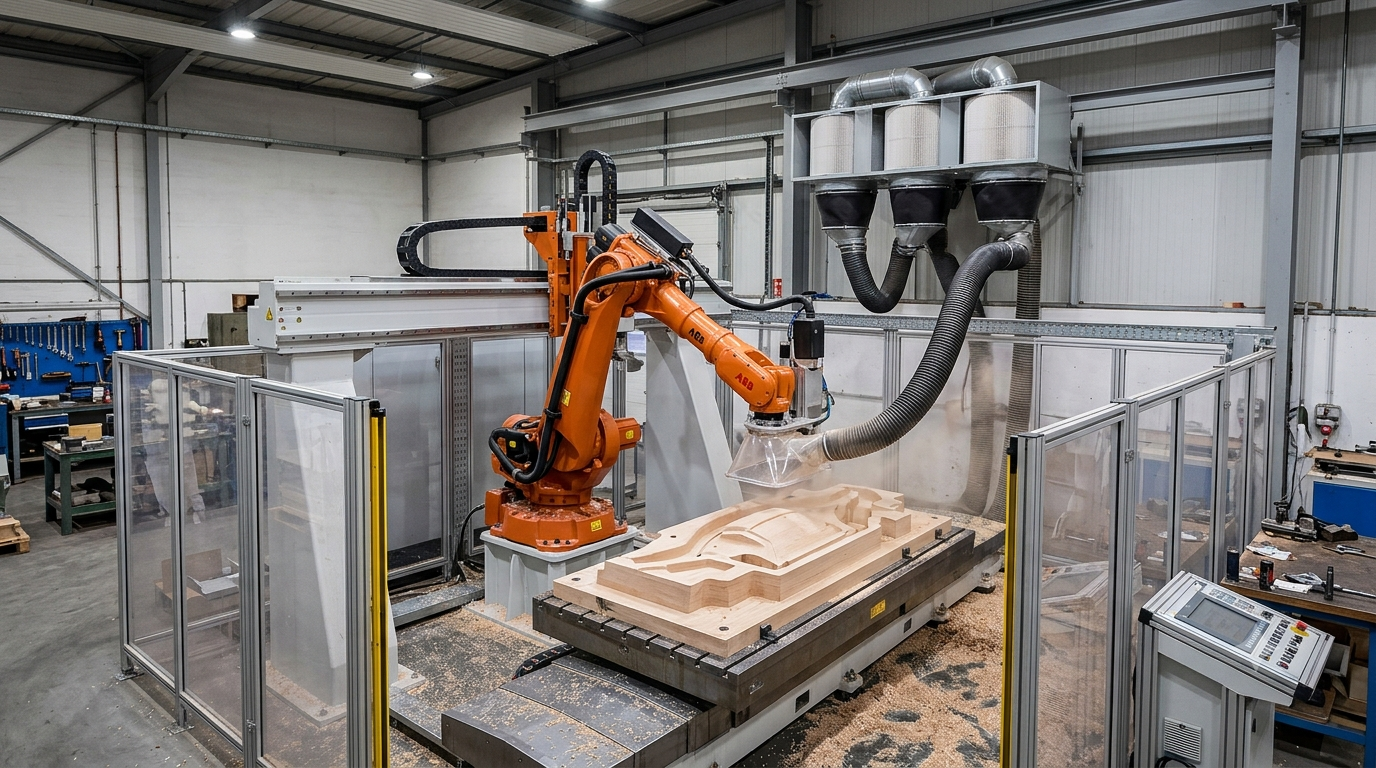

The Robot Is Rarely the Source of the Problem
Robotic milling dust extraction is often treated as a secondary engineering consideration compared with robot selection, spindle performance, or toolpath strategy. In large-format robotic milling cells, however, extraction performance can influence uptime, part quality, maintenance requirements, and overall production stability. A system that appears successful during commissioning can become a recurring source of downtime when chip and dust management is not designed for continuous production conditions.
The assumption is often that robotic milling performance depends primarily on the robot, spindle, and toolpath. In practice, many large-format milling projects encounter operational problems because chip and dust management was treated as an auxiliary system rather than a production-critical one. The result is not simply a housekeeping issue. Poor extraction can affect part quality, maintenance requirements, downtime, equipment life, and operator intervention.
The challenge becomes more significant as the workpiece size increases. Large-format robotic milling cells frequently process composite materials, tooling board, foam, plastics, wood-based materials, and other substrates capable of generating substantial volumes of chips, fine dust, or airborne particulate. A cell that appears technically sound during initial testing can experience performance degradation when production volumes increase, and debris accumulation becomes continuous.
The question is not whether a robotic milling cell needs extraction. The real question is whether the extraction strategy can maintain stable production conditions throughout the operating cycle.
For many manufacturers, robotic milling dust extraction becomes a deciding factor in long-term cell reliability because cleaning, maintenance, and contamination control directly influence production stability.
Why Extraction Requirements Increase with Cell Size
Large-format robotic milling creates conditions that differ significantly from enclosed CNC machining centers. The work envelope is larger, tool movement is more extensive, and material removal may occur across multiple orientations and heights within the same machining cycle.
As the robot traverses a large workspace, chips and dust can disperse over wider areas. Material may accumulate on fixtures, floor surfaces, cable routing systems, guarding structures, and sensing equipment. Unlike compact machining centers designed around containment, robotic milling cells often require extraction strategies that account for open-space movement.
Large-format robotic milling introduces several challenges that become more pronounced as the robot moves across an extended work envelope. Dust and chip management is one of them, but surface quality can also be affected by factors such as robot dynamics, structural behavior, and machining strategy. Robotic Hi-Tech Solutions discusses these considerations in its article on how robot dynamics influence surface quality in large-format robotic milling.
This creates a practical challenge. The extraction system must remain effective regardless of where the robot is operating within the cell. Collection performance that works well near one section of the work envelope may become inadequate elsewhere if airflow design, hood placement, or extraction routing has not been evaluated correctly.
Dust Extraction Is Also a Quality Control Issue
Dust management is frequently discussed as a maintenance or safety topic, but it also affects process stability. Material accumulation around fixtures, reference surfaces, sensors, or workholding systems can introduce variation into the machining process.
When debris remains on fixture surfaces between cycles, part positioning consistency may deteriorate. If sensors become contaminated, detection accuracy can suffer. Fine particulate can also interfere with machine vision systems, measurement devices, and other process-control technologies integrated into the cell.
In some materials, airborne dust can settle on finished surfaces, creating secondary cleaning requirements before inspection, assembly, bonding, painting, or finishing operations. The resulting quality issues are often attributed to downstream processes even though the root cause originates inside the milling cell.
Effective robotic milling dust extraction is often evaluated through maintenance hours, cleaning requirements, sensor reliability, and process consistency rather than extraction performance alone.
Technical Requirements for Effective Robotic Milling Dust Extraction
An effective robotic milling extraction strategy depends on more than installing a larger vacuum system. Several technical variables influence performance.
Tool-Level Capture
The closer dust and chips are captured to the cutting process, the more effective the extraction generally becomes. Collection systems integrated near the spindle or cutting area often reduce the volume of airborne material that escapes into the broader work envelope.
Airflow Consistency Throughout the Work Envelope
Large-format cells may include significant robot travel distances. Extraction effectiveness should remain consistent regardless of robot position. Dead zones can develop when the airflow design does not account for the full operating envelope.
Material Characteristics
Different materials generate different waste streams. Large chips, fibrous debris, composite dust, and fine particulate may require different collection approaches. A system optimized for one material may perform poorly when production shifts to another.
Maintenance Accessibility
Filters, ducts, collection containers, and extraction equipment require regular inspection and servicing. If maintenance access is difficult, performance degradation may go unnoticed until production problems emerge.
Common Mistakes When Designing Dust Management Systems
The first mistake is treating extraction as a facility utility rather than a production system. When extraction performance directly affects quality, uptime, and equipment reliability, it becomes part of the manufacturing process itself.
The second mistake is sizing extraction requirements around average conditions instead of peak material removal rates. Production environments rarely operate under average conditions continuously. Systems must accommodate the most demanding operating scenarios likely to occur.
The third mistake is focusing exclusively on visible chips. Fine particulate often creates more significant long-term operational challenges because it can migrate into equipment, electrical systems, sensors, and maintenance areas.
Many robotic milling dust extraction problems originate during the design phase, when airflow requirements are estimated without considering the full work envelope and actual material removal rates.
Another frequent error is failing to define ownership of extraction maintenance. Robotic systems typically receive structured maintenance planning, while extraction equipment may fall between facility and production responsibilities.
When Extraction Challenges May Delay Automation
Not every milling process is immediately ready for robotic automation. Certain applications should trigger additional evaluation before investment decisions are finalized.
If the material generates unusually high volumes of airborne particulate, specialized containment and filtration requirements may significantly influence project feasibility. Similarly, applications involving multiple materials may require extraction systems capable of handling changing waste characteristics.
Facilities with limited infrastructure capacity may also need to assess whether existing extraction equipment can support the robotic cell or whether dedicated systems are required.
In these situations, the extraction strategy should be developed during the early design phase rather than added after robot selection. A technically suitable robot cannot compensate for inadequate environmental control.
Dust accumulation is not only a housekeeping issue. Fine particulate can affect sensors, electrical enclosures, maintenance access, and overall cell reliability. For a broader industrial robotics safety context, OSHA’s robotics guidance treats robotic systems as more than the robot arm itself, including associated equipment, controls, energy sources, and end effectors.
What to Verify Before Investing
Before approving a large-format robotic milling project, use the following checklist to evaluate extraction readiness.
- Identify all materials that will be machined in production.
- Assess expected chip and dust generation characteristics.
- Determine whether extraction performance can be maintained across the full robot work envelope.
- Verify compatibility between spindle configuration and collection approach.
- Evaluate cleaning and maintenance access requirements.
- Define responsibility for filter inspection and replacement.
- Review potential impacts on sensors, fixtures, and downstream quality processes.
- Assess whether the facility infrastructure can support the extraction demand.
- Include extraction performance criteria within project acceptance requirements.
- Confirm long-term maintenance and support planning.
A robotic milling cell should be evaluated as a complete production system. Successful robotic milling dust extraction depends on matching the extraction strategy to the material, work envelope, maintenance requirements, and production volume expected from the cell. Extraction performance, maintenance accessibility, and environmental control can influence outcomes just as significantly as robot selection or toolpath strategy.
FAQ
Why is dust extraction important in robotic milling cells?
Dust extraction helps maintain process stability, equipment reliability, operator safety, and part quality. Poor extraction can lead to contamination, maintenance issues, and production interruptions.
Does robotic milling generate more dust than CNC machining?
Not necessarily, but robotic milling often operates in larger and more open environments. This can make dust containment and collection more challenging than in enclosed machining centers.
Can dust accumulation affect machining quality?
Yes. Debris can interfere with fixtures, sensors, measurement systems, and downstream finishing operations, potentially introducing quality variation.
Should the extraction be designed before selecting the robot?
Extraction planning should occur during the overall cell design phase. Waiting until after robot selection can create layout, airflow, and maintenance challenges that are more difficult to solve later.
What is the biggest mistake companies make with robotic milling extraction?
The most common mistake is treating extraction as a secondary facility system rather than a production-critical component that directly affects uptime, quality, and maintenance performance.
Talk to RHS About Robotic Milling Dust Extraction
If you are evaluating robotic milling dust extraction, contact RHS. We will give you a direct, technical answer based on your actual production requirements.