English
 Italiano
 Українська
 Русский
 Español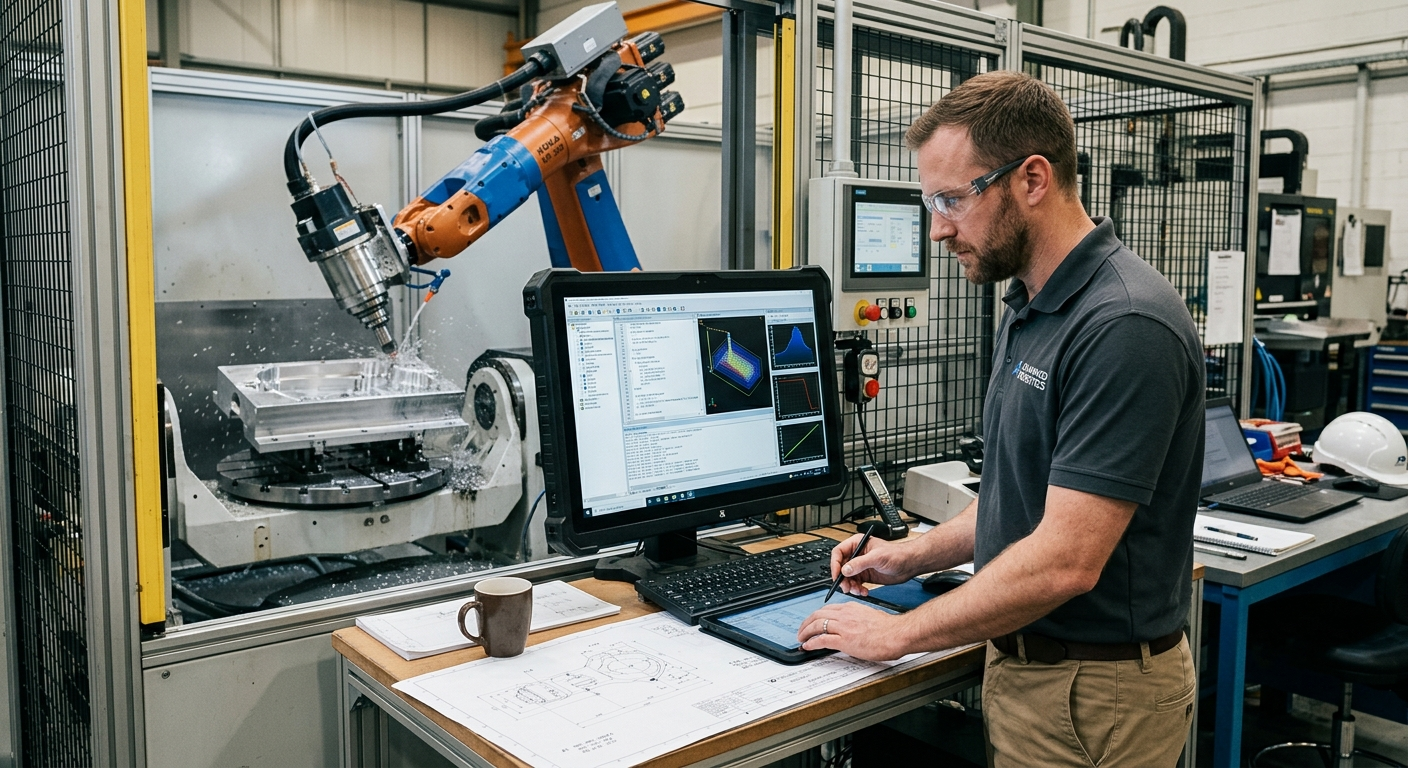

The Milling Robot Is Rarely the Problem
The challenge is that robotic milling is fundamentally different from conventional CNC machining. A CNC machine generally operates within a fixed kinematic structure that the CAM software already understands. An industrial robot introduces additional axes, singularity risks, multiple possible arm configurations, external positioners, and dynamic motion constraints that must be translated correctly during post-processing by a robotic milling post-processor.
A robot may be mechanically capable of performing the required milling operation, but if the post-processor cannot reliably convert CAM output into executable robot motion, programming time increases, verification becomes more difficult, and production risk grows.
This is why many robotic milling projects should evaluate the CAM-to-robot workflow as carefully as the robot hardware itself.
Why Robotic Milling Creates Different Post-Processing Requirements
A robotic milling cell does not simply follow a toolpath. The robot controller must calculate how the arm moves through space while maintaining tool orientation, avoiding singularities, respecting joint limits, and coordinating with any external axes.
In a conventional CNC environment, the machine configuration is usually known and predictable. The post-processor converts toolpaths into machine-specific code within a relatively fixed framework.
Robotic milling introduces significantly more kinematic complexity. Multiple robot poses may achieve the same cutter position. Some poses may be efficient and stable, while others may place joints near limits or create abrupt orientation changes.
The robotic milling post-processor must therefore do more than translate geometry. It must generate motion instructions that remain practical for the robot’s physical configuration.
Robot Kinematics Matter
Robot kinematics becomes increasingly important as toolpaths grow more complex. Five-axis and multi-axis milling operations often require continuous orientation changes that may appear valid inside CAM software but create motion problems when executed on the robot.
Without proper post-processing logic, programmers may discover issues only during simulation or commissioning, when corrections become significantly more expensive.
External Axes Add Another Layer
Many advanced robotic milling cells include rotary tables, positioners, linear tracks, or other coordinated axes. These components can dramatically improve reach and tool access.
However, every additional axis increases the complexity of post-processing. The system must determine how robot motion and external-axis motion are coordinated while maintaining acceptable cutting conditions throughout the operation.
Singularity Management Is Often Underestimated
One of the most common challenges in robotic milling is singularity management.
A CAM-generated path may appear smooth when viewed as a cutter motion. The robot, however, may encounter configurations where small tool movements require large joint movements. These situations can create instability, unexpected velocity changes, or controller warnings.
The post-processor plays an important role in identifying and avoiding these situations before code reaches production.
Advanced post-processors often incorporate strategies that help steer the robot away from problematic configurations. Even then, successful results depend on the relationship between tool orientation, fixture location, workpiece geometry, and robot placement.
A robotic milling post-processor must account for singularity risks before toolpaths are transferred to the robot controller.
This is one reason why robotic milling should be viewed as a complete cell-engineering problem rather than simply a programming exercise.
Controller Differences Create Additional Complexity
A common misconception is that a toolpath developed for one robotic platform can be transferred easily to another.
In practice, robot controllers differ significantly in how they interpret motion instructions, coordinate systems, acceleration profiles, and external-axis commands.
A post-processor developed around one controller architecture may require substantial modification before supporting another platform effectively.
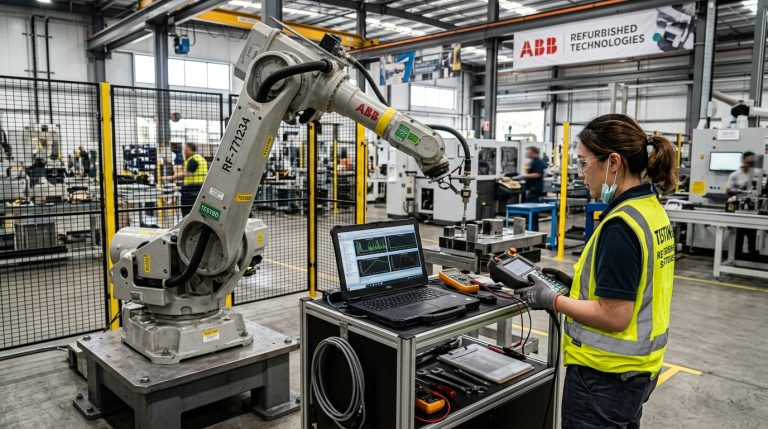
This becomes particularly important when companies evaluate refurbished or used robotic systems. Controller generation, software version, and available motion packages can influence how a post-processor behaves and what functionality is available.
The effectiveness of a robotic milling post-processor often depends on the specific controller architecture used in the cell.
Organizations evaluating automation investments often encounter similar compatibility considerations when assessing how to evaluate refurbished robot compatibility with existing systems, as explored in Refurbished Robots in Large-Scale 3D Printing: Architecture, Molds, and Functional Art, where integration flexibility and system adaptation are key factors.
Offline Programming Does Not Eliminate Post-Processor Risk
Offline programming software has significantly improved robotic milling workflows. Digital twins and simulation environments can identify many issues before the robot enters production.
However, simulation quality remains closely tied to post-processor quality.
If the post-processor does not accurately reflect controller behavior, simulation results may not fully match real-world execution. A toolpath that appears acceptable offline may require substantial adjustment during commissioning.
This disconnect often explains why some robotic milling projects experience longer startup periods than initially expected.
Programming efficiency depends not only on simulation software but also on the reliability of the translation layer between CAM output and controller instructions. Similar challenges appear in broader automation projects, such as those discussed in Augmentus Software Facilitates Robotic Programming, where reducing robot programming time remains a central objective for industrial automation.
Where ROI Is Lost When Post-Processing Becomes a Bottleneck
Many automation business cases focus on cycle time, labor reduction, machine utilization, or spindle hours. Yet inefficient post-processing can create hidden costs that affect overall project economics.
Engineering teams may spend excessive time modifying generated code. Validation cycles become longer. Production launches may be delayed while programming issues are resolved.
The result is not necessarily a failed project. Instead, the expected return on investment arrives more slowly because engineering resources are consumed by programming and troubleshooting activities.
Engineering teams frequently underestimate how a robotic milling post-processor influences programming efficiency and project timelines.
This is particularly important for companies comparing robotic machining against conventional alternatives. The financial evaluation should consider engineering effort alongside equipment cost, as highlighted in Robotic Milling vs CNC: 5 Key Thin-Wall Machining Limits, where decision-making goes beyond initial investment to include process stability and application constraints.
Common Mistakes When Selecting a CAM-to-Robot Workflow
Many robotic milling challenges originate long before production begins.
Assuming Any CAM Platform Will Work Equally Well
Not all CAM environments provide the same level of robotic support. The quality of robot-specific post-processing tools, simulation capability, and controller integration can vary significantly.
Evaluating the Robot Before the Workflow
Some projects select hardware first and investigate programming workflows later. This can create unexpected limitations when the chosen robot platform requires custom post-processing development.
Ignoring Future Complexity
A workflow that performs adequately for simple trimming operations may struggle when the cell evolves toward multi-axis milling, large workpieces, or coordinated external axes.
Expecting Automation to Correct Process Problems
A post-processor cannot compensate for poor fixture design, unstable part presentation, inaccurate workpiece models, or inconsistent manufacturing inputs.
As with many automation projects, the robot typically repeats the process that exists. If the process itself is unstable, automation may simply reproduce the same issues more consistently—a challenge analyzed in Robotic Machining Repeatability: What to Validate, where repeatability across the entire system is more critical than the robot alone.
When Post-Processor Development May Be Necessary
Standard post-processors are often sufficient for straightforward robotic applications. Advanced milling cells, however, may require customized development.
This becomes more likely when the project involves multiple coordinated axes, specialized tooling, unique machining strategies, custom controller functions, or unusual workpiece geometries.
Custom post-processor development should not be viewed as a software task alone. It requires understanding robot kinematics, controller behavior, manufacturing objectives, safety requirements, and the operational realities of the production environment.
The goal is not simply to generate executable code. The goal is to generate reliable code that supports repeatable production.
For a broader industrial robotics context, the International Federation of Robotics provides useful information about industrial robot adoption and manufacturing trends.
What to Verify Before Investing in a Robotic Milling Workflow
Before committing to a robotic milling strategy, engineering teams should evaluate the complete programming chain.
- Verify which robot controllers are officially supported.
- Confirm how external axes are handled.
- Assess singularity avoidance capabilities.
- Review simulation accuracy versus controller execution.
- Determine whether custom post-processor development may be required.
- Evaluate programming time for future product variations.
- Assess how software updates affect compatibility.
- Define ownership for maintaining post-processing workflows after commissioning.
The objective is not simply creating toolpaths. It is creating a sustainable process for generating reliable robotic motion as production requirements evolve, supported by a robust robotic milling post-processor capable of adapting to those changes.
FAQ
How important is a robotic milling post-processor in advanced milling cells?
A robotic milling post-processor is often one of the most important elements of the programming workflow because it translates CAM data into executable robot motion.
Why is a post-processor important in robotic milling?
The post-processor converts CAM-generated toolpaths into robot-specific motion instructions. Its quality directly affects programming efficiency, simulation accuracy, and production reliability.
Can a robotic milling cell operate with a generic post-processor?
Some simple applications can. More advanced cells often require robot-specific or controller-specific post-processing logic to manage kinematics, orientation control, and coordinated axes.
What is the biggest post-processing challenge in robotic milling?
Many projects struggle with singularities, external-axis coordination, and differences between simulated motion and actual controller behavior.
Do all robot controllers interpret milling paths the same way?
No. Different controllers handle motion planning, interpolation, acceleration, and coordinated movement differently, which can affect how a post-processor must generate code.
Should post-processor selection be part of the initial project evaluation?
Yes. Evaluating the programming workflow early can prevent integration delays and reduce the risk of discovering compatibility issues during commissioning, particularly when selecting and configuring a robotic milling post-processor that must align with the robot controller and application requirements.
Talk to RHS About Robotic Milling Integration
If you are evaluating robotic milling workflows, contact RHS. We will give you a direct, technical answer based on your actual production requirements.