English
 Italiano
 Українська
 Русский
 Español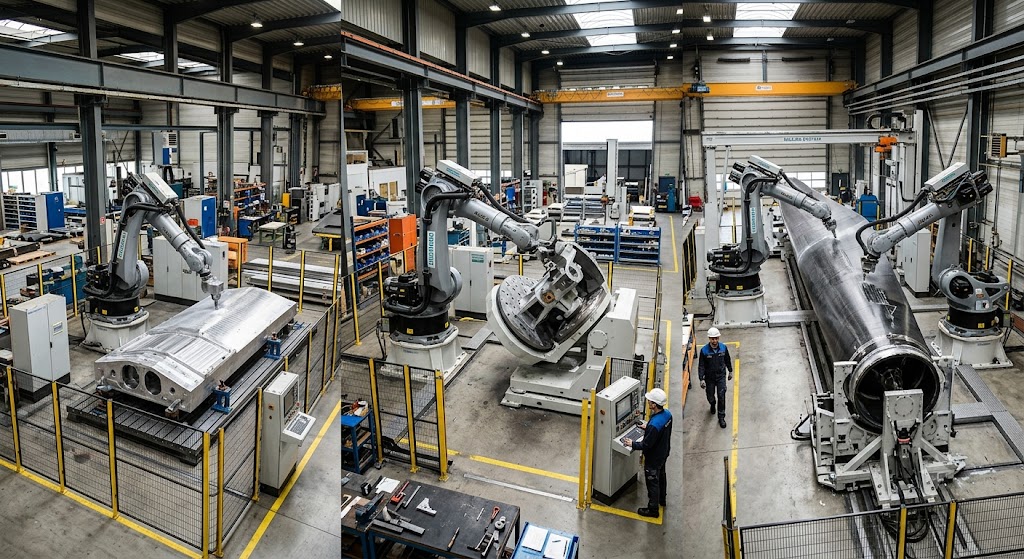

Robotic milling cell architecture is one of the most important decisions when designing a large-format machining system. The choice between one robot, a robot with a positioner, or dual synchronized robots affects reach, rigidity, cycle time, accessibility, investment level, and long-term scalability.
For manufacturers working with large molds, composite parts, aluminum structures, or complex industrial components, this decision should not be based only on payload or part size. It must be evaluated as a process engineering decision.
At Robotic Hi-Tech Solutions, cell architecture is assessed according to part geometry, machining strategy, tolerance requirements, tool access, fixture rigidity, and return on investment compared with traditional gantry CNC systems.
Single Robot Architecture for Robotic Milling
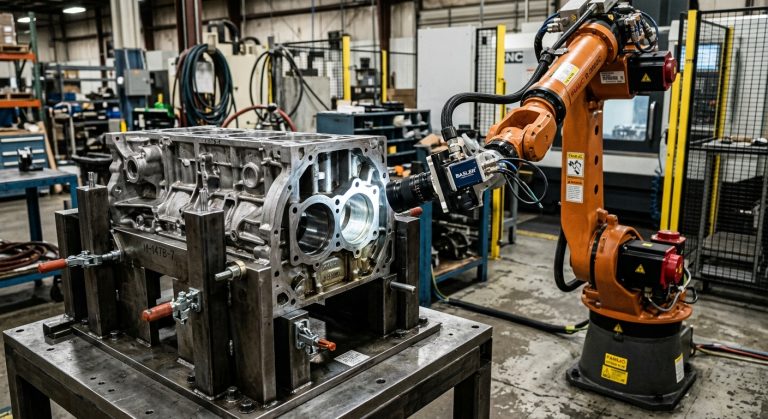
A single robot architecture is often the simplest and most cost-effective option for a robotic milling cell architecture. It works best when the part has good accessibility and most operations are performed from one main direction.
When a single robot works best
- Medium-to-large parts with open access
- Composite trimming, routing, or light milling
- Operations mainly performed on one side of the workpiece
- Flexible production environments with moderate cycle time requirements
Advantages
- Lower initial investment
- Simpler integration and programming
- Reduced maintenance complexity
- Smaller overall cell footprint
Limitations
- Limited part reorientation capability
- Reduced stiffness at extreme robot reach
- Possible downtime for manual repositioning
- Less efficient access to deep or multi-face geometries
A single robot can be a strong solution when the machining path is accessible and the process does not require constant part reorientation.
Robot with Positioner Configuration
Adding a servo-controlled positioner changes the dynamics of the system. In many large-format applications, a robot with a positioner offers the best balance between flexibility, accessibility, stability, and investment.
When a positioner is recommended
- Multi-face machining
- Heavy or complex geometries
- Parts that require stable tool orientation
- Applications where robot reach alone creates poor postures
Technical benefits
- Improved accessibility without pushing the robot to extreme positions
- Reduced risk of singularities
- Better control of cutting direction and tool angle
- More consistent surface quality
- Reduced non-cutting time in many applications
In a well-designed robotic milling cell architecture, the positioner helps keep the robot in a more stable working range. This can improve process consistency, especially when machining large composite molds, aluminum tooling, or complex curved surfaces.
This configuration is often considered a practical alternative to gantry CNC systems when the application requires flexibility but does not justify the cost or footprint of a large CNC machine.
For general industrial robot safety guidance, manufacturers can also review resources from the Occupational Safety and Health Administration when planning robotic automation environments.
Dual Robot Synchronized Architecture
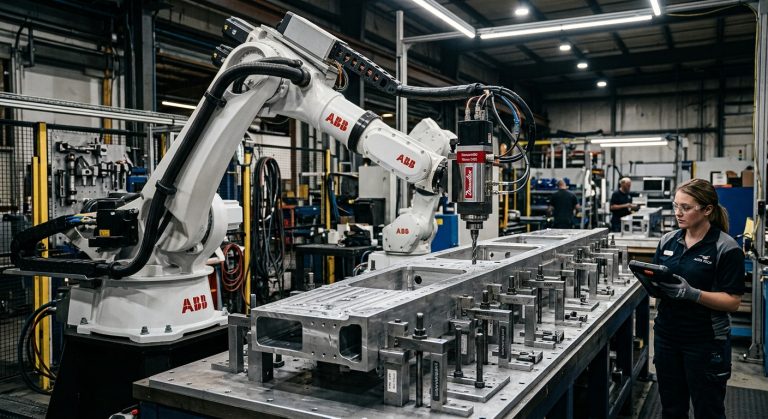
Dual robot systems are used when the application requires a larger working envelope, parallel operations, or advanced synchronized motion. This architecture can offer high productivity, but it also requires more engineering effort.
Typical applications
- Very large molds or structural components
- Simultaneous machining and handling
- Parallel trimming, routing, or finishing operations
- High-volume production where cycle time reduction has strong economic value
Engineering advantages
- Larger effective reach envelope
- Shared workload between robots
- Potential cycle time reduction
- Greater modular scalability
However, dual robot systems require accurate calibration, advanced motion coordination, collision management, and robust offline programming. They are usually justified when the productivity gain or part size clearly supports the added complexity.
Key Decision Variables
No single robotic milling cell architecture fits every application. Before choosing the system layout, manufacturers should evaluate the following engineering criteria:
- Part dimensions and mass: determine reach, fixture design, and positioner requirements.
- Required tolerances: influence robot model, spindle selection, calibration, and process validation.
- Machining strategy: defines whether the process needs 5-axis movement, repositioning, or synchronized motion.
- Target cycle time: helps determine whether one robot is enough or parallel operations are needed.
- ROI compared with CNC gantry: evaluates investment, flexibility, floor space, and long-term productivity.
Checklist Before Choosing the Architecture
- ✓ Define maximum part dimensions
- ✓ Confirm material type: composite, aluminum, plastic, or other material
- ✓ Evaluate accessibility constraints
- ✓ Analyze cycle time targets
- ✓ Review required tolerances
- ✓ Compare ROI against a CNC gantry system
- ✓ Confirm expansion and automation requirements
Conclusion
Choosing between one robot, a robot with a positioner, or dual synchronized robots is not only a question of capacity. It is a question of process strategy.
The right robotic milling cell architecture helps improve accessibility, protect process stability, control investment, and support long-term scalability. For large-format robotic milling, architecture design determines performance before the first chip is cut.
Need help evaluating the right robotic milling architecture for your application? Contact Robotic Hi-Tech Solutions to analyze your part geometry, machining goals, and automation requirements.
FAQs
Is a dual robot system always more precise?
No. Precision depends on calibration, stiffness, tooling, fixture design, and process setup. Adding a second robot does not automatically improve accuracy.
Does adding a positioner improve surface finish?
Often, yes. A positioner can help maintain better tool orientation and reduce unstable robot postures, which may improve surface quality consistency.
Can robotic milling replace a CNC gantry?
In many large-format composite, plastic, and aluminum applications, robotic milling can be a cost-effective alternative when the cell is properly engineered.
When is a single robot enough for milling?
A single robot is usually enough when the part is accessible, the process is not highly constrained, and the target cycle time does not require parallel operations.
When should a positioner be added?
A positioner should be considered when the part requires multi-face machining, better tool angles, reduced repositioning time, or improved access to complex surfaces.
When are dual robots justified?
Dual robots are justified when the part is very large, cycle time reduction has high economic value, or the process requires simultaneous operations.
What is the biggest mistake when choosing a robotic milling cell?
The biggest mistake is choosing the architecture based only on robot payload or reach, without analyzing stiffness, accessibility, machining strategy, and ROI.
Is the robot model more important than the cell architecture?
Both matter. The robot model is important, but the overall architecture, fixture, spindle, calibration, software, and process design determine the final performance.
Contact Robotic Hi-Tech Solutions to discuss the technical requirements of your robotic milling application.