English
 Italiano
 Українська
 Русский
 Español
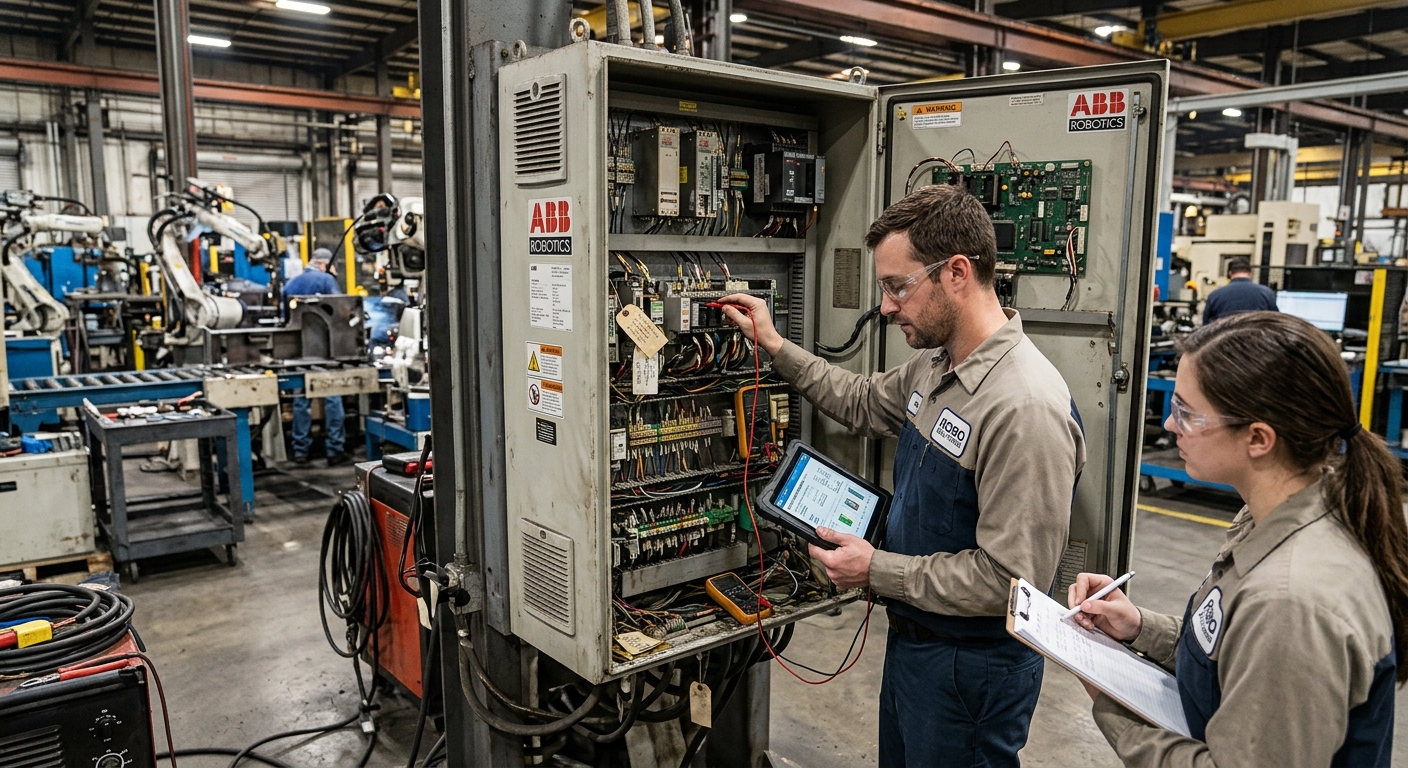

A robot controller retrofit stops making economic sense when modernization costs approach the price of a suitable replacement without delivering comparable reliability, technical support, or production capability. The decision depends on more than the controller’s purchase price. Compatibility, engineering work, safety requirements, and future maintenance expenses can substantially change the financial comparison.
An older industrial robot may remain mechanically serviceable while its controller becomes difficult to maintain. However, a robot controller retrofit does not automatically extend the useful life of every component. Motors, feedback devices, gearboxes, wiring, and peripheral equipment must remain suitable for the intended application. Otherwise, additional modifications can undermine the investment.
Before approving modernization, manufacturers should compare the complete retrofit project with continued maintenance, purchasing a refurbished robot, and installing a newer system. This article explains how to assess technical compatibility, estimate lifecycle costs, identify hidden expenses, and determine when replacement offers better economic value. The objective is to support a decision based on documented equipment condition and realistic production requirements.
1. When does a robot controller retrofit become uneconomical?
Compare total project costs.
The purchase price of a replacement controller is only one component of modernization. Engineering, electrical modifications, software migration, commissioning, training, and production interruptions also require consideration. A low initial quotation can become expensive when the existing robot needs extensive adaptation.
A robot controller retrofit becomes less attractive when these additional costs reduce the financial difference between modernization and complete replacement. Compare alternatives over the same evaluation period, using consistent assumptions about maintenance, availability, and expected production.
Identify the economic threshold.
There is no universal percentage at which replacement becomes preferable. The threshold depends on the remaining mechanical life, production requirements, available support, and financial consequences of downtime. A retrofit costing less initially may still have a higher total ownership cost.
2. How does controller compatibility affect retrofit costs?
Check motors, drives, and feedback systems.
Older robots may use drive electronics, motor interfaces, or position-feedback devices that differ from those supported by newer controllers. Compatibility must be confirmed for the exact robot model and hardware configuration before selecting replacement equipment.
Unsupported components may require additional interfaces or replacement. These changes increase engineering work and introduce further commissioning requirements. If several major electrical components need replacement, retaining the original manipulator may offer limited financial benefit.
Evaluate software migration requirements.
Controller modernization can require modifications to motion programs, coordinate systems, communication settings, and application-specific routines. Software developed for one controller generation may not transfer directly to another.
Before migration, preserve the existing configuration and verify the available recovery procedure. The RHTS article on managing robot backups before controller changes explains how to document programs, parameters, and recovery requirements.
3. Why does mechanical condition influence the decision?
Inspect components beyond the controller.
A controller upgrade cannot correct mechanical wear in gearboxes, bearings, brakes, or structural components. If the manipulator already requires major repairs, modernization may combine two expensive projects without producing a satisfactory remaining service life.
Review maintenance history, abnormal noise, joint play, lubrication records, and previous repairs. The article on robot maintenance records for refurbished equipment provides a framework for examining documented condition before making an investment.
Consider the remaining useful life.
Estimate how long the mechanical system can reasonably support the intended application, based on inspection findings and manufacturer guidance. Avoid treating the installation date or operating-hour counter as sufficient evidence of remaining life.
If major mechanical repairs are likely during the financial evaluation period, include their estimated cost and downtime. A robot controller retrofit is easier to justify when the retained manipulator remains suitable without extensive mechanical intervention.
4. How do safety requirements change modernization costs?
Review the complete robotic cell.
Replacing a controller can affect safety-related functions, operating modes, emergency-stop interfaces, and communication with protective devices. The modified system therefore requires an appropriate risk assessment and validation of affected functions.
The OSHA guidance on industrial robot system safety addresses risk assessments, safeguarding, maintenance hazards, and considerations for older robotic installations. Applicable legal requirements and technical standards must be determined for the installation’s jurisdiction.
Include validation and documentation.
Modernization budgets should include engineering documentation, safety-function verification, testing, and personnel training. These activities require qualified personnel and cannot be excluded simply because the original robot installation operated successfully.
When an older system needs extensive safety-related modifications, the additional work may reduce the economic advantage of retaining its controller architecture and mechanical equipment.
5. What hidden expenses can undermine the investment?
Account for production downtime.
Controller replacement normally requires planned interruption for installation, configuration, testing, and production approval. Unexpected compatibility problems can extend this interruption. Estimate downtime using the plant’s actual production schedule, available alternative capacity, and financial consequences of delayed output.
Include engineering preparation and contingency arrangements in the project schedule. An apparently inexpensive retrofit may become less attractive when commissioning delays affect customer deliveries or other connected production equipment.
Examine spare parts and technical support.
A newer controller does not guarantee that the remaining robot components will receive long-term manufacturer support. Check the availability of motors, feedback devices, drive components, cables, software licenses, and qualified service personnel.
When replacement parts depend on uncertain secondary-market availability, maintenance exposure remains. The economic evaluation should distinguish components covered by the robot controller retrofit from obsolete equipment that will continue operating unchanged.
6. How should retrofit and replacement options be compared?
Calculate lifecycle costs consistently.
Compare the alternatives over a defined period using total installed cost, planned maintenance, expected repairs, energy consumption where relevant, and downtime exposure. Include the residual value of equipment when it can be estimated reliably.
For example, compare the cost of retrofitting the existing controller against purchasing a refurbished robot with a compatible controller and documented condition. The RHTS guide to refurbished robot acceptance testing explains the inspections and verification needed before accepting replacement equipment.
Evaluate production requirements
Determine whether the existing manipulator can meet future payload, reach, cycle-time, accuracy, and application requirements. Controller modernization cannot overcome every mechanical or geometric limitation.
If production demands require a different robot configuration, replacement may offer greater value. Conversely, retaining a mechanically suitable robot can be reasonable when the application remains stable and controller compatibility is established.
7. Eight checks before approving a controller retrofit
Use the following checklist to compare modernization with replacement. Record the evidence, responsible evaluator, and estimated financial consequences for each item.
- Confirm equipment identification: Record the robot model, controller generation, serial numbers, installed software, and electrical configuration.
- Verify controller compatibility: Obtain documented confirmation of supported motors, drives, feedback devices, communication interfaces, and required software options.
- Inspect mechanical condition: Review gearboxes, brakes, bearings, cabling, previous repairs, and applicable maintenance records.
- Estimate complete retrofit expenses: Include hardware, engineering, software migration, electrical modifications, installation, and commissioning.
- Assess safety modifications: Identify affected protective functions, required risk assessments, validation activities, and documentation updates.
- Calculate production interruption: Estimate installation downtime, testing duration, recovery contingencies, and associated production losses.
- Verify future support: Check spare-part availability, software maintenance, service expertise, and expected support limitations.
- Compare replacement alternatives: Request complete quotations for suitable refurbished or newer robots, including integration and acceptance testing.
Use the results to prepare comparable financial scenarios. Where costs or technical requirements remain uncertain, request additional inspection or supplier clarification rather than assuming the lowest estimate will be achieved.
8. When is complete robot replacement the better investment?
Recognize the limits of modernization.
Replacement becomes more attractive when controller incompatibility requires extensive electrical reconstruction, mechanical repairs are substantial, or the existing robot cannot meet production requirements. Limited technical support can further weaken the robot controller retrofit case.
However, a replacement robot also requires installation, programming, integration, and validation. Compare complete operational systems rather than the price of a new robot against the price of controller hardware alone.
Make the final investment decision
Approve modernization when technical compatibility is documented, the manipulator remains suitable, and lifecycle costs support the investment. Select replacement when its expected operational benefits justify the additional expenditure and implementation requirements.
For an application-specific assessment, contact Robotic Hi-Tech Solutions with the robot model, controller configuration, maintenance history, and intended production requirements. These details help define the technical scope and compare feasible alternatives.
9. FAQ’s
Can every older robot receive a newer controller?
No. Compatibility depends on the manipulator, motors, feedback devices, drive architecture, and available controller support. Some combinations require extensive modifications or have no supported retrofit solution.
Is retrofitting always cheaper than buying another robot?
No. Hardware, engineering, safety validation, and downtime can make modernization more expensive than purchasing and integrating a suitable replacement system.
Does a controller retrofit improve robot accuracy?
Not automatically. Positioning performance also depends on mechanical condition, calibration, load, and operating conditions. Any improvement must be verified through appropriate testing.
Can existing robot programs be transferred?
Sometimes. Transfer depends on controller compatibility, software versions, programming languages, and installed options. Programs may require conversion, modification, and validation.
Should an older robot be replaced when manufacturer support ends?
Not necessarily. Evaluate available service expertise, replacement components, operational requirements, and downtime exposure before deciding whether continued operation remains economical.
Does controller replacement require a new safety assessment?
Changes affecting safety-related functions require appropriate assessment and validation. The exact scope depends on the modifications, application risks, and applicable regulatory requirements.
Can a refurbished robot be a better alternative?
Yes. A suitable refurbished robot may offer a lower total installed cost than an extensive retrofit. Its mechanical condition, controller support, and application compatibility must be verified.
What information is needed before requesting a retrofit quotation?
Provide the robot and controller models, serial numbers, software configuration, application requirements, maintenance records, and available electrical documentation. Include any known faults or integration limitations.