English
 Italiano
 Українська
 Русский
 Español
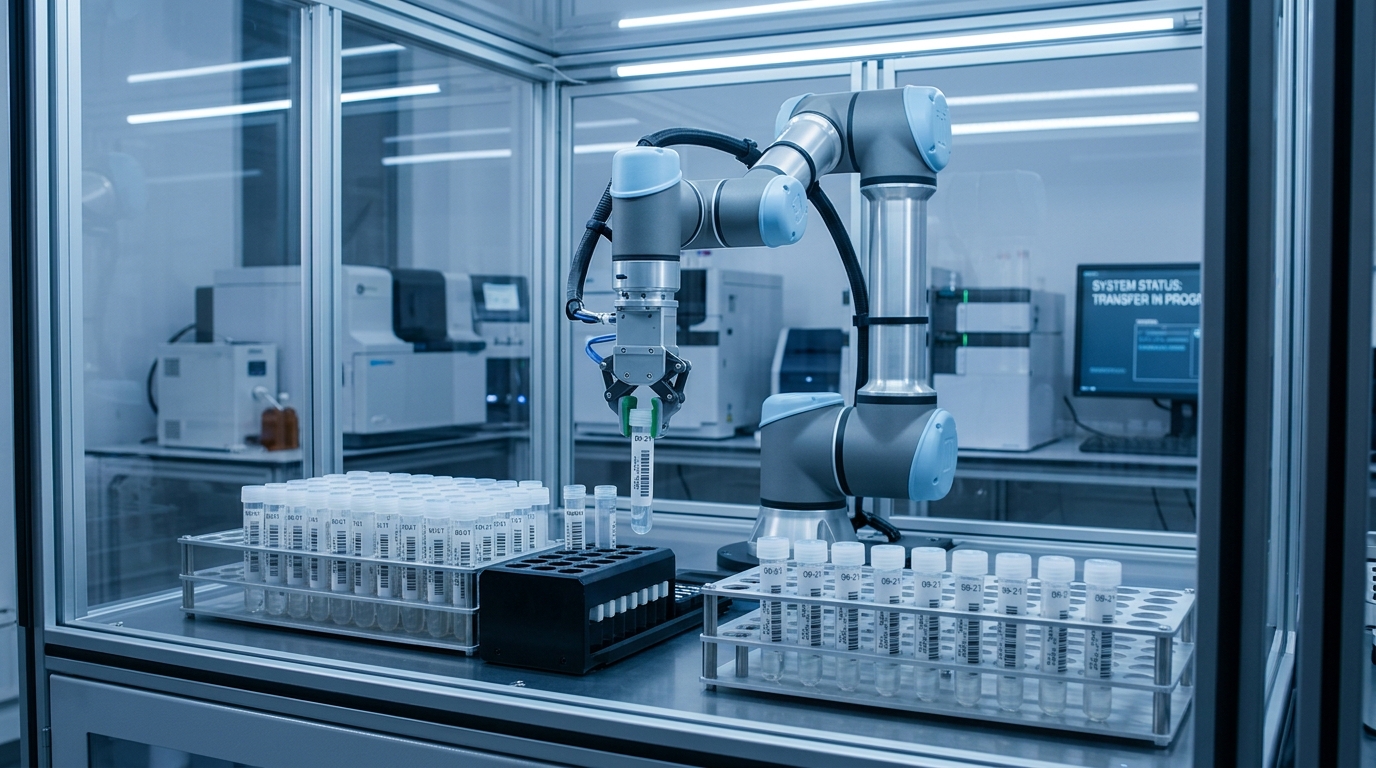

Industrial robots automate laboratory sample handling by transferring tubes, racks, containers, and other materials between laboratory workstations. Their movements can connect instruments, storage systems, and preparation equipment without requiring an operator to perform every transfer. However, successful automation depends on accurate positioning, suitable gripping tools, reliable identification, and controlled workflows.
Laboratory sample handling requires more than moving containers between locations. Each sample must reach the correct destination while maintaining its identity and required handling conditions. A robotic system must therefore coordinate physical movements with laboratory procedures, equipment signals, and sample tracking records.
This article explains how industrial robots support laboratory operations, which tasks can be automated, and what engineers should consider before selecting equipment. It also examines gripper design, identification systems, contamination control, safety, and commissioning. The objective is to help laboratory managers and automation engineers determine where robotic handling is technically appropriate and how to evaluate its performance before routine operation.
How does laboratory sample handling automation work?
Automated laboratory sample handling combines robotic motion with sample identification, equipment coordination, and process control. A robot receives an instruction, retrieves the required container, and transfers it to a defined location. The control system then confirms whether the operation was completed successfully.
Moving samples between workstations
Robots can transfer sample racks between preparation stations, analytical instruments, and temporary storage areas. Their usefulness depends on workstation accessibility, container geometry, and the ability to coordinate transfers with instrument availability.
Coordinating laboratory equipment
The robot controller may communicate with a programmable logic controller or laboratory automation software. These systems coordinate equipment readiness, movement permissions, and transfer completion. A reliable sequence prevents the robot from placing samples into unavailable or incorrectly configured equipment.
Which laboratory tasks can industrial robots automate?
Industrial robots are particularly useful for laboratory sample handling when operations involve repeated transfers between fixed positions. Their programmable movements allow engineers to adapt handling sequences to different equipment arrangements, provided the mechanical interfaces and operating requirements remain compatible.
Sample loading and unloading
Robots can load compatible containers into analytical instruments and remove them after processing. This application requires consistent positioning and a verified interface between the robot and instrument. The system must also detect whether a container has been successfully inserted or removed.
Rack and container transportation
Robotic arms can move racks, trays, and sealed containers between designated stations. However, moving individual tubes may require different tooling from transporting complete racks. Engineers should evaluate both approaches before selecting the handling method.
What robot characteristics matter for laboratory applications?
Robot selection for laboratory sample handling should reflect the complete task rather than payload capacity alone. Reach, repeatability, installation space, tool compatibility, and environmental requirements all influence suitability. Laboratory automation may use articulated industrial robots, SCARA robots, or other handling mechanisms.
Reach and positioning requirements
The robot must access every required pickup and placement location without collisions or unsuitable joint configurations. Positioning requirements depend on container tolerances, fixture design, and instrument interfaces. Robot repeatability alone does not establish the accuracy of the complete handling system.
Payload and movement control
Payload calculations must include the gripper, sample containers, racks, and associated tooling. Acceleration and deceleration also require attention because abrupt movements may disturb liquids or destabilize loosely supported containers.
For applications requiring optical verification, the related article on robotic machine vision inspection explains how camera positioning, calibration, and lighting affect inspection performance.
How should robotic grippers handle laboratory samples?
The end effector is the tool attached to the robot for manipulating objects. In laboratory sample handling, grippers must accommodate container dimensions, gripping surfaces, material properties, and handling restrictions. An unsuitable gripper can damage containers or produce unreliable transfers.
Mechanical and vacuum gripping
Mechanical grippers hold containers through controlled contact forces. Vacuum tools may be suitable for certain objects with compatible surfaces. Neither approach is universally preferable. Selection depends on geometry, cleanliness requirements, material compatibility, and the consequences of losing grip.
Preventing damage and sample loss
Engineers should verify gripping force, contact location, and movement speed using representative containers. Tests should include partially filled vessels when applicable. The system also needs a defined response when a container is missing, incorrectly positioned, or released unexpectedly.
How are samples identified and tracked?
Sample traceability connects each physical container with its identification and processing records. Automated handling must preserve this relationship throughout transfers. Barcode readers, machine vision, and laboratory information management systems can support identification and tracking.
Barcode verification and sample identity
Identification systems can verify that the expected container is present before transfer. A successful barcode reading does not independently prove that the sample contents are correct. Laboratories must maintain appropriate identification procedures throughout collection, preparation, and analysis.
Connecting robots with laboratory software
Integration may connect the robot controller with a laboratory information management system, commonly called a LIMS. The interface should associate transfer events with sample identifiers, destinations, and relevant timestamps.
The article on industrial robot data architecture provides additional guidance on communication interfaces, equipment coordination, and data management.
What contamination and safety requirements apply?
Laboratory automation must account for both mechanical hazards and sample integrity. The required safeguards depend on the materials handled, laboratory classification, applicable regulations, and the equipment installation.
Contamination control
Potential contamination sources include gripper contact surfaces, reusable fixtures, spills, and movement between incompatible processing areas. Cleaning procedures, suitable materials, and physical separation may be necessary. Handling hazardous biological materials can require specialized containment equipment.
Robot cell safety
Safety engineering must address moving machinery, access points, maintenance activities, and unexpected motion. Risk assessment determines appropriate protective measures. The OSHA industrial robot safety guidance provides relevant information about robotic hazards and protective practices.
Industrial robots are not automatically suitable for sterile, cleanroom, or biological containment applications. Compatibility must be established for the specific equipment, environment, cleaning agents, and applicable requirements.
Eight checks before implementing laboratory sample handling
Before commissioning a robotic laboratory workstation, engineers should document the handling requirements and verify the complete operating sequence. The following checklist identifies practical evaluation points.
- Identify sample formats: Record container dimensions, materials, closures, rack configurations, and allowable handling orientations.
- Verify robot reach: Confirm access to every workstation, including approach paths and clearance around instruments.
- Evaluate gripping tools: Test gripping forces, contact surfaces, release behavior, and compatibility with representative containers.
- Define identification procedures: Specify when sample identifiers are read and how mismatches prevent incorrect transfers.
- Check equipment communication: Verify readiness signals, transfer acknowledgments, and responses to communication interruptions.
- Assess contamination risks: Identify cleaning requirements, material restrictions, spill scenarios, and necessary separation between work areas.
- Validate safety functions: Review access protection, emergency stops, maintenance procedures, and unexpected restart conditions.
- Test abnormal operations: Simulate missing containers, incorrect placement, interrupted movements, and recovery after equipment faults.
How should robotic laboratory systems be validated?
Validation should demonstrate that laboratory sample handling systems perform their intended tasks under defined operating conditions. Testing must cover physical transfers, identification accuracy, equipment communication, and error handling. Acceptance criteria should be established before testing begins.
Transfer repeatability and error recovery
Repeated trials can reveal problems involving container alignment, gripping consistency, and workstation positioning. Engineers should test representative sample formats and operating sequences rather than relying exclusively on successful demonstrations with empty containers.
Fault recovery requires particular attention. After an interrupted transfer, the system must establish the actual container location before resuming. Automatic retries should not create duplicate processing records or place samples into incorrect positions.
Documentation and change management
Commissioning records should identify robot programs, gripper configurations, workstation positions, and approved operating procedures. Subsequent modifications may require additional verification. The article on robot program version control explains how controlled software releases support reliable equipment management.
When does laboratory robotic automation make sense?
Robotic laboratory sample handling is worth evaluating when repetitive transfers consume operator time, connect several instruments, or create handling bottlenecks. However, a dedicated transport mechanism may be simpler when containers follow a fixed route with limited variation.
The decision should consider sample volume, workflow variability, available space, instrument compatibility, maintenance resources, and validation requirements. A robot offers programmable movement, but additional interfaces and safeguards increase integration complexity.
Laboratories evaluating an industrial robotic handling cell can contact Robotic Hi-Tech Solutions to discuss robot selection, end-effector requirements, workstation interfaces, and the technical feasibility of the proposed application.
Frequently Asked Questions
Can industrial robots handle laboratory sample tubes?
Yes. Industrial robots can manipulate compatible tubes using suitable grippers and fixtures. The complete system must be tested for container positioning, gripping reliability, and required handling conditions.
Are industrial robots suitable for sterile laboratories?
Only when the selected equipment and installation meet the applicable environmental requirements. Standard industrial robots should not be assumed suitable for sterile or controlled environments without verification.
Can robots work with laboratory information management systems?
Yes, through suitable software interfaces and integration architecture. Communication must associate physical transfers with the correct sample identifiers and processing records.
What is the difference between laboratory robots and industrial robots?
Laboratory robots may be purpose-built for specific instruments or sample formats. Industrial robots are programmable manipulators that can support laboratory tasks when properly integrated and validated.
Can robotic sample handling prevent contamination?
Automation can reduce certain manual handling steps, but it does not eliminate contamination risks. Cleaning procedures, equipment materials, container design, and environmental controls remain necessary.
How is robotic sample handling accuracy verified?
Engineers test container pickup, transfer, placement, and identification under representative conditions. Acceptance criteria should reflect instrument interfaces, container tolerances, and laboratory operating requirements.
Can one robot serve several laboratory instruments?
Yes, when the robot has sufficient reach and the instruments support coordinated operation. Engineers must verify cycle timing, access clearance, communication interfaces, and recovery procedures.
When should a laboratory consider robotic sample handling?
Consider automation when repeated transfers create measurable workload or workflow constraints. Compare robotic handling with dedicated laboratory automation equipment using actual throughput, integration, maintenance, and validation requirements.