English
 Italiano
 Українська
 Русский
 Español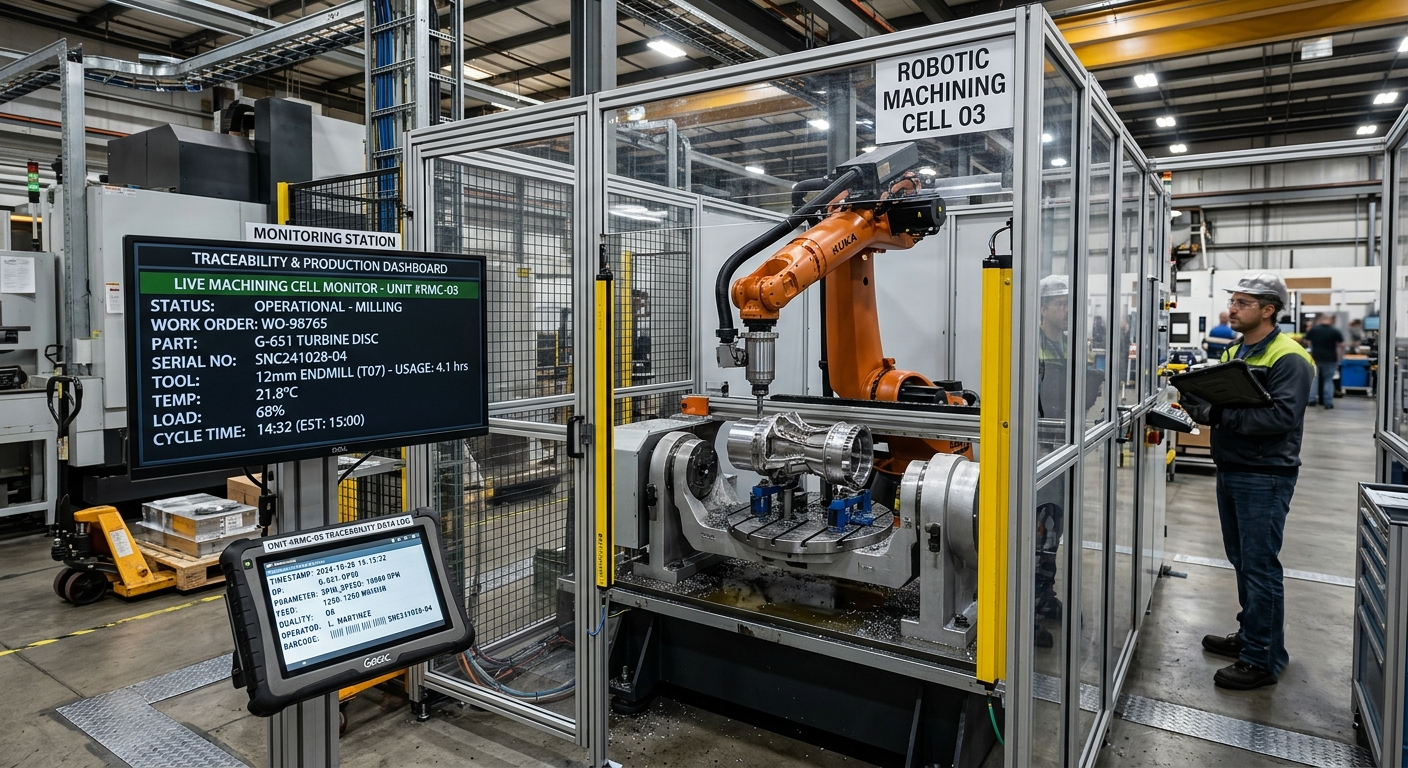

Why Traceability Can Become a Hidden Risk During Robotic Machining Projects
Many manufacturers focus on cycle time, flexibility, and equipment cost when evaluating robotic machining. The problem is that machining traceability often receives less attention until quality issues, customer audits, or production investigations reveal gaps in the data trail.
Traditional CNC machines frequently operate within mature manufacturing environments where programs, tool offsets, machine parameters, operator actions, and production records are already integrated into existing quality systems. When robotic cells replace CNC machines, that traceability structure may no longer transfer automatically.
The question is not whether a robotic cell can remove material. The question is whether the organization can maintain machining traceability at the same level—or better—after the process changes. If traceability requirements are not addressed during system design, the robotic cell may create new quality and compliance challenges that are far more expensive to solve after commissioning.
For a broader industrial robotics context, the International Federation of Robotics provides useful information about industrial robot adoption and manufacturing trends.
Why CNC-Based Traceability Does Not Automatically Transfer to Robotic Cells
Many companies assume that replacing a CNC machine with a robotic machining cell is primarily a hardware decision. In reality, the data architecture often changes as much as the physical process.
A CNC machine typically centralizes machining programs, tooling data, machine parameters, alarms, and production records within a single platform. A robotic cell may distribute that information across several systems, including robot controllers, CAM software, spindle controls, external axes, PLCs, MES platforms, and quality databases.
As a result, machining traceability becomes dependent on how these systems communicate with one another rather than on a single machine platform.
This challenge is often overlooked when organizations focus only on machining performance instead of information flow.
7 Machining Traceability Risks That Commonly Appear in Robotic Cells
Program Version Uncertainty
When multiple software platforms are involved, it can become difficult to determine exactly which machining program was used to produce a specific part. Effective machining traceability requires reliable version control across CAM software, post-processors, robot programs, and production releases.
Disconnected Tool Data
Tool information may reside in separate databases or software environments. If tooling changes are not synchronized properly, machining traceability can be compromised during quality investigations.
Limited Event Logging
Some robotic machining implementations capture less production-event data than established CNC environments. Alarm history, parameter changes, and intervention records should remain accessible for future analysis.
External Axis Visibility Gaps
Advanced robotic machining often relies on positioners, rotary tables, or linear tracks. Without proper monitoring, these assets can create blind spots within the machining traceability system.
Manual Data Collection
When operators must manually record process information, data quality often becomes inconsistent. Traceability systems should minimize manual intervention whenever practical.
Poor Integration Between Systems
A robotic cell may perform well mechanically while still creating information gaps between manufacturing, quality, and maintenance departments.
Unclear Responsibility for Data Ownership
One of the most common problems is organizational rather than technical. Teams may not clearly define who owns traceability records, data validation, and long-term record retention.
The Process Conditions That Influence Machining Traceability
Not every robotic machining application has the same traceability requirements.
Low-risk applications with simple geometries and limited customer documentation demands may require only basic production records. Highly regulated industries often require significantly greater process visibility.
Before replacing CNC machines, manufacturers should identify which information must be retained for each part, batch, order, or production cycle.
Part Identification Strategy
The traceability strategy should define how individual parts are identified and linked to machining records. Without reliable identification, machining traceability becomes difficult regardless of software capability.
Process Change Tracking
Companies should determine how process changes are recorded and approved. This includes updates to toolpaths, robot programs, machining parameters, fixtures, and inspection methods.
Why Post-Processors and CAM Systems Affect Traceability
Traceability is often viewed as a quality issue, but programming workflows play a major role.
CAM software, simulation platforms, and post-processors influence how machining instructions are generated, revised, and approved. If version control is weak, engineering teams may struggle to determine which software output produced a specific part.
Manufacturers evaluating robotic machining should therefore consider not only the machining process itself but also the governance of engineering data.
Organizations facing similar workflow questions may also benefit from understanding how to reduce robot programming time in industrial automation, since programming structure and revision control often influence traceability performance.
This is explored in Augmentus software facilitates robotic programming, where challenges in robot programming time, complexity, and deployment are directly addressed.
Where ROI and Traceability Intersect
Many automation business cases focus on productivity improvements. However, machining traceability can also influence the financial outcome of a project.
Quality investigations become more expensive when production data is incomplete. Root-cause analysis takes longer. Customer audits become more difficult to support. Corrective actions may require additional engineering effort because historical production information cannot be verified easily.
Strong machining traceability helps reduce these risks by providing a reliable record of what occurred during production.
This is similar to broader automation evaluations where manufacturers must consider more than equipment cost when assessing ROI. Companies comparing robotic machining with traditional machining methods often review factors discussed in Robotic Milling vs CNC: 5 Key Thin-Wall Machining Limits, where the decision depends on process stability, geometry, and production requirements rather than cost alone.
When a Robotic Machining Cell May Not Be Ready for Full Traceability Requirements
Not every robotic machining project should move immediately into highly controlled production environments.
If data collection requirements remain undefined, software interfaces are incomplete, or ownership of production records has not been established, the organization may struggle to maintain machining traceability consistently.
In these situations, additional planning may be more valuable than accelerating deployment.
The goal is not simply to automate machining. The goal is to automate machining while preserving the visibility required to support quality, compliance, and continuous improvement.
What to Verify Before Replacing CNC Machines With Robotic Cells
Before approving a robotic machining project, use the following checklist to evaluate machining traceability requirements.
- Define which production records must be retained.
- Verify how part identification will be managed.
- Confirm version control procedures for CAM and robot programs.
- Review event logging capabilities across all systems.
- Assess integration between controllers, PLCs, MES, and quality platforms.
- Determine ownership of traceability records.
- Verify retention and retrieval procedures for historical data.
- Validate audit requirements before commissioning.
FAQ
What is machining traceability in a robotic machining cell?
Machining traceability is the ability to identify, record, and retrieve production information related to a machined part, including programs, tooling, process parameters, and production events.
Why can machining traceability become more difficult after replacing CNC machines?
Robotic cells often distribute data across multiple software and control platforms, making information management more complex than in traditional CNC environments.
Does machining traceability only affect quality departments?
No. Machining traceability affects engineering, production, maintenance, quality, and management teams because it influences investigations, audits, process improvement, and operational decision-making.
Can robotic machining provide the same level of traceability as CNC machines?
Yes, but only when traceability requirements are addressed during system design and integrated across the relevant software and control systems.
When should machining traceability be planned?
Machining traceability should be planned during the earliest stages of robotic cell design rather than after commissioning, when modifications become more costly and disruptive.
Talk to RHTS About Robotic Machining Traceability
If you are evaluating machining traceability in robotic machining applications, contact RHTS. We will give you a direct, technical answer based on your actual production requirements.