English
 Italiano
 Українська
 Русский
 Español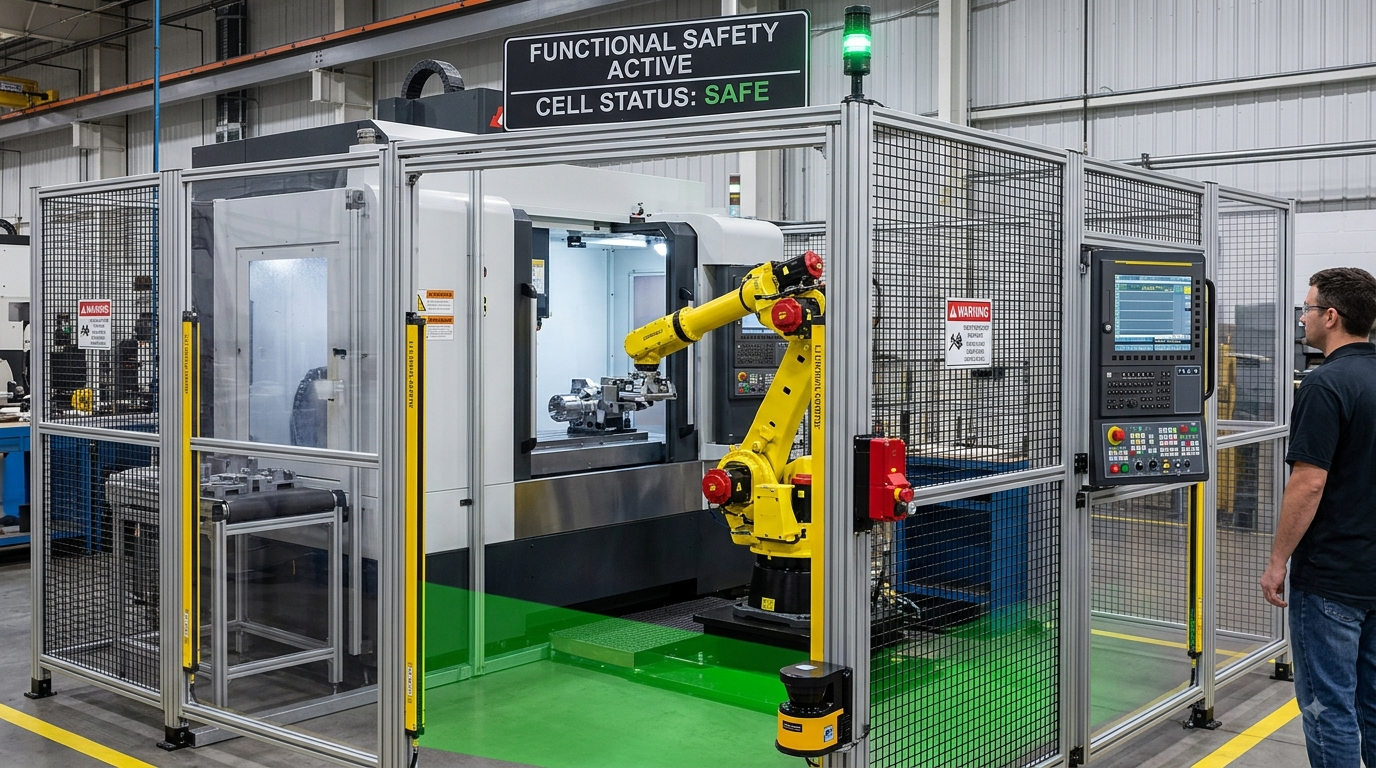

CNC robot functional safety begins with understanding what can cause harm and deciding how each unacceptable risk will be reduced. A robot loading a machining center or lathe combines several machines, control systems, moving mechanisms, access points, tools, fixtures, and operating modes.
A proper safety process starts with risk assessment, defines the required safety functions, establishes the performance required from safety-related control systems, and then verifies and validates that the implemented measures work as intended. Performance Level, commonly abbreviated PL, is one part of this process rather than a general safety rating for the complete cell.
For CNC automation, the assessment must consider normal production as well as setup, teaching, troubleshooting, cleaning, tool changes, recovery after faults, and maintenance. The objective is to reduce risk systematically and document why the selected safeguards and safety functions are appropriate for the actual application.
What Does Functional Safety Mean in a CNC Robot Cell?
Functional safety concerns safety functions that depend on a control system responding correctly to specific conditions. Examples can include stopping hazardous motion when a guarded door is opened, preventing automatic restart while access conditions are unsafe, or supervising conditions required for a permitted operating mode.
It is only one part of machinery safety. Fixed guards, mechanical design, safe access, procedures, electrical protection, pneumatic isolation, chip containment, and other measures may also be required. A safety PLC or safety-rated robot function cannot compensate for hazards that should instead be eliminated or reduced through mechanical or process design.
ISO 10218-2:2025 addresses integration of industrial robot applications and cells, including their design, commissioning, operation, maintenance, and decommissioning. The complete application must therefore be considered, not simply the specifications of an individual robot.
Start Functional Safety for CNC Robot Cells With Risk Assessment
Define the limits of the complete cell
The assessment should first define the machinery, operating modes, interfaces, expected users, foreseeable interventions, and physical boundaries of the system. In a CNC tending cell this can include the robot, machine tool, gripper, part storage, conveyors, doors, fixtures, auxiliary equipment, and safety system.
ISO 12100 provides a general methodology for machinery risk assessment and risk reduction. OSHA also discusses robot-system hazards, risk assessments, and risk-reduction measures in its Industrial Robot Systems and Industrial Robot System Safety guidance.
Identify hazards by task and operating mode
Hazards can change substantially between automatic production and human intervention. During normal production, operators may remain outside the safeguarded space. During teaching, troubleshooting, adjustment, or recovery, a person may need to approach equipment that can move or retain hazardous energy.
The assessment should therefore examine tasks rather than relying only on a general list of hazards. It should consider who performs each task, where that person is located, what machinery can move, what energy is present, and what foreseeable error or failure could create exposure.
How Performance Level Fits Into CNC Robot Functional Safety
Define safety functions before selecting PL
A safety function describes the safety-related response required from the control system. Depending on the cell, functions may concern emergency stopping, guard interlocking, prevention of unexpected hazardous motion, mode selection, or monitored robot functions. The required functions depend on the risk assessment and machine architecture.
ISO 13849-1:2023 provides principles for designing safety-related parts of control systems and uses Performance Levels. It does not assign a universal required Performance Level to every robot or CNC application. The required performance, commonly expressed as PLr when this method is used, must be determined for the specific safety function and application.
PL applies to a safety function, not the entire machine
It is misleading to describe a complete robot cell simply as having one PL without explaining the safety functions involved. Different safety functions can have different architectures, components, failure modes, and performance requirements.
The design process therefore links each identified risk to a risk-reduction measure and, where that measure relies on a safety-related control function, defines the required performance for that function. The implemented control system must then be evaluated against that requirement.
Designing the Safety-Related Control System
Evaluate the complete safety chain
A safety function normally depends on more than one component. An interlocked access door, for example, may involve a guard switch, safety logic, communications, output devices, robot controls, CNC controls, and actuators that remove or control hazardous motion.
Component specifications alone do not establish the performance of the complete safety function. The design must consider the architecture and relevant reliability characteristics of the safety-related parts involved, together with diagnostic coverage, common-cause considerations, software, wiring, and interfaces where applicable under the selected methodology.
This is especially relevant when the robot and CNC have separate control systems. Engineers must define what each machine does when the safety circuit changes state and ensure that interfaces do not allow hazardous motion because one controller assumes another device has already created a safe condition.
CNC-Specific Hazards That the Assessment Must Address
A CNC robot cell combines hazards from robotic motion with hazards generated by machining and workpiece handling. These can include movement of the robot, CNC axes, spindle and chuck, automatic doors, clamps, fixtures, grippers, conveyors, and other equipment within the integrated system.
The process itself may introduce further hazards. The assessment should consider the actual materials and operations used, including the possibility of released parts, swarf, fluids, sharp workpieces, tools, and stored pneumatic, hydraulic, mechanical, or electrical energy where relevant to the application.
Communication between the robot and machine also requires attention. Signals such as machine ready, door status, clamp confirmation, cycle start, and robot clear must have clearly defined behavior within the control sequence. Communication architecture varies by robot, CNC controller, and integration method. For an example of direct robot-CNC integration, see G-Codes for Programming FANUC CNC Robots.
Validation: Proving the Safety Functions Work
Validation is a necessary part of CNC robot functional safety because commissioning must confirm that the implemented safety-related measures satisfy their specified requirements. It is not simply a matter of checking that the robot stops during one test.
The validation plan should be based on documented safety requirements. Testing should examine relevant inputs, outputs, modes, permitted sequences, access conditions, reset behavior, fault responses, and interfaces between the robot, CNC, safety controller, and peripheral equipment.
Tests should also address foreseeable faults where required by the applicable design methodology. Results need to be recorded so that the tested configuration, expected response, actual response, and acceptance decision can later be identified.
Verification and validation should not be treated as interchangeable terms. Verification asks whether the design and implementation satisfy specified technical requirements. Validation considers whether the resulting safety functions adequately meet their intended safety requirements in the actual application.
Practical Safety Review Before Commissioning
Before releasing an automated machining cell for production, the integrator or responsible engineering team should confirm that the documented CNC robot functional safety concept matches the installed equipment. The following eight checks provide a practical review framework:
- Confirm that the risk assessment covers automatic operation, setup, teaching, fault recovery, cleaning, maintenance, and other foreseeable interventions.
- Identify each safety function and document the hazard or hazardous situation it is intended to control.
- Confirm the required performance of each safety-related control function using the applicable assessment and design method.
- Check the complete safety chain, including sensors, logic, communications, outputs, robot controls, CNC interfaces, and final switching or stopping elements.
- Test guard doors, access points, emergency stop devices, resets, operating modes, and relevant safety-rated robot functions under defined conditions.
- Verify that resetting a safety device does not by itself create unexpected hazardous motion where additional deliberate action is required.
- Record validation tests, expected results, measured or observed results, configuration information, identified deviations, and corrective actions.
- Review the assessment and validation when software, tooling, guarding, equipment, operating modes, safety devices, or production processes are modified in a way that can affect safety.
Why Safety Must Be Managed After Installation
A validated cell can later be changed. New grippers, modified fixtures, faster sequences, new components, controller updates, changed access procedures, or additional equipment can alter assumptions used during the original risk assessment.
Changes should therefore be evaluated before they are accepted into production. The extent of reassessment and revalidation depends on what changed and whether the change can affect hazards, exposure, safety functions, or safety-related control performance.
Documentation should also remain consistent with the installed configuration. Risk assessments, safety requirements, electrical drawings, software versions, validation records, operating instructions, and maintenance information are much more useful when they describe the equipment that actually exists on the factory floor.
For a CNC automation project that requires review of robot integration, interfaces, safeguarding, or cell architecture, the engineering requirements can be discussed through the Robotic Hi-Tech Solutions contact. Final safety decisions should be based on the actual application, applicable regulations, current standards, and a documented engineering assessment.
FAQ
What does CNC robot functional safety include?
It is the part of safety that depends on safety-related control functions responding correctly to defined conditions, such as an opened interlocked guard or a request to stop hazardous motion.
Does every CNC robot cell require the same Performance Level?
No. The required performance depends on the specific safety function and risk assessment. ISO 13849-1 does not prescribe one universal PLr for all robot cells.
Is PL the same as a general safety rating for the complete cell?
No. Performance Level is associated with safety-related control functions. The overall safety of a cell also depends on mechanical design, safeguarding, operating procedures, energy control, integration, and other risk-reduction measures.
Should the CNC machine and robot be assessed separately?
The individual machines have their own safety requirements, but the integrated application must also be assessed as a system because new hazards and control interactions can arise from their combination.
What should be tested during safety validation?
The test scope follows the defined safety requirements. It can include access devices, emergency stopping, mode behavior, reset logic, safety-related interfaces, robot functions, CNC responses, peripheral equipment, and relevant fault conditions.
Does an emergency stop replace perimeter guarding?
No. An emergency stop is a complementary protective measure. It does not automatically replace guards, interlocks, presence-sensing devices, safe distances, or other measures identified by the risk assessment.
When should a CNC robot cell be reassessed?
A reassessment is appropriate when a modification can affect hazards, exposure, safeguarding, safety functions, control architecture, or assumptions used in the existing assessment. The required scope depends on the change.
Which standards are especially relevant to this process?
ISO 12100 provides general principles for machinery risk assessment and risk reduction. ISO 10218-2:2025 addresses industrial robot applications and robot cells, while ISO 13849-1:2023 addresses the design of safety-related parts of control systems. Other standards and legal requirements can apply depending on the machine, country, process, and safeguarding technology.