English
 Italiano
 Українська
 Русский
 Español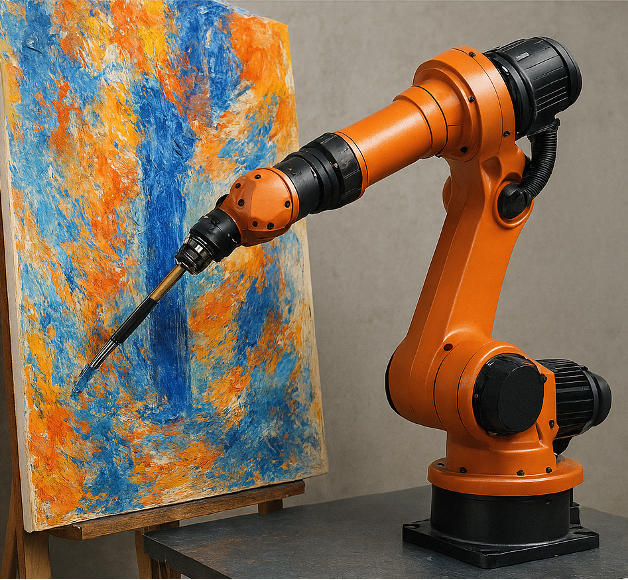

Can robotic arms have their own style? They can produce a recognisable aesthetic signature, but that does not mean the robot possesses taste, intention, or artistic identity. What appears to be a robotic style usually emerges from a complete system: the algorithm, movement rules, mechanical characteristics, end effector, material behaviour, sensor feedback, and choices made by the artist or programmer.
If the same system repeatedly produces related forms, marks, rhythms, or textures, viewers may recognise a consistent visual language. That language can be described as a system-level style.
The distinction is important. The style is not generated by the arm in isolation. It is produced by the interaction between human decisions, software logic, machine behaviour, and physical material.
Quick Answer
- The algorithm defines rules, parameters, variation, and decision logic.
- The robot translates those rules into physical movement.
- The end effector determines how movement becomes line, texture, light, sound, or material change.
- The material introduces resistance, deformation, flow, and irregularity.
- Sensors and AI can modify the result in response to data.
- The artist or designer defines the framework, selects outcomes, and assigns meaning.
A robotic system can generate a consistent aesthetic. It does not follow that the machine understands or owns that aesthetic.
What Does “Style” Mean in Robotic Art?
In human art, style may develop through education, cultural context, personal experience, technical habits, material preference, and repeated aesthetic decisions.
In robotic art, style is more often the visible consequence of a repeatable system.
It may appear through:
- recurring movement patterns;
- consistent line quality;
- recognisable geometric structures;
- specific relationships between control and randomness;
- repeated tool marks;
- characteristic speed and rhythm;
- material behaviours intentionally preserved;
- the way external data is converted into physical form.
A robotic painting system may repeatedly produce elongated curves and sudden changes in pressure. A robotic sculpture workflow may create surfaces defined by dense parallel toolpaths. An interactive installation may respond to visitors through slow, delayed movements.
Each can develop a recognisable character even though the machine does not understand that character as style.
Where a Robotic Aesthetic Comes From
| System Layer | Aesthetic Contribution | Who Defines It |
|---|---|---|
| Algorithm | Controls geometry, sequence, variation, repetition, and response. | Artist, programmer, designer, or research team. |
| Robot Motion | Creates rhythm, speed, acceleration, orientation, and spatial gesture. | Programmed rules filtered through the robot’s kinematics. |
| End Effector | Translates motion into paint, carving, light, sound, deposition, or object movement. | Tool designer, artist, and integrator. |
| Material | Introduces flow, grain, deformation, resistance, heat, texture, and irregularity. | Selected by people, but never controlled completely. |
| Sensors | Allow movement to respond to surfaces, sound, people, force, or environmental data. | System designers determine inputs, mappings, and limits. |
| Selection | Determines which outputs become part of the final work. | Artist, curator, designer, or project team. |
Key distinction: the robot contributes physical behaviour, but the aesthetic system is designed, interpreted, and selected by people.
How Algorithms Create a Recognisable Visual Language
An algorithm can generate a consistent aesthetic by applying the same underlying relationships across different outputs.
Those relationships may control:
- curve direction;
- pattern density;
- stroke length;
- movement speed;
- pressure or force;
- orientation relative to a surface;
- distribution of repeated elements;
- reaction to sound, image, or environmental data;
- the permitted range of randomness.
The individual works may differ, but their generative logic remains related.
This is similar to a parametric architectural system in which no two components are identical, yet all belong to the same design family.
Style emerges from the persistence of rules, not necessarily from the repetition of one final form.
Can Randomness Become Part of a Robotic Style?
Randomness can be used to create variation, but uncontrolled randomness does not automatically produce a meaningful aesthetic.
A creative robotic system may use:
- pseudo-random numerical values;
- live environmental data;
- camera input;
- sound amplitude or frequency;
- recorded human movement;
- generative models;
- material feedback;
- variations introduced between production cycles.
The artist usually defines the limits within which variation can occur.
For example, a painting robot may vary stroke length and direction, while colour palette, surface boundaries, tool pressure, and maximum velocity remain fixed.
The result may be unpredictable in detail but coherent at system level.
Why the Robot’s Motion Profile Affects Style
Two robots can follow the same geometric path and still produce different physical results if their motion settings differ.
Movement characteristics include:
- velocity;
- acceleration;
- deceleration;
- path blending;
- pause duration;
- tool orientation;
- joint configuration;
- approach and departure behaviour.
A slow movement may allow paint to accumulate or clay to deform. Rapid acceleration may create a sharper physical gesture. Continuous path blending may produce fluid motion, while exact stops may create segmented marks.
The programmed trajectory defines where the robot moves. The motion profile influences how that movement is physically perceived.
Mechanical Characteristics Can Leave a Signature
An industrial robot is not a mathematically perfect point moving through space. It is a physical machine with mass, joints, gearboxes, structural flexibility, and controller behaviour.
Its physical characteristics may influence:
- path smoothness;
- vibration;
- orientation changes;
- tool pressure;
- surface finish;
- movement rhythm;
- repeatability under changing loads.
In a precision manufacturing process, some of these effects may be treated as errors to reduce.
In an artistic process, selected mechanical characteristics may remain visible and become part of the work.
However, a technical defect should not automatically be romanticised as style. Excessive backlash, unstable calibration, or uncontrolled vibration may simply produce unreliable results.
Style, Variation, and Technical Error Are Not the Same
| Observed Result | Possible Interpretation | Required Evaluation |
|---|---|---|
| Repeated visual pattern | A stable algorithmic or movement language. | Confirm that the pattern is intentional and connected to the concept. |
| Controlled differences between outputs | Parametric or sensor-driven variation. | Verify that the variation remains within defined limits. |
| Unexpected material behaviour | Emergent aesthetic or process instability. | Determine whether it is safe, repeatable, and artistically relevant. |
| Inconsistent tool position | Mechanical error, calibration problem, or load effect. | Inspect the technical system before treating it as expression. |
| Different response to every audience interaction | Authored behavioural variation. | Check the mapping between input data and robot response. |
Editorial principle: a recognisable aesthetic is not evidence that every technical deviation is meaningful. Artistic interpretation should remain separate from process diagnosis.
How Materials Contribute to Robotic Style
The same movement can produce different results in paint, clay, wood, metal, light, or flexible fabric.
Materials contribute their own physical behaviour:
- paint flows, accumulates, and changes with viscosity;
- clay deforms and responds to pressure;
- wood follows grain and local density;
- metal changes under heat and force;
- polymers shrink or retain deposited layers;
- light leaves no permanent mark but creates temporal patterns;
- fabric reacts dynamically to motion and gravity.
A robotic style may therefore be inseparable from the material used.
A system that produces precise geometric paths in software may generate soft, irregular forms when those paths interact with a deformable medium.
The final aesthetic belongs to the relationship between code and matter rather than to either one alone.
Can Sensor Feedback Create an Emerging Style?
Sensors can allow a robotic system to change its behaviour while operating.
Possible inputs include:
- force;
- distance from a surface;
- camera images;
- human position;
- sound;
- light;
- temperature;
- material flow;
- the position of another machine.
The system may map those inputs to:
- movement direction;
- speed;
- tool angle;
- pressure;
- colour;
- path density;
- timing;
- selection between programmed behaviours.
If the mapping remains consistent, the system may develop a recognisable behavioural character.
That character still originates from human decisions about which data matters, how it is interpreted, and what limits apply.
Example: A Sound-Responsive Robotic Painting System
A robotic arm holds a brush above a large vertical canvas. Audio software analyses live music and extracts tempo, amplitude, and frequency ranges.
Low-frequency energy changes the horizontal direction of the stroke. High-frequency content modifies brush rotation. Overall volume affects movement speed and pressure.
The mapping remains consistent throughout the performance, but the music changes continuously. Each painting is different while retaining a recognisable relationship between sound, movement, and mark.
The robot has not invented an artistic identity. The system designers have created a visual grammar that the robot executes in response to live data.
What Role Artificial Intelligence Can Play
Artificial intelligence may contribute at several stages of a robotic art workflow.
It can be used to:
- generate images or geometric proposals;
- classify visual input;
- identify patterns in previous outputs;
- select or rank variations;
- convert sound, text, or movement into parameters;
- adapt robot paths according to sensor data;
- optimise selected technical variables;
- create new combinations from a trained dataset.
AI does not eliminate the need for path planning, simulation, calibration, material testing, and safety.
An AI system may propose an image, but the robotic workflow must still determine:
- how that image becomes physical movement;
- which tool should be used;
- which geometry is reachable;
- how material will behave;
- which result should be selected;
- what operating limits remain valid.
AI can expand the generative layer. It does not replace the engineering layer or the human responsibility for context and interpretation.
Can a Robotic System Evolve Its Style Over Time?
A robotic system can change its output over time if its software, data, parameters, or feedback rules change.
Evolution may occur through:
- manual parameter adjustment;
- training with new data;
- reinforcement or optimisation routines;
- material experiments;
- changes in tooling;
- audience interaction;
- selection of previous successful outputs;
- modified sensor mappings.
The resulting work may appear to show artistic development.
But the system does not necessarily experience that development as a human artist would. There may be no subjective intention, memory, dissatisfaction, or desire to change.
What evolves is the production logic and the set of conditions generating the work.
Can a Robot Be Recognised by Its Output?
Potentially, yes. A specific robotic system may produce recognisable outputs because of its programmed rules, physical configuration, tool, motion settings, and material choices.
Recognition may come from:
- recurring geometry;
- characteristic stroke behaviour;
- specific path density;
- repeated tool orientation;
- consistent response to data;
- visible mechanical rhythms;
- a limited material palette;
- the selective use of controlled imperfection.
That does not prove the robot has an independent artistic personality.
It proves that the system is sufficiently coherent to produce an identifiable aesthetic language.
Who Is the Author of Algorithmic Robotic Art?
Authorship may be distributed across several contributors:
- the artist who defines the concept;
- the programmer who creates the generative logic;
- the robotic integrator who develops the executable process;
- the tool designer;
- the data or model used by the system;
- the material process;
- the curator or team selecting the final output.
Technical contribution and artistic authorship are not automatically identical.
The relevant questions include:
- Who established the artistic intention?
- Who defined the rules controlling variation?
- Who selected the inputs and training data?
- Who designed the tool and material process?
- Who evaluated and approved the final result?
- Which contributions should be credited publicly?
The robot itself executes the system. Whether it is described metaphorically as a collaborator or author depends on the cultural framing of the project, not only on its technical behaviour.
Can an Algorithmic Robotic Style Be Protected?
Questions about copyright, design rights, patents, software ownership, datasets, and contractual attribution depend on jurisdiction and project structure.
Possible protectable or contractually controlled elements may include:
- the source code;
- the generated images or forms;
- the tool design;
- the robotic process;
- the visual identity of a project series;
- the dataset or trained model;
- the final physical artworks;
- confidential technical know-how.
There is no universal rule stating that a robot owns the style or output it executes.
Creative teams should define ownership, attribution, licensing, reuse, and access to code or data in writing before production begins.
Legal note: intellectual-property treatment varies by country and project structure. Specific cases require qualified legal advice.
What Makes a Robotic Aesthetic Coherent?
A coherent system does not need to produce identical work. It needs stable relationships between its changing and non-changing elements.
Coherence may come from:
- a consistent movement grammar;
- a defined material family;
- a limited parameter range;
- repeated relationships between data and movement;
- the same tool or process;
- stable rules for selection and rejection;
- a recognisable relationship between precision and variation;
- a clear conceptual reason for using robotics.
Without those relationships, the system may generate variation but fail to establish a recognisable identity.
When Robotic Style Becomes a Marketing Claim Rather Than a Real System
The language of “machine creativity” can exaggerate what a robotic installation actually does.
Warning signs include:
- the robot executes one fixed prerecorded movement but is described as autonomous;
- randomness is presented as intelligence without explaining the rules;
- mechanical errors are treated as artistic decisions after the fact;
- AI is mentioned without identifying its actual role;
- human selection and programming are hidden;
- the system has no consistent visual or behavioural logic;
- the robot is used primarily as spectacle rather than as an essential creative process.
A credible robotic-art project should explain what is generated, what is programmed, what varies, and which decisions remain human.
Can Refurbished Robots Produce a Recognisable Aesthetic?
Yes. A refurbished industrial robot can support algorithmic and generative art when its controller, mechanical condition, programming workflow, communication interfaces, and safety requirements match the project.
The robot’s age does not determine whether the system can produce a coherent aesthetic.
The evaluation should include:
- controller generation;
- available program memory;
- offline-programming compatibility;
- communication with sensors and external software;
- motion quality;
- gearbox and brake condition;
- tool and cable payload;
- external-axis support;
- system backups and documentation;
- spare-parts and technical support.
An older controller may be sufficient for offline-generated paths and repeated artistic sequences. Interactive or real-time systems may require more advanced communication and control architecture.
RHTS provides new and refurbished industrial robots that can be evaluated for generative art, painting, sculpture, performance, and interactive installations.
How to Evaluate an Algorithmic Robotic Art Project
Algorithmic Aesthetics Evaluation Framework
- Intent: What artistic question or experience should the system create?
- Rules: Which algorithms or relationships generate the output?
- Variables: What is allowed to change between executions?
- Constants: Which characteristics preserve visual coherence?
- Inputs: Will the system use data, sound, images, sensors, or AI?
- Movement: How do speed, acceleration, orientation, and rhythm influence the result?
- Tool: How does the end effector translate motion into physical expression?
- Material: Which behaviours are controlled, and which remain open?
- Selection: Who decides which outputs are accepted?
- Attribution: How are artistic and technical contributors credited?
- Safety: What operating limits apply to the robot, material, and audience?
- Technology: Can the controller, software, sensors, and communication support the intended behaviour?
If the team cannot explain which rules produce the aesthetic and which decisions remain human, claims about an independent robotic style should be treated cautiously.
Frequently Asked Questions
Can Robotic Arms Have Their Own Style?
They can produce a recognisable aesthetic signature through consistent algorithms, movement, tooling, materials, and feedback. This does not mean the robot possesses personal taste or artistic intention.
What Is Algorithmic Aesthetics?
Algorithmic aesthetics describes visual, spatial, or behavioural qualities generated through computational rules, parameters, data, and procedural systems.
Can a Robot Create Art Without Human Input?
A robotic system can generate outputs automatically after activation, but people still define or select the software, data, tools, materials, operating limits, context, and interpretation.
Does Artificial Intelligence Give a Robot Artistic Intention?
No. AI can generate, classify, or modify content, but this does not establish consciousness, cultural understanding, or independent artistic purpose.
Can Random Robotic Movement Be Considered a Style?
Randomness can contribute to style when it operates inside a coherent set of rules and supports the artistic concept. Uncontrolled variation alone does not create a meaningful aesthetic.
Why Can Two Robots Produce Different Results From the Same Path?
Different controllers, motion settings, calibration, tools, payloads, mechanical conditions, and material interactions can affect the physical outcome.
Who Owns Art Produced by a Robotic System?
Ownership depends on contracts, applicable law, authorship, software, datasets, and the contributions of the people involved. Legal advice is required for specific cases.
Can Refurbished Robots Be Used for Algorithmic Art?
Yes, when their mechanical condition, controller, software compatibility, communication interfaces, and safety architecture support the intended creative workflow.
A Robotic Style Belongs to the System, Not to the Arm Alone
Robotic arms can produce work with a consistent and recognisable aesthetic. Patterns can recur. Movement can develop a characteristic rhythm. Materials can respond in identifiable ways. Sensor mappings can create a stable behavioural language.
But the arm alone does not create that style.
The aesthetic emerges from the complete system: human intention, algorithms, robot motion, tool design, material behaviour, feedback, and selection.
Describing the result as a robotic style can be useful when it refers to this coherent system-level signature. It becomes misleading when it implies that the machine possesses independent taste, cultural awareness, or artistic ambition.
The most interesting question is therefore not whether the robot has become an artist.
It is whether the system has been designed well enough to produce a visual language that remains recognisable while continuing to generate difference.
Explore related analysis in the Robot Art & Architecture section, or read how robotic arms function as creative tools.
Artists, universities, studios, and research laboratories can also contact RHTS with the intended tool, movement, data input, interaction, payload, and working envelope for an initial robotic-platform assessment.