English
 Italiano
 Українська
 Русский
 Español
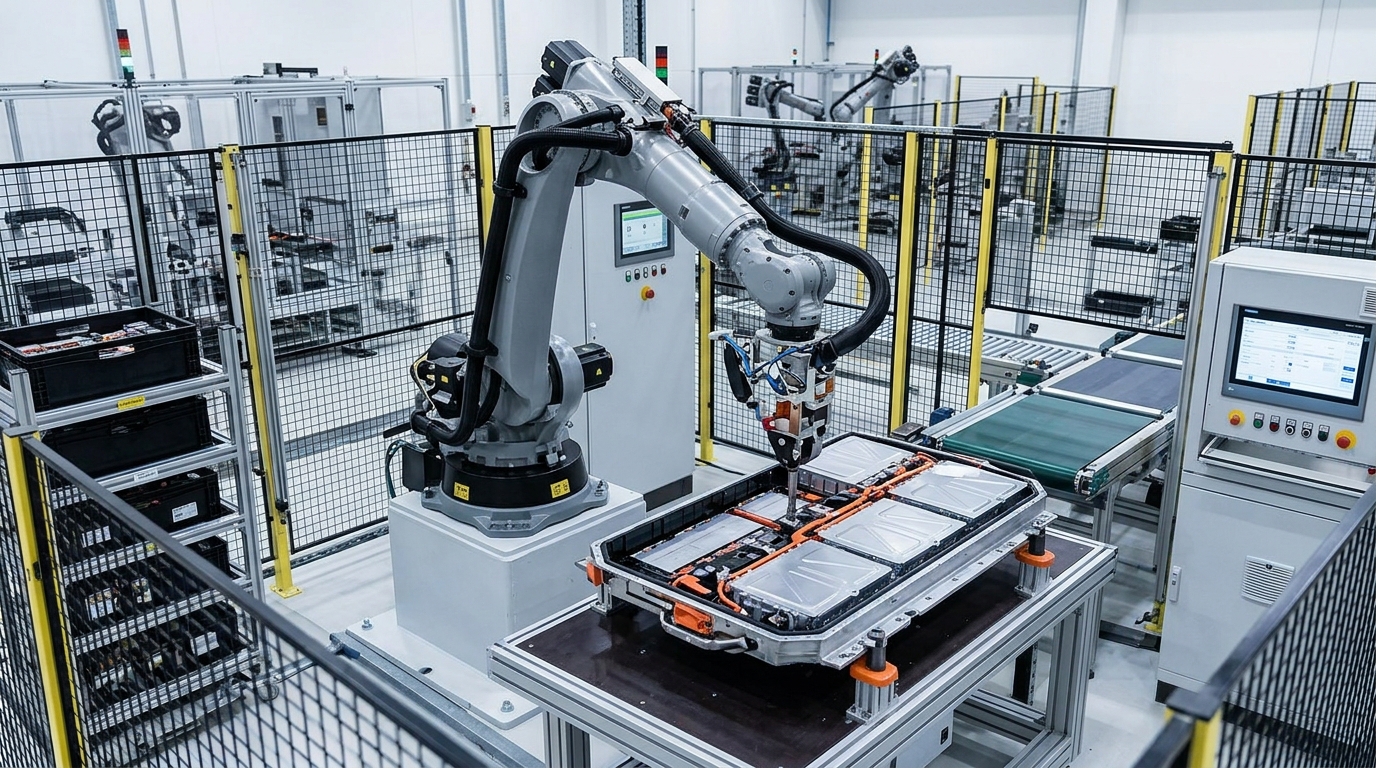

Industrial robots can support battery pack disassembly, but the process is difficult because battery packs combine electrical hazards, complex mechanical assemblies, and components that may arrive damaged or in unknown condition. Unlike conventional assembly, dismantling requires equipment to identify connections, remove fasteners, separate materials, and respond to unexpected resistance without creating additional hazards.
Battery pack disassembly becomes particularly challenging when packs differ in construction, fastening methods, service history, and accessibility. Adhesives, sealed housings, damaged connectors, and restricted tool access can prevent a robot from following a fixed sequence. Automated equipment must therefore work within a controlled process that accounts for both mechanical variation and electrical safety.
This article examines the technical limitations of robotic battery dismantling, including inspection, tooling, sensing, programming, and cell integration. It also explains which operations may be suitable for automation and where qualified human intervention remains necessary. The objective is to help engineers evaluate realistic automation opportunities without assuming that every battery pack can be dismantled using the same robotic process.
Why is battery pack disassembly difficult to automate?
Different battery pack constructions
Battery packs vary in enclosure geometry, module arrangement, cooling connections, electrical interfaces, and fastening methods. Even packs with similar external dimensions may require different disassembly sequences. A robot programmed for one configuration cannot automatically handle another without suitable tooling, identification, and process adjustments.
Uncertain condition of incoming batteries
Battery packs entering recycling or repair facilities may have experienced impacts, corrosion, overheating, or previous maintenance. These conditions can change component positions and introduce hazards that are not visible externally. A controlled intake assessment is therefore necessary before determining whether robotic processing is appropriate.
What electrical hazards affect robotic disassembly?
High-voltage components and stored energy
During battery pack disassembly, electric vehicle battery packs can contain hazardous electrical energy. Disconnecting a pack from a vehicle does not necessarily eliminate voltage within its internal circuits. Isolation, verification, and access procedures must follow the relevant battery manufacturer’s instructions and applicable electrical safety requirements.
Robots cannot independently establish that a battery is electrically safe simply by removing connectors or detecting an open circuit. Qualified personnel and validated procedures must determine when mechanical operations may begin. Unexpected conductive contact can create electrical hazards even when robot motion is accurately programmed.
Thermal and chemical hazards
Damaged lithium-ion cells can present fire, thermal runaway, and hazardous substance exposure risks. Thermal runaway involves self-sustaining heat generation within a cell and may affect neighboring cells. Mechanical damage, electrical faults, and certain thermal conditions can contribute to hazardous failures.
Risk controls may require temperature monitoring, appropriate ventilation, fire protection, emergency procedures, and isolation of suspect packs. The selected measures must reflect the battery chemistry, condition, operation, and site-specific risk assessment. Robot safeguarding alone does not control battery-related hazards.
How do industrial robots identify components?
Machine vision and component recognition
Machine vision can help locate fasteners, connectors, enclosure edges, and accessible components. However, dirt, corrosion, reflections, and mechanical deformation can interfere with detection. Inspection performance depends on lighting, camera calibration, component visibility, and the accuracy required for the next operation.
Robot-mounted cameras may provide additional viewing angles without moving a heavy battery pack. The RHTS article on robotic machine vision inspection explains how sensor positioning, calibration, and lighting influence inspection performance. These principles also apply when locating disassembly features.
Identification before tool engagement
Recognizing a fastener is different from confirming that it can be removed safely. The system may also need to establish the component type, tool approach, surrounding clearance, and expected removal sequence. Where identification confidence is insufficient, the process should stop or request authorized review.
Why are fasteners and adhesives challenging?
Fastener access and removal forces
During battery pack disassembly, technicians and robots may encounter screws, bolts, brackets, and other mechanical connections. Restricted access can limit tool orientation, while corrosion or damaged fastener heads may prevent normal removal. Automated fastening tools need suitable alignment, engagement confirmation, and monitoring of relevant process parameters.
Unexpected resistance should trigger a defined response rather than repeated uncontrolled tool movement. A failed removal operation may require inspection, an alternative approved method, or manual intervention. Applying additional force without understanding the cause can damage surrounding components.
Adhesives, sealants, and bonded assemblies
Adhesive bonds and sealants introduce further uncertainty because separation behavior depends on material properties, bond geometry, condition, and the approved removal method. Mechanical separation can generate forces that are difficult to predict from the original assembly model.
Cutting or prying operations near cells and electrical components require particular care. Tool selection must consider possible penetration, debris, heat generation, and unintended contact. Some bonded structures may not be suitable for automated separation without specialized fixtures and validated procedures.
What makes robotic handling of battery components complex?
Mass, geometry, and gripping limitations
Battery enclosures and modules can be heavy, irregularly shaped, or difficult to access. The robot must support the component throughout removal while accounting for its center of gravity, tool mass, and available gripping surfaces. Payload capacity alone does not establish handling suitability.
Some components also include cables, seals, insulation, or flexible connections that can move during extraction. The RHTS guide to robotic handling of flexible materials examines gripping stability, deformation, and sensor feedback. Similar handling principles can inform the treatment of flexible connections during battery dismantling.
Controlled extraction and placement
During battery pack disassembly, robots must maintain controlled movement once a component has been released. Residual connections, unexpected adhesion, or incomplete fastening removal may prevent extraction. Force monitoring can help identify abnormal resistance, but its thresholds require validation for the specific component and operation.
Removed parts also need suitable destinations. Reusable components, recyclable materials, and potentially hazardous items may require different handling routes. Sorting decisions should follow the facility’s approved classification procedures rather than assumptions based only on component appearance.
How should engineers evaluate battery pack disassembly?
Battery pack disassembly feasibility should be established using representative battery packs and a documented process assessment. Engineers should examine the complete dismantling sequence before selecting a robot, gripper, or cutting tool.
The following eight checks help identify technical limitations and define the information required for system design:
- Identify battery configurations: Record pack models, enclosure designs, module arrangements, and known construction differences.
- Assess incoming condition: Define inspection criteria for impact damage, leakage, corrosion, deformation, and suspected thermal damage.
- Verify electrical safety procedures: Establish authorized isolation, testing, and access requirements before mechanical dismantling.
- Map disassembly operations: Document fastener locations, connector types, removal sequences, and components requiring special handling.
- Evaluate robotic accessibility: Check reach, wrist orientation, tool clearance, fixtures, and potential collision zones.
- Test tooling performance: Examine gripping stability, fastening-tool engagement, force monitoring, and approved separation methods.
- Define abnormal-condition responses: Specify actions for damaged components, failed removal, unexpected resistance, and sensor faults.
- Validate the complete process: Test representative variations, record failures, and confirm safety and performance acceptance criteria.
Testing should distinguish successful individual operations from reliable execution of the complete sequence. A robot may remove accessible fasteners consistently while still being unable to process damaged packs or assemblies with inaccessible connections.
How can robotic cells manage unexpected conditions?
Sensor feedback and controlled stopping
Force-torque sensors, vision systems, and process monitoring can provide information about component location and tool interaction. However, sensor readings require defined interpretation. An unexpected force may indicate an incomplete release, incorrect alignment, mechanical obstruction, or another condition requiring investigation.
Control logic should specify when the robot continues, retries an approved operation, stops, or requests intervention. Repeated movement without verified clearance can create additional damage. The RHTS article on collision prevention in robotic cells provides related guidance on movement coordination, shared zones, and controlled recovery.
Human intervention and recovery procedures
Some dismantling tasks may remain manual because component conditions cannot be identified reliably or access is insufficient. Hybrid systems can allocate predictable operations to robots while reserving uncertain tasks for trained personnel.
Manual intervention requires controlled access, suitable energy isolation, and documented recovery procedures. A stopped robot does not automatically mean that the battery, tooling, or surrounding equipment is safe to approach.
What safety requirements affect system integration?
Robot safeguarding and battery-specific risks
A battery dismantling cell must address robot movement, tooling hazards, electrical energy, and possible battery failures. The assessment should consider normal production, maintenance, cleaning, manual intervention, and foreseeable abnormal conditions.
The OSHA technical guidance on industrial robot systems provides information about robotic hazards and safeguarding. Battery-specific risks require additional assessment using applicable electrical, fire, environmental, and equipment requirements.
Commissioning and production validation
Commissioning a battery pack disassembly system should verify the complete sequence, including component identification, tool engagement, removal, transfer, fault handling, and restart procedures. Tests should include representative variations and foreseeable failures, not only successful operations with undamaged packs.
For facilities evaluating robotic battery dismantling, contact Robotic Hi-Tech Solutions with the battery configurations, intended operations, production requirements, and known constraints. This information provides a basis for discussing robotic integration feasibility and the engineering assessment required.
FAQ
Can industrial robots fully disassemble electric vehicle battery packs?
Some operations can be automated, but complete disassembly depends on pack construction, condition, accessibility, and validated safety procedures. Certain operations may still require qualified personnel.
Why is battery pack disassembly harder than battery assembly?
Disassembly must accommodate wear, damage, corrosion, and unknown previous interventions. These conditions can make component locations and removal forces less predictable than during controlled assembly.
Can machine vision identify every battery component?
No. Hidden components, reflective surfaces, damage, and poor visibility can limit recognition. Additional identification methods or manual verification may be necessary.
Can robots safely remove damaged battery modules?
Only when the specific condition and removal procedure have been assessed and suitable controls established. Severely damaged or unstable batteries may require specialized handling instead of routine robotic processing.
What robotic tools are used for battery dismantling?
Depending on the operation, equipment may include fastening tools, mechanical grippers, vacuum devices, inspection cameras, and force sensors. Tool selection must follow the actual component and safety requirements.
Is force control necessary for robotic disassembly?
Not for every operation. However, force monitoring or controlled contact can be useful when resistance varies or components require careful extraction. The required capability depends on the process.
Can the same robot process different battery pack designs?
Potentially, with compatible tooling, fixtures, identification methods, and validated programs. Significant differences in construction may require equipment changes or separate processing sequences.
What should be validated before production begins?
Validation should cover electrical safety prerequisites, component identification, tooling performance, handling stability, safeguarding, abnormal-condition responses, and the complete disassembly sequence under representative conditions.