English
 Italiano
 Українська
 Русский
 Español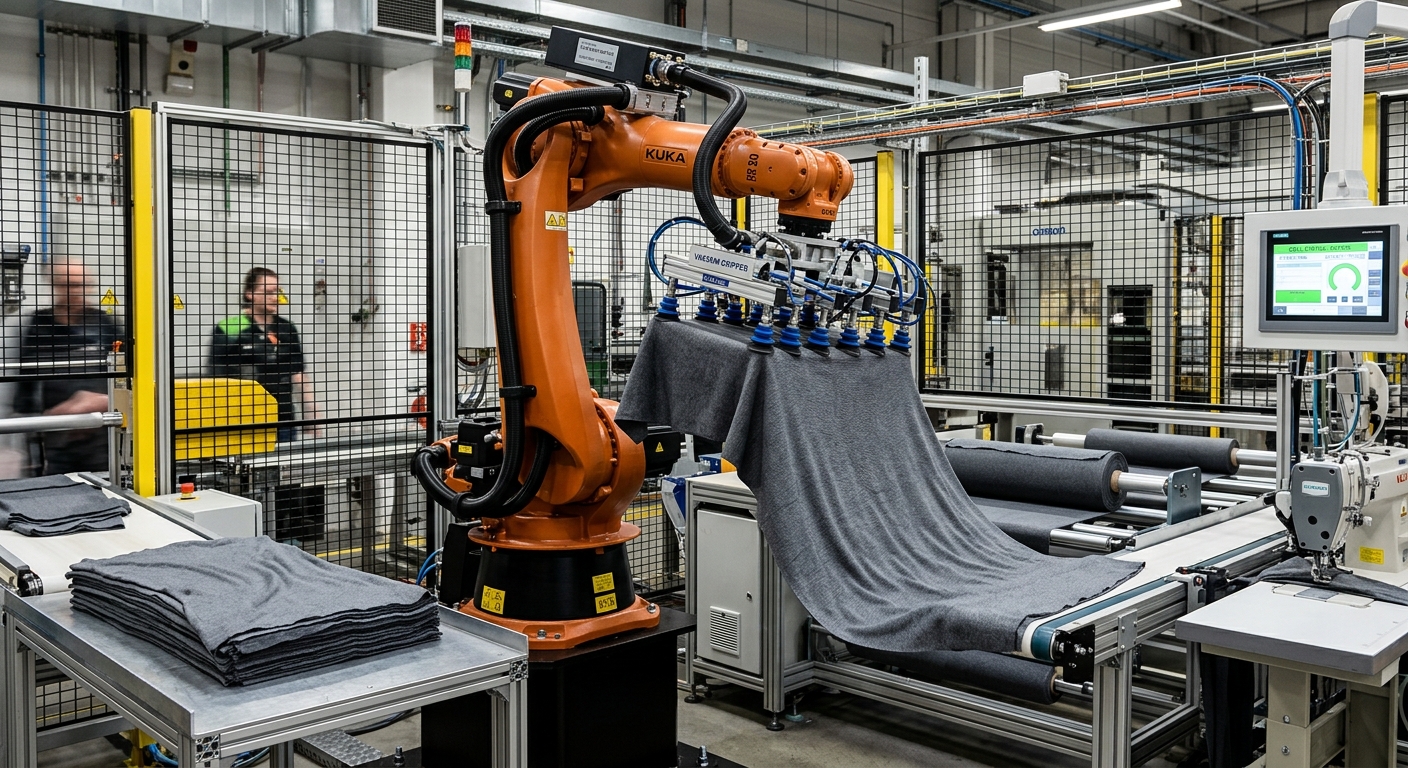

Industrial robots handle flexible materials by combining suitable gripping tools, controlled movements, and sensors that detect changes in position or contact. Unlike rigid components, deformable objects can bend, stretch, fold, or change shape during handling. Successful automation therefore depends on understanding how each material behaves when lifted, transported, and released.
Applications include handling textiles, rubber components, plastic films, flexible packaging, foam products, and soft industrial parts. Each material presents different challenges involving friction, surface characteristics, weight distribution, and resistance to deformation. A gripping method suitable for a rubber sheet may damage a delicate fabric or fail to secure a porous foam component.
The practical approach is to evaluate the material first, select an appropriate end effector, and validate the complete handling sequence under realistic production conditions. This article explains gripping technologies, sensing methods, robot programming, and testing procedures used when automating deformable material handling. It also examines common failure modes and the technical factors that determine whether a robotic application is suitable for production.
Why flexible materials are difficult for industrial robots
Changes in shape and position
Rigid components generally maintain their geometry during handling. Flexible materials behave differently because their shape depends on gravity, contact forces, orientation, and movement. A suspended fabric panel may fold, while a rubber component may stretch when supported from one side. These changes affect the position of the material relative to the robot.
Unpredictable gripping conditions
Surface friction, porosity, thickness, and moisture can influence gripping performance. Flexible materials may also arrive folded, compressed, or positioned differently between cycles. These variations make fixed gripping coordinates less reliable unless the feeding process consistently presents each object in a known position.
How industrial robots grip flexible materials
Vacuum gripping systems
Vacuum grippers use pressure differences to hold objects against suction cups or gripping surfaces. They can handle certain sheets, films, and packaging materials when an adequate seal can be established. Porous surfaces, wrinkles, and air leakage may reduce holding reliability. Cup arrangement and vacuum monitoring should therefore be evaluated using representative samples.
Mechanical and adaptive grippers
Mechanical grippers hold materials through controlled contact between fingers or gripping surfaces. Soft or compliant fingers can accommodate limited shape variations and distribute contact forces. However, excessive pressure may compress or damage the product. Grip force, contact geometry, and material recovery must be tested before production use.
Some applications benefit from combining mechanical support with vacuum gripping. For example, a flexible sheet may require distributed support to prevent excessive sagging during transfer. The selected end effector should match the object’s mechanical behavior rather than rely exclusively on its weight.
How sensors improve robotic material handling
Machine vision and object detection
Machine vision systems can identify object location, orientation, and visible surface features before gripping. Cameras may help locate edges or distinguish overlapping materials. However, reflective surfaces, folds, shadows, and changing lighting conditions can reduce detection reliability. Vision algorithms require validation against the actual presentation conditions.
Force and tactile feedback
Force-torque sensors and tactile sensing technologies can provide information about contact conditions. Depending on the system, this feedback may support grip adjustment or detection of unexpected resistance. Sensor capability must be matched to the application because not every robot controller or gripper supports closed-loop force regulation.
Sensor information is most useful when it triggers defined control decisions. For example, an unsuccessful vacuum confirmation can prevent the robot from lifting an unsecured object. The article on end-of-arm tooling and gripping stability examines how contact conditions, gripping forces, robot motion, and validation influence reliable workpiece handling.
How robot motion affects deformable objects
Acceleration and material movement
Rapid acceleration, abrupt stopping, and sudden changes in direction can cause flexible materials to swing, fold, or slip. Robot programming should account for these effects through suitable motion profiles. Lower acceleration may improve handling stability, although the resulting cycle time must still meet production requirements.
Orientation and support during transfer
The position of the end effector influences how gravity acts on a flexible object. Horizontal transfer may be appropriate for some sheets, while vertical lifting can introduce stretching or folding. Supporting the material at several locations can reduce unsupported spans and help maintain its intended orientation.
Robot paths should also consider nearby fixtures, conveyors, and machine openings. A flexible object may extend beyond its nominal dimensions during movement. Collision checks must therefore include possible material deformation, not merely the programmed path of the robot flange.
Which industrial applications use flexible material handling
Packaging and production operations
Industrial robots can manipulate flexible bags, packaging films, pouches, and certain soft products during loading, sorting, and transfer operations. The gripping system must accommodate variations in product shape and packaging condition. Reliable feeding and consistent presentation often simplify the robotic handling process.
Textiles, rubber, and foam components
Textile handling may require separating individual layers before transfer. Rubber parts can deform under gripping pressure, while foam products may experience significant compression. Each application requires material-specific testing to establish acceptable gripping forces, support arrangements, and placement accuracy.
These requirements make end-effector compatibility an essential part of application planning. The article on robot tooling compatibility and end-effector requirements explains how payload, mechanical interfaces, controller functions, and tooling integration should be evaluated before approving a robot configuration.
How to evaluate a robotic handling application
Before selecting equipment, engineers should document the material properties, handling sequence, and required production outcome. The following eight checks help identify technical limitations before committing to a particular gripping system or robot configuration.
- Identify material behavior: Examine flexibility, elasticity, thickness, porosity, and surface friction using actual production samples.
- Measure dimensional variation: Record changes in shape, size, and presentation between representative workpieces.
- Evaluate gripping locations: Identify contact areas that can support the object without unacceptable deformation.
- Test gripping force: Determine whether the proposed end effector can hold the material without slipping or damage.
- Check robot payload: Include the end effector, workpiece, associated equipment, and relevant dynamic loading conditions.
- Validate transfer movements: Observe material behavior during acceleration, direction changes, and placement.
- Assess sensor requirements: Determine whether vision, vacuum monitoring, or force feedback is necessary.
- Verify production performance: Test representative material variations and record handling failures, damage, and cycle times.
Acceptance criteria should be established before testing begins. These may include permitted deformation, placement tolerance, cycle time, and acceptable product condition. Results should be documented so different gripping configurations can be compared using the same evaluation method.
What causes failures when handling flexible materials
Slipping, folding, and incomplete gripping
Material slipping can result from insufficient friction, unsuitable gripping pressure, or excessive acceleration. Folding may occur when the material lacks adequate support. Incomplete gripping can arise from incorrect pickup coordinates, vacuum leakage, or overlapping objects. Each failure requires investigation of both tooling and process conditions.
Wear and inconsistent material presentation
Gripping surfaces, suction cups, and pneumatic components require inspection according to their operating conditions. Changes in material supply can also affect handling reliability. A robot programmed for consistently positioned products may encounter difficulties when items arrive wrinkled, rotated, or partially overlapping.
Maintenance procedures should include checking gripping surfaces, sensor signals, pneumatic connections, and mechanical attachments. Operators should record recurring failures and identify whether they originate from equipment condition, incoming material variation, or robot programming.
How to integrate safe and reliable robotic handling
Risk assessment and safeguarding
Flexible materials do not eliminate hazards associated with industrial robot movement. Grippers, moving equipment, and transferred objects can introduce impact, trapping, or unexpected-release risks. The OSHA guidance on industrial robot system safety explains risk assessment, safeguarding, and integration considerations relevant to robotic applications.
Testing before production deployment
Validation should cover normal operation, material variation, interrupted cycles, and foreseeable equipment faults. Engineers should verify that the system responds appropriately to failed grips, sensor errors, and unexpected product movement. Restart procedures and recovery sequences also require documented testing.
Changes to robot motion, sensor logic, gripping parameters, and recovery routines should be documented and controlled after validation. The article on robot program version control for manufacturers explains how approved programs, configuration data, and software revisions can be managed to prevent undocumented changes from affecting production.
Companies assessing a new handling application can contact Robotic Hi-Tech Solutions to discuss material characteristics, tooling requirements, and integration feasibility. Providing representative samples and a description of the handling process supports a more specific technical assessment.
FAQ
Can industrial robots handle very soft materials?
Yes, provided the gripping method and motion profile are suitable. Soft materials may require compliant contact surfaces, distributed support, and controlled gripping forces to avoid excessive deformation.
Are vacuum grippers suitable for all flexible materials?
No. Vacuum gripping depends on surface characteristics and the ability to establish sufficient holding force. Porous, irregular, or heavily wrinkled materials may require alternative gripping methods.
Why is machine vision useful for flexible material handling?
Machine vision can help identify changes in object position, orientation, or visible geometry. Its effectiveness depends on lighting, material appearance, camera placement, and detection accuracy.
How can robots prevent flexible objects from slipping?
Suitable gripping surfaces, verified holding force, distributed support, and controlled acceleration can reduce slipping. The complete transfer sequence should be tested under representative operating conditions.
Can one robot handle several different flexible materials?
Potentially, but different materials may require separate gripping configurations, adjustable tooling, or different motion programs. Compatibility must be confirmed for each material and handling task.
Do deformable materials require special robot programming?
They may require adjusted acceleration, orientation control, sensor-based decisions, and additional recovery routines. Programming complexity depends on material variability and the required placement accuracy.
What should be tested before automating flexible material handling?
Tests should cover gripping reliability, product deformation, transfer stability, placement accuracy, sensor response, and foreseeable failures using representative production samples.
How is the appropriate robot selected for flexible materials?
Selection depends on payload, reach, working envelope, required cycle time, tooling compatibility, and integration requirements. Material behavior and process testing should guide the final configuration.