English
 Italiano
 Українська
 Русский
 Español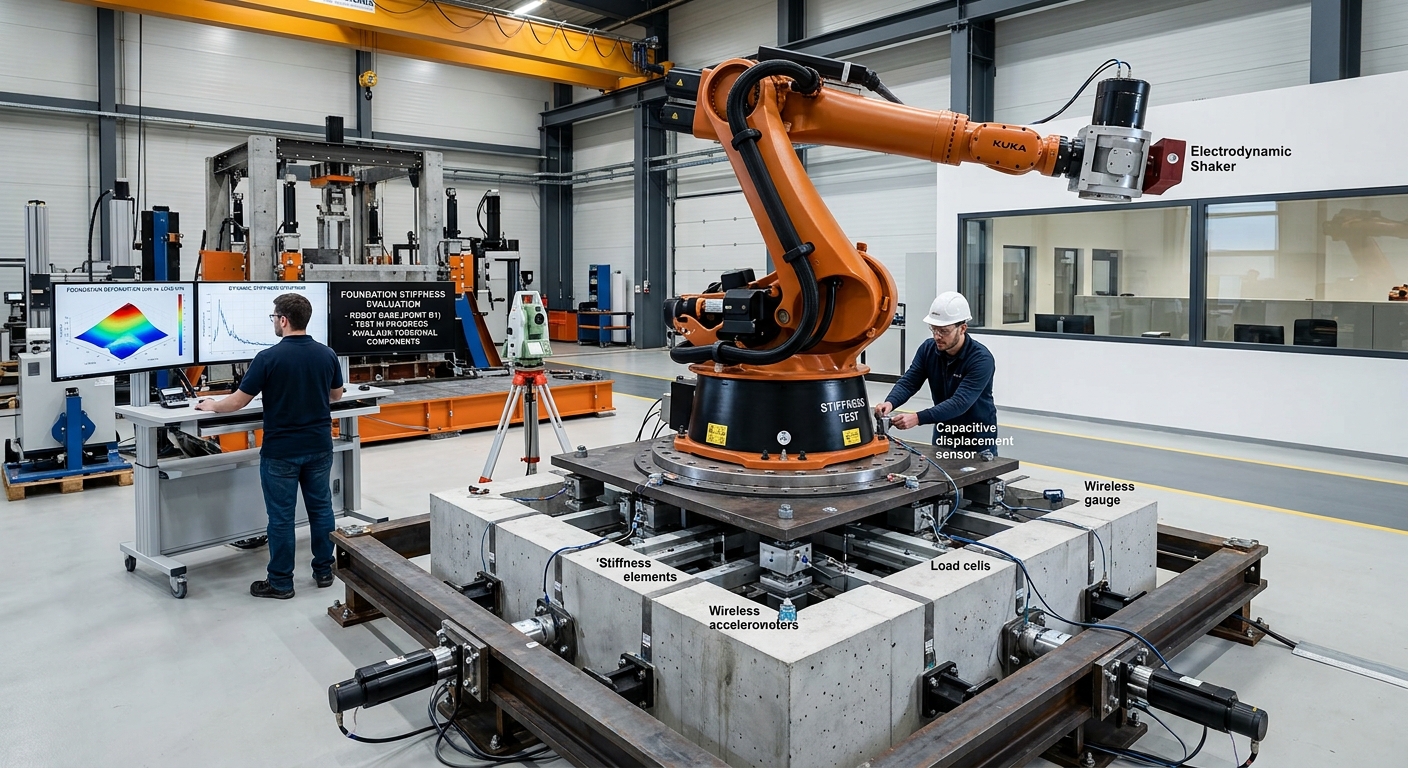

Industrial robot foundation stiffness affects how the complete robot system responds when the arm accelerates, decelerates, changes direction, or reacts to external process forces. A robot can meet its published specifications and still show unwanted vibration or path deviation if the structure supporting it is too flexible for the application.
The foundation is part of the robot’s mechanical chain. The floor, concrete foundation, pedestal, mounting plate, anchors, and interfaces between them all influence how forces generated by robot motion are transferred into the surrounding structure. If that structure moves, twists, or oscillates, the robot controller must operate on a mechanical system that behaves differently from an adequately rigid installation.
This article explains how foundation stiffness influences dynamic performance, why resonance matters, how mounting conditions affect accuracy, and what engineers should inspect before blaming the robot, programming, or calibration for unstable behavior. The required foundation cannot be selected from a universal stiffness value. Robot manufacturers specify installation requirements for individual models, so those requirements should be checked during cell design.
Why Industrial Robot Foundation Stiffness Matters
The foundation is part of the mechanical system
An industrial robot does not operate independently from its mounting structure. Forces and moments produced during motion pass through the robot base into its support. A sufficiently rigid foundation limits movement at that interface, while a flexible structure can deflect as the robot changes posture or direction.
This effect becomes more relevant when the robot carries a large payload, operates with high acceleration, uses an extended arm configuration, or performs a process that introduces additional forces. The correct assessment therefore considers the robot, tooling, payload, pedestal, anchors, and foundation as one mechanical system.
Static strength and stiffness are different
A structure can be strong enough to support the robot without being stiff enough for the required dynamic performance. Strength concerns whether components can withstand applied loads without structural failure. Stiffness describes how much they deform when those loads are applied. Both must be evaluated, but they answer different engineering questions.
How Industrial Robot Foundation Stiffness Changes Robot Motion
Deflection at the robot base
When a robot accelerates, reaction forces act through its base. If the support moves under those loads, the position of the robot base is no longer effectively fixed relative to the workpiece. The amount and direction of movement depend on the structure, robot posture, load, acceleration, and force direction.
The resulting error may be difficult to identify because the robot can still repeat its programmed joint motion while the mounting structure moves beneath it. For applications such as handling, this movement may remain within acceptable process limits. Milling, trimming, dispensing, measurement, and other path-sensitive processes can be less tolerant of it.
Oscillation after acceleration changes
Flexible supports can also oscillate after rapid acceleration or deceleration. ABB’s robot tuning documentation specifically describes mounting-stiffness compensation as a way to reduce oscillations, overshoot, and path-accuracy problems when the foundation does not provide the intended stiffness. This confirms that foundation behavior can interact directly with motion performance rather than acting only as an installation issue.
Why Resonance Frequency Is Important
Every mechanical structure has natural frequencies at which it responds strongly to excitation, which is why industrial robot foundation stiffness must be considered together with the dynamic response of the mounting system. The robot, pedestal, mounting system, foundation, and installed equipment together create a dynamic system with its own modes of vibration.
Robot manufacturers may therefore specify a minimum resonance or natural frequency for the mounting structure. The required value is model-specific and should come from the product manual rather than being assumed from another robot. ABB documentation, for example, gives different foundation requirements for different robot models and identifies minimum resonance frequency as a condition associated with optimal performance.
Operating near a structural resonance can amplify motion caused by acceleration or process forces. Increasing controller accuracy settings cannot remove a mechanical resonance. The structural source must first be identified and, when necessary, corrected or accommodated using manufacturer-approved methods.
Foundation Stiffness and Robot Accuracy
Repeatability does not describe foundation movement
A robot’s repeatability specification describes the robot under defined test conditions. It should not be interpreted as a guarantee that an installed cell will reproduce the same process accuracy regardless of its floor, pedestal, fixture, tooling, calibration, or operating conditions.
If industrial robot foundation stiffness is insufficient and the base shifts relative to the workpiece, the TCP can move even when the robot itself follows its commanded position consistently.
Foundation flatness also matters
Stiffness is not the only mounting requirement. Manufacturer documentation can also specify mounting-surface flatness, inclination, anchoring arrangements, and allowable loads. ABB manuals note that foundation flatness influences calibration-related behavior, while Epson installation guidance warns that an unsuitable mounting surface can affect robot performance or damage the manipulator.
Applications Most Sensitive to Foundation Flexibility
The significance of industrial robot foundation stiffness depends on the process and on how sensitive the application is to vibration, deflection, and path deviation. A pick-and-place system handling parts with generous positional tolerance may behave acceptably on a structure that would be unsuitable for machining or precision inspection.
Robotic machining is particularly sensitive because cutting forces act through the tool, robot, base, and supporting structure. Foundation flexibility becomes one element in a larger compliance chain that also includes the robot joints, spindle mounting, toolholder, cutting tool, fixture, and workpiece.
For additional context on how structural elements influence machining results, the article Why Robot Accuracy Alone Does Not Guarantee Precision in Robotic Milling examines the interaction between robot support, fixtures, vibration, and process stability.
How to Evaluate a Robot Foundation Before Installation
Use the robot manufacturer’s installation data
The first reference should be the installation or product manual for the exact robot variant. Foundation loads, mounting geometry, surface requirements, anchor arrangements, and dynamic requirements vary between robot models. Values should not be transferred from a robot of similar payload or reach without manufacturer confirmation.
Industrial robot foundation stiffness should therefore be checked against the installation requirements for the exact robot model.
A structural engineer may also need to evaluate the floor, concrete foundation, pedestal, reinforcement, anchors, and surrounding building structure. The scope depends on robot size, application loads, installation environment, and local engineering requirements.
- Confirm the robot’s mass, installed equipment, payload range, and mounting orientation.
- Review manufacturer-specified foundation loads, moments, flatness, and dynamic requirements.
- Check whether a pedestal or riser introduces additional bending or torsional compliance.
- Verify the condition and geometry of the mounting surface before positioning the robot.
- Confirm that anchors and mounting hardware match the approved installation design.
- Evaluate whether nearby machines can transmit significant vibration into the robot structure.
- Validate the foundation under representative robot speeds, payloads, postures, and process conditions.
- Document the final installation so later structural changes can be compared with the commissioned condition.
Diagnosing Foundation-Related Performance Problems
Look for symptoms that change with motion
Foundation-related problems often change when robot acceleration, payload, posture, or direction changes. Excessive settling after a fast move, visible pedestal movement, path variation during strong directional changes, or vibration that appears only in particular configurations can justify a structural investigation.
Changes in these symptoms can help determine whether industrial robot foundation stiffness should be investigated further.
These symptoms do not prove that the foundation is responsible. Similar effects can come from loose mechanical connections, tooling, fixtures, incorrect calibration, worn components, process forces, or unsuitable motion parameters. Diagnosis should separate these possible sources instead of assuming that every vibration problem begins at the robot base.
Measure before modifying the structure
Where dynamic behavior is suspected, suitable measurement methods can be used to characterize vibration or structural response. The appropriate instrumentation and acceptance limits depend on the robot and application. Any controller compensation for flexible mounting should follow the robot manufacturer’s documentation and should not be treated as a substitute for an installation that fails structural or safety requirements.
Foundation Design, Installation, and Safety
Industrial robot foundation stiffness should be reviewed as part of the complete cell installation, especially when the robot operates with significant dynamic loads or performs a precision-sensitive process.
Foundation engineering must also be considered within the complete robot-cell integration process. Mounting, commissioning, safeguards, application equipment, and structural changes can affect the risks associated with the finished system.
ISO 10218-2:2025 addresses safety requirements for industrial robot applications and robot cells, including integration, commissioning, operation, maintenance, and decommissioning. The standard does not replace the robot manufacturer’s foundation calculations or local structural requirements, but it provides the broader safety framework within which the robot application is integrated.
If a project requires evaluation of the robot base, pedestal, application loads, or complete cell architecture, Robotic Hi-Tech Solutions can be contacted to discuss the application requirements before the final installation concept is selected.
FAQ
Can a weak foundation reduce industrial robot accuracy?
Yes. Movement or oscillation of the robot support can change the relationship between the robot base and the workpiece, affecting path behavior and installed-cell accuracy.
Does a heavier concrete floor automatically provide sufficient stiffness?
No. Foundation behavior depends on geometry, support conditions, reinforcement, interfaces, anchors, pedestals, robot loads, and dynamic response. Mass alone does not establish suitability.
Is foundation stiffness the same as foundation strength?
No. Strength concerns resistance to failure under load. Stiffness concerns deformation under load. A foundation must satisfy the relevant requirements for both.
Can software compensate for a flexible robot foundation?
Some robot platforms provide tuning functions intended to address certain mounting-flexibility effects. Their applicability is manufacturer- and controller-specific. Such functions do not eliminate the need for an acceptable structural installation.
Can foundation flexibility cause vibration?
Yes. A flexible support can deform and oscillate under robot motion or process forces. Its dynamic response can interact with the robot and other elements of the cell.
Are machining robots more sensitive to foundation stiffness?
Machining often makes structural flexibility more noticeable because cutting forces act through the entire robot-tool-foundation chain and can influence vibration, path stability, and surface quality.
Should foundation requirements be checked before purchasing the robot?
Preferably, yes. Reviewing installation loads and dynamic requirements during cell design allows the foundation, pedestal, anchors, layout, and robot selection to be evaluated together.
How should foundation stiffness be verified?
Start with the exact robot manufacturer’s installation requirements. Where structural or dynamic verification is required, use appropriate engineering analysis or measurement under conditions representative of the intended application.