English
 Italiano
 Українська
 Русский
 Español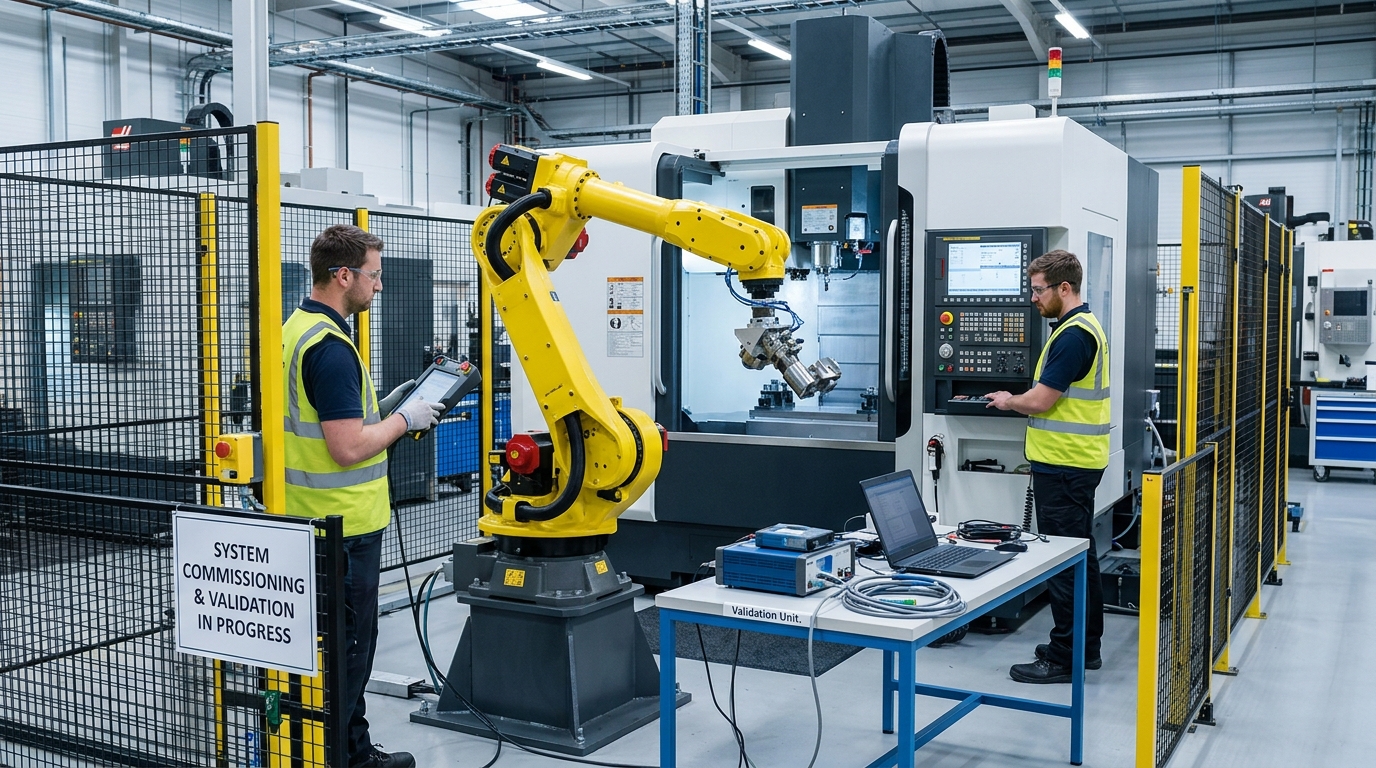

Robot CNC cell commissioning should confirm more than whether the robot moves and the CNC completes a cycle. Before production release, the integrated system needs evidence that its hardware, controls, interfaces, safety functions, operating sequences, and machining process behave according to the defined project requirements.
Factory Acceptance Testing (FAT) normally evaluates the system before final installation at the customer’s production site. Site Acceptance Testing (SAT) checks the installed cell in its actual environment. Process validation then examines whether the complete production process can consistently meet the defined acceptance criteria under representative operating conditions. The exact scope and acceptance criteria depend on the project, equipment, contractual requirements, process, and applicable regulations.
A useful commissioning plan therefore separates these activities rather than treating them as one final test. This makes failures easier to identify and assign: an interface problem discovered during FAT requires a different response from a utility problem found during SAT or a machining result that fails during process validation.
What FAT, SAT, and Process Validation Prove
FAT and SAT answer different questions
FAT asks whether the assembled cell meets the agreed requirements before shipment or final handover at the destination. Tests can cover robot motion, CNC communication, PLC logic, tooling, peripherals, guarding, safety functions, alarms, operating modes, and documented sequences where those elements are included in the FAT scope.
SAT takes place after installation and checks conditions that cannot be fully established at the supplier’s facility. These may include final utilities, machine placement, interfaces with surrounding equipment, network connections, production material flow, operator access, and behavior of the complete installation.
Process validation focuses on the production result
A cell can pass functional testing and still require process development. Process validation examines whether the configured robot, CNC equipment, tooling, fixtures, programs, workpieces, and operating conditions produce the required result. Acceptance criteria should therefore be defined before testing rather than decided after results are available.
FAT in Robot CNC Cell Commissioning
Test the integrated sequence before shipment
FAT should verify the functions that can reasonably be tested in the supplier’s environment. For a robot tending a CNC machine, this can include part pickup, positioning, CNC loading and unloading, clamp confirmation, automatic-door commands, machine-ready signals, cycle start, robot-clear conditions, fault handling, and return to a defined state after an interruption.
The objective is not simply to demonstrate one successful automatic cycle. Repeated functional testing should expose sequencing errors, incorrect I/O logic, missing interlocks, inconsistent sensor behavior, or recovery procedures that are not yet adequately defined.
Safety-related testing also needs documented requirements. A related review of functional safety for CNC robot cells explains how risk assessment, safety functions, Performance Level considerations, and validation fit into the integrated cell.
SAT After the Cell Reaches the Production Site
Confirm the real installation conditions
SAT should not simply repeat FAT without considering the installation. During robot CNC cell commissioning, SAT confirms that the functions previously tested still operate correctly after transport, installation, connection to site utilities, and integration with the production environment.
The team should verify that the installed configuration matches the approved documentation and that required utilities remain within the equipment manufacturers’ specified conditions. Robot mastering or calibration status, tooling installation, fixtures, safety devices, peripheral equipment, and communication links should also be checked where applicable.
Tests involving access points, operating modes, stopping behavior, resets, and safety-related interfaces should follow the documented safety requirements for the actual cell. OSHA’s Industrial Robot Systems and Industrial Robot System Safety guidance discusses risk assessment, risk reduction, validation, and considerations for evaluating robot safety systems.
Process Validation Before Production Release
Use representative production conditions
During robot CNC cell commissioning, process validation should move beyond basic automation behavior and examine the manufacturing result. For machining applications, relevant checks depend on the process but may include part dimensions, surface requirements, tool behavior, workholding stability, robot positioning, program execution, process alarms, and inspection results.
For machining applications, relevant checks depend on the process but may include part dimensions, surface requirements, tool behavior, workholding stability, robot positioning, program execution, process alarms, and inspection results.
The test material, workpiece configuration, tooling, programs, fixtures, and relevant process settings should represent the intended production configuration closely enough for the results to be meaningful. A test performed with substantially different tooling or workpieces may not demonstrate performance under the final production conditions.
Where several part families or substantially different operations will run in the same cell, one validated cycle should not automatically be treated as evidence that every other process has been validated. The validation scope should correspond to the differences that can affect the required result.
Robot CNC Cell Commissioning Checklist
The following eight checks provide a practical framework for FAT, SAT, and final process validation. They should be adapted to the documented requirements of the specific cell.
- Confirm the approved configuration: compare the installed robot, CNC machine, end-effector, fixtures, sensors, peripherals, controller versions, and relevant software configuration with the project documentation.
- Test the complete automatic sequence: verify loading, unloading, clamping, machine commands, robot-clear conditions, cycle initiation, completion signals, and transfer between defined operating states.
- Challenge abnormal conditions: test defined responses to missing parts, failed confirmations, interrupted cycles, communication faults, or other foreseeable faults included in the system requirements.
- Verify safety functions: test access devices, emergency stopping, operating modes, resets, safety-related interfaces, and other protective functions required by the cell’s risk assessment.
- Check site utilities and interfaces: confirm electrical supply, compressed air or other required services, network connections, extraction, coolant services, and surrounding equipment where they affect operation.
- Run representative workpieces: use the intended tooling, fixtures, programs, materials, and process conditions needed to evaluate the production process against defined criteria.
- Record deviations and corrections: identify each failed or conditional acceptance item, its responsible party, corrective action, retest requirement, and final status.
- Control the accepted baseline: record the software, programs, parameters, drawings, safety configuration, tooling, and documentation associated with the configuration that passed acceptance.
Documentation and Acceptance Criteria
During robot CNC cell commissioning, acceptance becomes difficult when FAT or SAT requirements use phrases such as “works correctly” without defining what constitutes a pass. Wherever practicable, test procedures should identify the required initial condition, action to perform, expected response, observed result, and acceptance status.
Documentation should also distinguish unresolved defects from agreed limitations or future work. A signed acceptance record should not make open technical issues disappear. Outstanding items need sufficient description to determine what must be corrected and whether another test is required.
Configuration records are particularly useful in automated cells because software and parameter changes can alter behavior without obvious mechanical changes. Recording the accepted configuration provides a reference for troubleshooting and future modifications.
Common Gaps During CNC Cell Commissioning
One recurring problem is testing only the normal automatic cycle. Setup, manual operation, recovery after a stopped cycle, part shortages, failed sensor confirmations, maintenance access, and restart behavior can expose conditions that normal production does not reveal.
Another gap is assuming that successful robot-CNC communication proves the process is ready. The handshake may work while the fixture, toolpath, workpiece orientation, process parameters, or inspection result remains unsuitable for production.
Commissioning teams should also avoid treating modifications made after FAT as automatically accepted. A change to PLC logic, robot programming, tooling, guarding, safety configuration, or machine interface may require targeted verification or validation according to what the modification affects.
Before Releasing the Cell to Production
Before completing robot CNC cell commissioning, production release should occur only after the required acceptance tests have been completed, deviations have been evaluated, and the responsible parties understand any remaining conditions. The final package should reflect the installed system rather than an earlier design that no longer matches the cell.
Operators and maintenance personnel also need the information required for their assigned tasks. Operating instructions, recovery procedures, maintenance requirements, drawings, backups, and safety-related information should correspond to the released configuration.
For projects that require evaluation of robot-CNC integration, commissioning scope, interfaces, or machining-cell architecture, the application can be reviewed through the Robotic Hi-Tech Solutions contact page. Final acceptance criteria should remain specific to the equipment, process, site requirements, applicable regulations, and current technical standards.
FAQ
What is FAT for a robot CNC cell?
Factory Acceptance Testing evaluates defined cell functions before final installation at the customer’s site. Its scope is established by the project requirements and agreed acceptance procedure.
What is SAT in robot commissioning?
Site Acceptance Testing verifies the installed system under actual site conditions, including relevant utilities, interfaces, installation details, safety functions, and production-environment requirements.
Is SAT the same as process validation?
No. SAT mainly addresses acceptance of the installed system, while process validation evaluates whether the production process satisfies defined process or product acceptance criteria.
Should FAT include safety testing?
Safety functions that can be meaningfully tested during FAT should be included when required by the commissioning and validation plan. Final validation must also reflect the actual installed application.
Can a robot CNC cell pass FAT and fail SAT?
Yes. Site utilities, installation changes, communication infrastructure, surrounding equipment, reassembly, or other site-specific conditions can reveal issues that were not present during FAT.
How many parts are required for process validation?
There is no universal quantity that applies to every robot CNC cell. The required sample and acceptance method depend on the process, specifications, quality requirements, customer requirements, and applicable procedures.
Should faults and recovery procedures be tested?
Yes, where they form part of the system requirements. Defined fault conditions and recovery sequences should be tested so expected system behavior is understood before production release.
When should commissioning tests be repeated?
Relevant tests should be reconsidered when a modification can affect an accepted function, safety measure, interface, program, tooling arrangement, process condition, or previously validated requirement.