English
 Italiano
 Українська
 Русский
 Español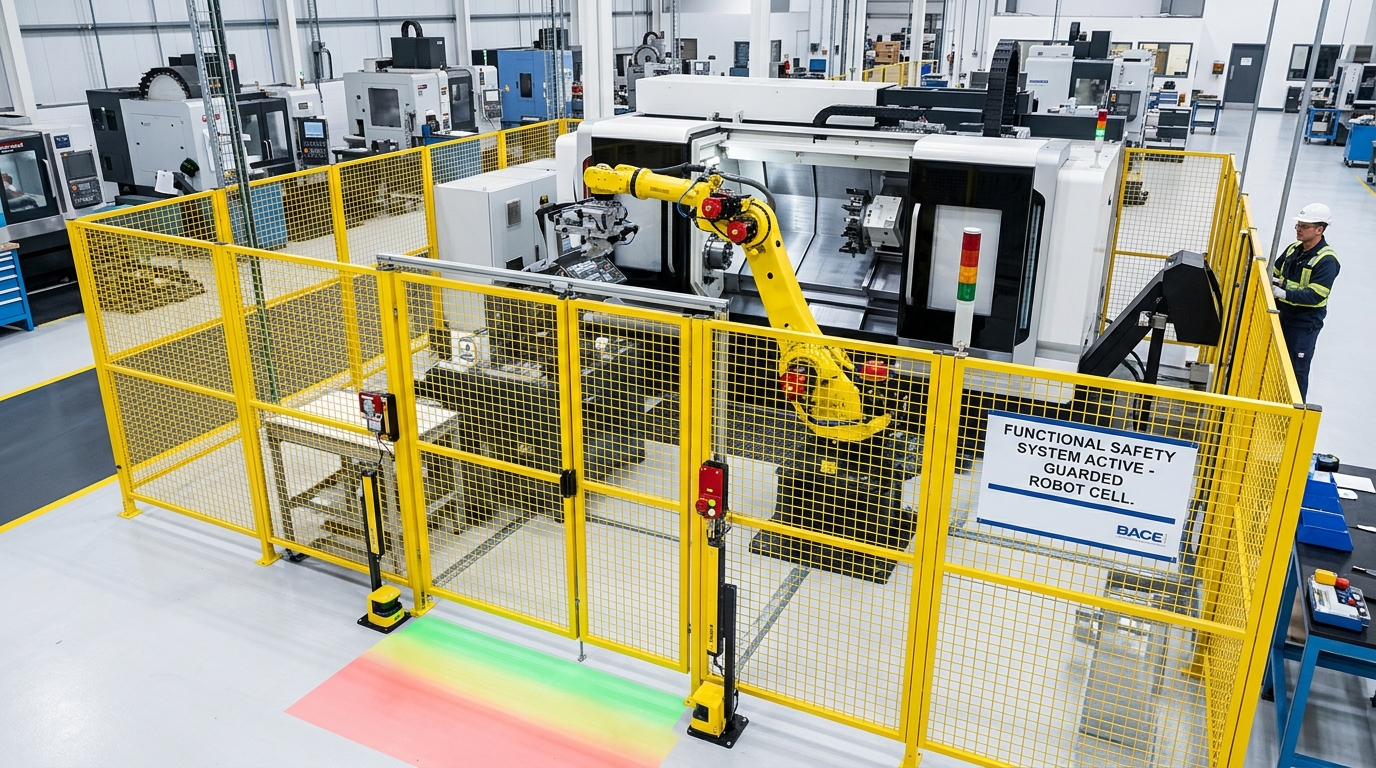

CNC robot cell functional safety begins with identifying how people can be exposed to hazardous motion, stored energy, cutting processes, automatic doors, clamping systems, and unexpected machine or robot movements. The objective is not simply to install guards and emergency stops. The complete cell must reduce identified risks through coordinated mechanical safeguards, safety-related control functions, procedures, and validation.
A CNC robot cell normally combines equipment from several systems: the robot, CNC machine, end-of-arm tooling, workholding equipment, access doors, sensors, safety devices, and communication interfaces. Safety therefore has to be assessed at cell level. A safe robot and a safe CNC machine do not automatically create a safe integrated application when their functions interact.
The engineering process normally starts with risk assessment, continues with specification of required safety functions and their required performance, and ends with verification and validation. Standards such as ISO 12100 and ISO 13849 provide frameworks for this work, while robot-specific requirements must also be considered. The actual measures depend on the hazards, tasks, equipment, and operating conditions of the individual cell.
How CNC Robot Cell Functional Safety Is Structured
Functional safety concerns the parts of the control system that perform safety functions. In a CNC robot cell, these functions may respond to an open guard, an emergency-stop command, an access request, or another condition that requires hazardous motion to stop or remain inhibited.
Safety must be considered at cell level
The assessment should include more than robot movement. The CNC spindle, chuck or fixture, automatic doors, pneumatic or hydraulic equipment, conveyors, tool changers, and other auxiliary systems may create hazards of their own. Their interaction can also create conditions that are absent when each machine operates independently.
For example, stopping robot motion does not necessarily remove every hazard if the spindle continues rotating or the CNC machine can still execute an automatic movement. The safety concept therefore needs defined responses for each hazardous condition rather than relying on one general stop command.
Risk Assessment Comes Before Selecting a Performance Level
A risk assessment identifies hazards, determines who may be exposed, examines the tasks performed in the cell, estimates risk, and identifies measures needed to reduce that risk. It should address normal production as well as setup, teaching, troubleshooting, cleaning, recovery, maintenance, and other reasonably foreseeable activities.
Task-based assessment is essential
Access requirements often change between tasks. During automatic production, personnel may remain outside the safeguarded space. During setup or fault recovery, however, a trained worker may need closer access to the robot, fixture, CNC door, or tooling. Those operating conditions require separate consideration because the exposure is different.
The assessment should also consider foreseeable faults and failures. OSHA guidance for industrial robot systems specifically addresses risk assessment, risk reduction, validation, and review as parts of evaluating a robot application. Its industrial robot system safety guidance provides additional background on hazards and safeguarding principles.
What Performance Level Means in a CNC Robot Cell
ISO 13849-1 provides a methodology for designing and integrating safety-related parts of control systems. The standard uses Performance Level, or PL, to characterize the ability of those parts to perform a safety function under foreseeable conditions.
PLr comes from the risk assessment
The required Performance Level, commonly written as PLr, should not be selected because a particular robot, safety PLC, scanner, or guard switch is advertised with a certain capability. ISO 13849-1 does not prescribe one universal PLr for a particular machinery application. The required level has to be determined for the safety function being assessed.
The design must then demonstrate that the complete safety-related control chain can achieve the required performance. That chain can include input devices, logic, communication, and output elements. A component rating alone does not establish the performance of the complete safety function.
Which Safety Functions Should Be Defined?
Each significant risk reduction measure that depends on the control system should be translated into a clearly defined safety function. The specification should describe the initiating condition, required response, affected equipment, reset conditions, and any relevant operating mode.
Typical functions depend on the application
A guarded CNC robot cell may require functions associated with guard-door monitoring, prevention of unexpected automatic restart, emergency stopping, safe interruption of hazardous movement, or controlled access. Which functions are necessary depends on the cell design and the results of its risk assessment.
The CNC and robot also need coordinated behavior. For example, an access request may require robot motion and relevant CNC hazards to reach an appropriate safe condition before an interlocked door can be opened. The exact sequence must be engineered for the machinery and process rather than assumed from a generic template.
Safety Interfaces Between the Robot and CNC Machine
The interface between independent controllers deserves particular attention. Production signals such as machine ready, robot clear, part clamped, cycle complete, or door closed can coordinate the process, but a standard control signal should not automatically be treated as a safety-related signal.
A clear distinction between standard control signals and safety-related signals is therefore essential for functional safety for CNC robot cells.
Where a signal contributes to a safety function, its architecture and failure behavior must satisfy the requirements established for that function. Designers should clearly distinguish ordinary sequencing signals from safety-related communication so that a production command cannot unintentionally substitute for a validated protective function.
Related integration issues involving robot, CNC, tooling, software, sensors, and complete-cell behavior are also discussed in the Robotic Hi-Tech Solutions technical articles on robotic machining and automation.
How Validation Confirms That the Safety Concept Works
Validation is a key part of functional safety for CNC robot cells because it confirms that the specified safety functions have been implemented and tested as intended. It determines whether the specified safety functions and their implementation meet the safety requirements established for the cell. ISO 13849 addresses both design principles and validation of safety-related control systems.
Effective validation is one of the final checks needed to demonstrate that functional safety for CNC robot cells has been implemented according to the defined safety requirements.
Validation should test the intended behavior
The validation process should examine safety functions under the conditions defined in the specification. This includes confirming the response to protective-device operation, relevant operating modes, reset behavior, interfaces, and foreseeable faults covered by the design.
Documentation is part of this process. The risk assessment, safety requirements, circuit or architecture information, relevant calculations, configuration information, test procedures, and results should be traceable enough to explain why the implemented measures satisfy the specified requirements.
Eight Checks Before Approving a CNC Robot Cell
A structured review before production helps identify gaps between the original safety concept and the completed installation. The following eight checks provide a practical starting point, although they do not replace the applicable standards or a project-specific assessment.
- Confirm that the risk assessment covers automatic operation, setup, teaching, cleaning, maintenance, fault recovery, and other foreseeable tasks requiring access.
- List each safety-related function separately and document its initiating condition, required response, affected equipment, and reset behavior.
- Determine the required performance for each safety function from the risk assessment rather than selecting a PLr from component specifications alone.
- Check the complete safety chain, including sensors or protective devices, safety logic, communication paths, contactors, drives, valves, and other final elements involved in achieving the safe state.
- Verify that robot and CNC safety states are coordinated so that stopping one system does not leave an uncontrolled hazard active in another part of the cell.
- Test guards, access devices, emergency-stop functions, resets, operating modes, and relevant fault conditions according to the documented validation plan.
- Confirm that ordinary production I/O is clearly distinguished from signals that form part of a safety-related control function.
- Record validation results and review any modification to software, tooling, guarding, machinery, layout, or operating procedures that could affect the original risk assessment.
When Changes Require the Safety Assessment to Be Reviewed
Validation at commissioning should not be treated as permanent evidence that every future configuration remains acceptable. A robot cell can change through new tooling, different workpieces, modified fixtures, software updates, altered guarding, new operating modes, or changes to the CNC interface.
For this reason, functional safety for CNC robot cells should be reviewed whenever a modification could affect hazards, safety functions, or access conditions.
A change should be reviewed for its effect on existing hazards, safety functions, and assumptions used during validation. Not every modification necessarily requires redesign of the complete safety system, but its safety relevance should be evaluated and documented before continued production where appropriate.
Companies designing or modifying automated machining cells can contact Robotic Hi-Tech Solutions to discuss the integration requirements of a specific robotic machining application. Final safety decisions should remain based on the actual machinery, applicable regulations and standards, risk assessment, and qualified engineering review.
FAQ
What is functional safety in a CNC robot cell?
It is the part of machine safety that depends on control systems correctly performing defined safety functions when required, such as responding to guarded access or a stop demand.
Does every CNC robot cell require the same Performance Level?
No. ISO 13849-1 does not prescribe one PLr for every CNC robot cell. Required performance is determined for individual safety functions based on the applicable risk assessment and standards.
Is a safety-rated robot enough to make the complete cell safe?
No. The integrated application also includes the CNC machine, tooling, workholding, guarding, auxiliary equipment, control interfaces, operating tasks, and other hazards that must be assessed.
Can a standard PLC signal be used as a safety signal?
Ordinary control signals should not be assumed to satisfy safety requirements. A signal used as part of a safety function must be implemented according to the architecture and performance requirements applicable to that function.
What is the difference between verification and validation?
Verification checks whether specified design requirements have been implemented correctly. Validation determines whether the resulting safety functions satisfy the defined safety requirements for the intended application.
When should validation be performed?
Validation should be completed before the relevant safety functions are accepted for production use and should be reconsidered when modifications could affect the safety assumptions or implementation.
Should maintenance and fault recovery be included in the risk assessment?
Yes. Risk assessment should address foreseeable tasks beyond normal automatic production, particularly activities that may require closer access to machinery or temporary changes in operating conditions.
Does an emergency stop replace guards and other protective measures?
No. Emergency stopping is one possible protective measure. The complete risk reduction strategy may also require guards, interlocks, safe control functions, procedures, and other measures determined by the risk assessment. “`