English
 Italiano
 Українська
 Русский
 Español
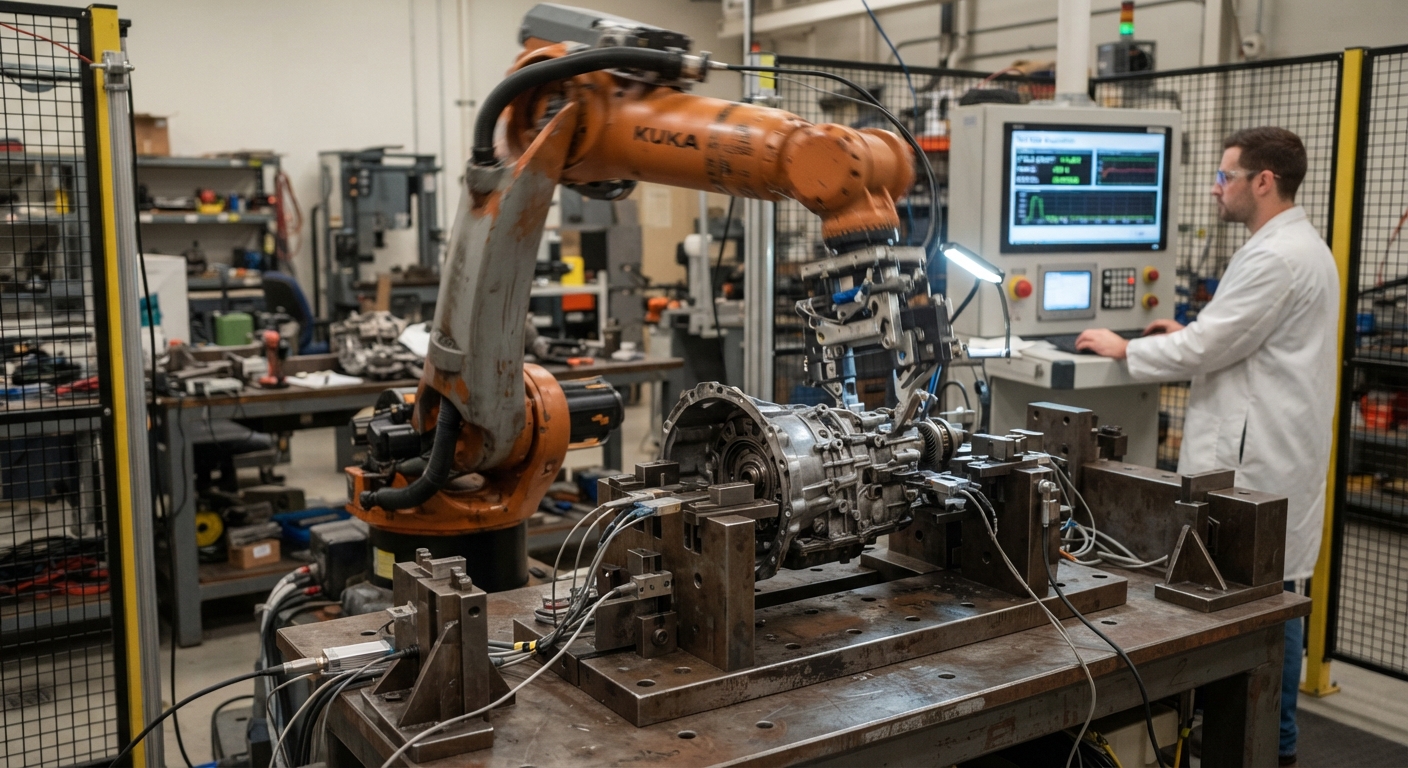

Industrial robots can automate tool testing and product durability tests when repeated movements, controlled loading, or consistent test sequences are required. Robotic durability testing allows manufacturers to program defined actions while suitable instruments measure how a product responds. This approach is useful when test conditions must remain consistent across multiple samples.
Applications include operating switches, exercising mechanical joints, testing handles, manipulating tools, and repeatedly opening or closing assembled components. However, programmed movements do not automatically guarantee valid results. Fixtures, applied forces, measurement accuracy, and environmental conditions can influence test outcomes. Engineers must evaluate the complete testing system rather than the robotic arm alone.
This article explains how industrial robots perform durability tests, which equipment they require, and how manufacturers can evaluate their suitability. It also examines force control, data collection, safety precautions, and system validation. Understanding these factors helps engineers determine when robotic automation is appropriate and when a dedicated testing machine may be preferable.
1. How robotic durability testing works
Robotic durability testing uses programmed movements to reproduce defined interactions with a component. A robot may push, pull, rotate, press, or manipulate a product while external sensors measure its mechanical response. Each sequence must follow an established procedure that reflects the intended test conditions.
Programmed movements and repeated cycles
Engineers define movement paths, speeds, positions, and test sequences according to the required operation. The robot executes these instructions repeatedly while its controller communicates with sensors and supporting equipment. Cycle counters and monitoring devices help document completed operations, interruptions, and changes in test conditions.
Testing mechanical tools and assembled products
A robotic system may operate a hand tool, exercise a hinge, or actuate a mechanical control. Fixtures must maintain suitable alignment without introducing unwanted loads or restricting normal component movement. Proper mounting helps ensure that the test evaluates the product rather than errors caused by its installation.
2. Which industrial products can robots test?
Robotic automation can support testing of products that require repeated mechanical interaction. The most suitable applications involve movements that a robot can reproduce within its operating limits. Engineers must also verify that the selected equipment can measure the variables required by the test procedure.
Tool operation and mechanical endurance
Industrial robots can reproduce tool movements during functional and endurance tests. Examples include operating levers, manipulating handles, and moving mechanical assemblies through specified positions. Additional sensors may be necessary when applied force or torque forms part of the acceptance criteria.
Consumer and industrial product testing
Switches, drawers, doors, and articulated components may require repeated operation during product evaluation. Robotic durability testing can reproduce these actions while recording cycle counts and defined failure events. The test procedure must account for alignment, operating limits, specimen variation, and the expected conditions of use.
3. How to select a robot for automated testing
Robot selection should begin with the testing requirements rather than the robot’s published specifications. Engineers must identify required movements, forces, working positions, test duration, and measurement uncertainty. These parameters determine whether the robot can complete the procedure without exceeding its mechanical or control limitations.
Payload, reach, and mechanical configuration
Payload calculations must include the end effector, adapters, sensors, and additional equipment carried by the robot. The system must reach every required position while maintaining suitable orientation. Engineers should also examine possible collisions, joint limits, and the space needed for specimen installation.
Repeatability versus testing accuracy
Repeatability describes the ability to return to programmed positions under defined conditions. It does not establish applied force accuracy or guarantee reliable test results. Complete system validation remains necessary. The RHTS article on robotic machining repeatability examines this distinction in another industrial application.
4. Force control and measurement during testing
Position-controlled movements may be sufficient when displacement defines the test procedure. However, tests requiring specific contact forces or torques need suitable measurement equipment. Without appropriate feedback, changes in fixture alignment or component stiffness can alter the actual loading applied to the specimen.
Force and torque sensors
Sensors can measure interaction forces and moments during robotic durability testing. Their measurement range, calibration, installation, and uncertainty must match the test requirements. Engineers should also consider dynamic loading and determine whether the sensor response is suitable for the programmed movements.
Displacement and visual inspection
External displacement sensors can measure component movement independently of robot position. Cameras may identify visible defects or dimensional changes when properly configured and validated. The RHTS article on robotic machine vision inspection discusses how sensor positioning, calibration, and lighting affect inspection performance.
5. Safety requirements for automated durability tests
Repeated loading creates hazards beyond normal robotic movement. Components may fracture, release stored energy, or separate from their fixtures. Risk assessments must therefore consider the robot, test specimens, supporting equipment, and foreseeable failure conditions throughout the complete operating sequence.
Protective measures may include guarding, interlocked access, emergency stopping functions, and containment of fragments. Their selection depends on the identified hazards and applicable requirements. OSHA provides guidance in its industrial robot systems safety manual.
6. How to validate robotic test results
Robotic durability testing requires validation before collected data can support engineering decisions. Initial trials should establish whether programmed movements match the specified procedure and whether measurement equipment captures the necessary variables. Reference measurements can help identify systematic errors or unexpected differences between samples.
Engineers should document test parameters, calibration records, specimen identification, interruptions, and observed failures. Consistent records support comparison between tests and help investigate unusual results. The RHTS guide to the digital thread for robotic manufacturing discusses the connection between process information and inspection records.
7. Eight checks before implementing robotic testing
Before selecting equipment for an automated testing cell, engineers should evaluate these technical requirements:
- Define the test objective, measurable variables, and applicable acceptance criteria.
- Identify required movements, travel limits, operating speeds, and cycle sequences.
- Calculate payload requirements, including tooling, sensors, and mounting accessories.
- Verify access to every test position and examine possible collisions.
- Select force, torque, displacement, or inspection sensors with suitable measurement uncertainty.
- Evaluate fixture rigidity, specimen alignment, and component replacement procedures.
- Assess hazards involving unexpected movement, component fracture, and stored energy.
- Validate complete test cycles using reference measurements and documented results.
8. When is robotic testing the appropriate solution?
Robotic durability testing is worth evaluating when procedures require several movement directions, changing orientations, or interaction with different product features. Programmable robots may also support different specimen configurations, provided tooling changes and validation requirements remain manageable.
Dedicated testing machines may be preferable when procedures involve a single controlled movement or demanding loading requirements. Economic comparisons should include fixtures, sensors, programming, calibration, maintenance, safety equipment, and testing throughput rather than considering robot purchase price alone.
Manufacturers considering robotic durability testing can contact Robotic Hi-Tech Solutions to discuss specimen characteristics, required movements, measurement objectives, and integration constraints. A technical feasibility assessment can determine whether the proposed system is suitable for the intended testing procedure.
Frequently asked questions
Can industrial robots perform durability tests automatically?
Yes. Industrial robots can execute programmed movements and communicate with suitable measurement equipment. However, the complete system must be validated against the required test procedure before its results are accepted.
What is the difference between functional testing and durability testing?
Functional testing checks whether a product performs specified operations. Durability testing examines its response to defined use, loading, or repeated operation over an established testing sequence.
Can robotic systems measure the force applied to a product?
Yes, when suitable force sensors or calibrated measurement devices are integrated. Robot position data alone cannot establish the actual contact force applied during a test.
Are industrial robots suitable for testing mechanical tools?
They can be suitable when the required movements and loads remain within system capabilities. Fixtures and instrumentation must reproduce the operating conditions specified by the test procedure.
Does robot repeatability guarantee reliable durability results?
No. Test reliability also depends on measurement uncertainty, specimen variation, fixture alignment, loading conditions, and the validity of the procedure used.
Can one robot test different products?
Potentially. A programmable robot may support different testing procedures, although each product can require dedicated tooling, revised programs, additional safety checks, and separate validation.
What happens when a product fails during a robotic test?
The system should detect defined failure conditions where practicable and respond according to its validated control and safety design. Mechanical failure hazards must be considered during risk assessment.
When should a dedicated testing machine be preferred?
A dedicated machine may be preferable when the test requires highly controlled loading or a fixed movement that specialized equipment can reproduce and measure more appropriately.