English
 Italiano
 Українська
 Русский
 Español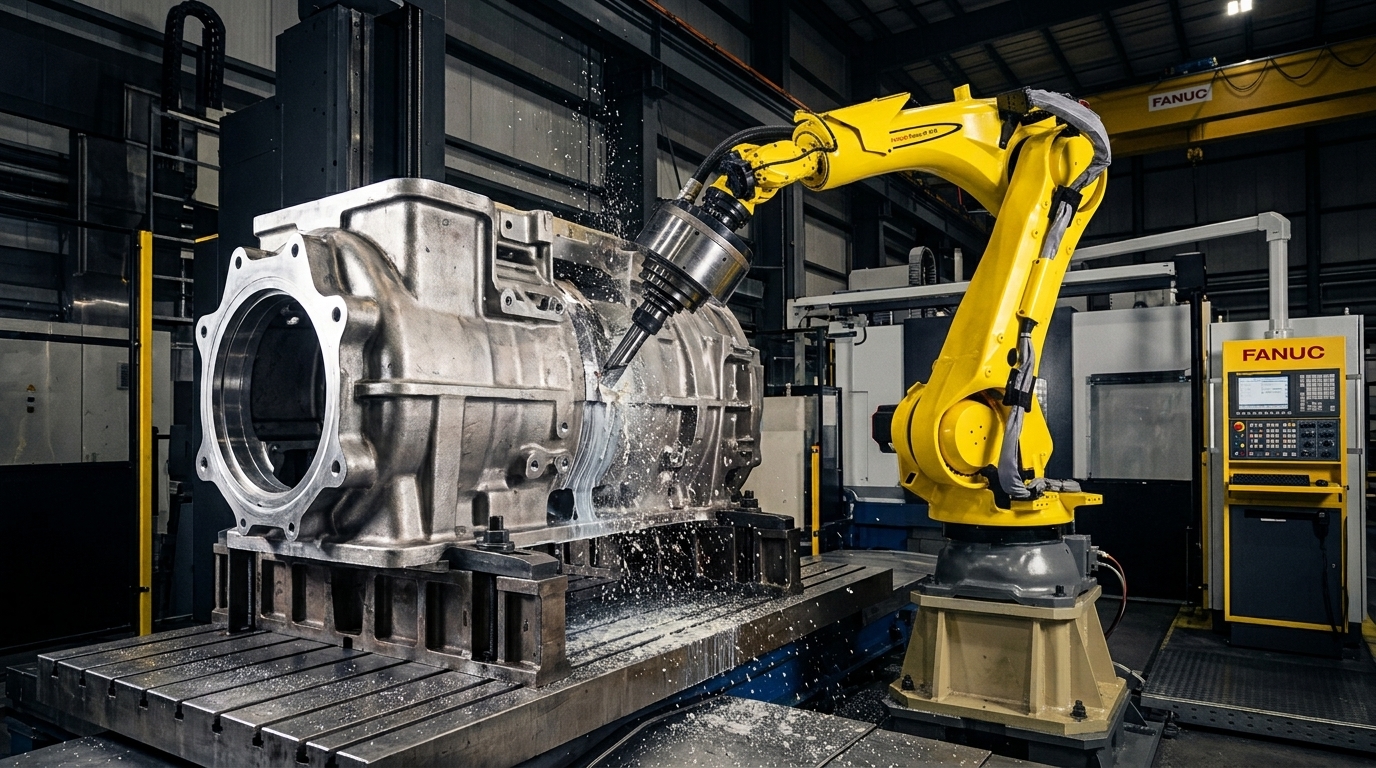

The FANUC M-810 is a machining-focused six-axis robot series developed for material-removal processes that place higher external loads on the robot than ordinary handling work. FANUC presents it for milling, drilling, tapping, and related machining tasks, with emphasis on stiffness, path accuracy, and operation around large workpieces.
For manufacturers evaluating robotic material removal, the important change is not simply higher payload. The M-810 is intended to keep a programmed tool path more stable while cutting forces act on the arm. FANUC lists two models: the M-810/190-20B with a 190 kg payload and 2,040 mm reach and the M-810/270-27B with a 270 kg payload and 2,687 mm reach.
This article explains what the FANUC M-810 changes technically, where it may expand robotic machining, and what integrators still need to validate before treating it as an alternative to a conventional machine tool. The focus is on practical consequences for stiffness, cutting loads, cell design, accuracy, and process validation.
Why the FANUC M-810 matters for robotic machining
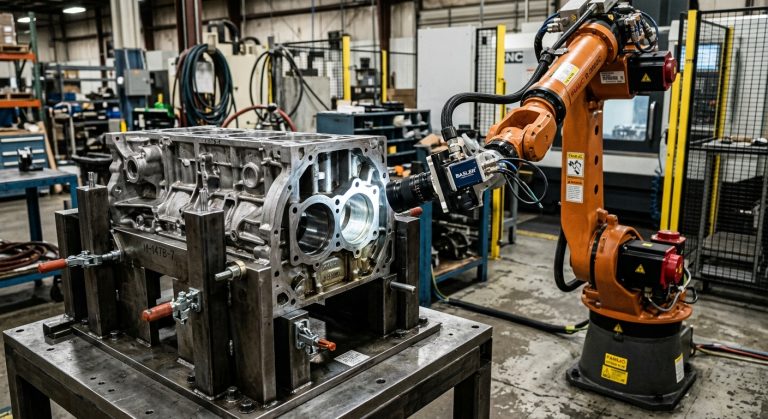
Robotic machining involves a trade-off. Six-axis robots offer a large working envelope and flexible tool orientation, but their structure is generally more compliant than a purpose-built machining center. Cutting force can therefore affect position, vibration, and surface quality.
A robot designed around machining loads
FANUC says the M-810 uses a rigid casting design, enhanced backlash compensation, and high-accuracy calibration to improve machining performance under external loads. That makes the series different from selecting a general handling robot, mainly because its payload can carry a spindle.
Two models for different envelopes
The 190 kg model combines 2,040 mm reach with ±0.02 mm repeatability. The 270 kg model offers 2,687 mm reach with ±0.03 mm repeatability. These are robot specifications, not guaranteed machining tolerances, so part accuracy must still be proven at the cell level.
What higher stiffness changes during material removal?
In milling, drilling, or tapping, reaction forces pass through the spindle, wrist, robot arm, base, and foundation. Compliance anywhere in that chain can change the real cutter position even when the programmed path is correct.
Path behavior under cutting force
FANUC states that the M-810 uses control technology intended to maintain tool-path accuracy while machining forces act on the robot. This is intended to reduce tool-path deviation associated with external machining forces.
It does not remove the need to control tool stick-out, spindle runout, fixture stiffness, robot posture, and cutting parameters. A useful complementary reference is Robotic Hi-Tech Solutions’ guide to robotic milling stability.
Where the M-810 may expand robotic material removal
FANUC identifies steel milling, drilling, and tapping among the intended applications. This matters because higher-force metal cutting places greater structural demand on an articulated robot than trimming composites, machining foam, or other relatively low-force operations.
Large and difficult-to-access components
A six-axis robot can approach a workpiece from several directions and work around parts that are awkward to place inside a conventional machine envelope. Its six-axis architecture and available reach make the series relevant to machining applications involving large workpieces.
Not every large part becomes a good robotic machining candidate. Required tolerance, material, tool engagement, feature depth, cycle time, and inspection strategy still determine whether the process is technically sensible.
How the M-810 compares with a conventional CNC approach
The M-810 is not a universal replacement for machining centers or gantry machines. Conventional machine tools are designed around high structural rigidity, controlled axes, and chip-management systems built specifically for machining.
Robotic machining becomes attractive when flexibility, access, and work envelope matter strongly. A robot can move the spindle around a fixed component and may avoid building an oversized machine structure around the whole part. FANUC presents this as an option for some large-component applications, not a blanket substitute for CNC equipment. See the official FANUC M-810 series page for the manufacturer’s current specifications.
What the new series means for cell design
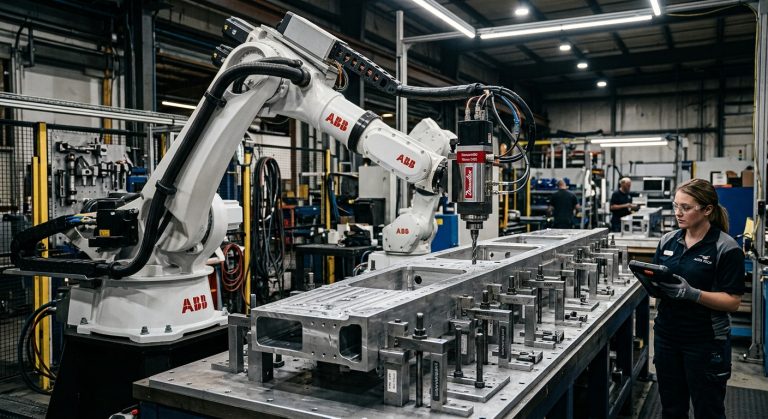
A machining-oriented robot changes the starting point for integration. Still, the spindle, mounting bracket, tooling, workholding, controller, coolant or extraction system, guarding, and measurement strategy still determine the production result.
Spindle and wrist loading remain critical
The payload calculation must include the complete wrist package: spindle, holder, cutter, mounting hardware, cables, sensors, and auxiliary equipment. Engineers also need to check center of gravity and wrist inertia against the selected model’s limits.
Wet machining affects the whole cell
FANUC states that the series can support wet as well as dry machining. Coolant containment, chip evacuation, cable protection, filtration, and maintenance access still need to be engineered for the complete installation.
Eight checks before specifying a FANUC M-810 cell
- Define the material and operation. Separate milling, drilling, tapping, deburring, and trimming because they create different forces and tooling requirements.
- Set the real accuracy requirement. Use drawing tolerances and inspection criteria instead of assuming robot repeatability equals part tolerance.
- Map the cutting envelope. Validate tool orientation, joint posture, singularity risk, fixtures, and collision clearance across the complete part.
- Calculate the full wrist load. Include spindle, bracket, toolholder, cutter, hoses, cables, and sensors, plus center of gravity and inertia.
- Evaluate cutting-force direction. Check whether demanding cuts occur in weak postures or near the edge of the working envelope.
- Engineer the fixture as part of the machine. Confirm that the workpiece cannot shift, bend, or vibrate under cutting load.
- Plan measurement and calibration. Define TCP verification, base and work frames, part location, and dimensional inspection before production.
- Validate representative cuts. Test real material, tooling, feed strategy, coolant conditions and repeated cycles before acceptance.
Safety and process validation still come first
Material removal adds hazards beyond robot motion, including rotating tools, chips, swarf, coolant, and possible tool or workpiece failure. Cell design therefore needs risk assessment, safeguarding, safe access, and validated procedures for setup, tool changes, and maintenance.
For general U.S. machine and robotics safety context, the OSHA technical guidance on industrial robot systems and machine hazards can support an early review. Applicable requirements must still be identified for the installation location and process.
Frequently Asked Questions
What is the FANUC M-810 designed for?
It is a six-axis robot series developed for demanding machining and material-removal applications, including milling, drilling, and tapping.
What M-810 models are currently listed?
FANUC lists the M-810/190-20B with 190 kg payload and 2,040 mm reach, and the M-810/270-27B with 270 kg payload and 2,687 mm reach.
Does robot repeatability guarantee machining tolerance?
No. Tooling, calibration, fixture stiffness, spindle behavior, cutting force, and measurement strategy also affect final part accuracy.
Can the M-810 machine steel?
FANUC specifically identifies steel milling, drilling, and tapping as intended applications for the series.
Can the M-810 be used for wet machining?
Yes. FANUC states that the series supports both dry and wet machining, subject to correct cell-level coolant and chip-management design.
Is the M-810 a replacement for a CNC machine?
Not automatically. It can suit applications where large work envelopes and multi-directional access matter, but tolerance, cutting forces, productivity, and stability must be compared with CNC alternatives.
Which controller is used with the M-810?
FANUC specifies the R-50iA controller for the M-810 series.
What should be tested before production approval?
Use representative workpieces, fixtures, tools, cutting parameters, and inspection methods. Repeated trials are more informative than a single demonstration cut.
What manufacturers should take from the M-810 launch
The FANUC M-810 indicates a move toward robots designed around cutting loads rather than adapting general-purpose handling arms after selection. Greater stiffness does not eliminate tool deflection, spindle condition, fixturing, thermal effects, or calibration errors, but it can widen the range of realistic robotic material-removal projects.
For a new project, application validation matters more than specification comparison alone. Manufacturers evaluating spindle integration, work envelope, fixturing, and process requirements can contact Robotic Hi-Tech Solutions to review whether a robotic machining cell fits the part, material, and production objective.