English
 Italiano
 Українська
 Русский
 Español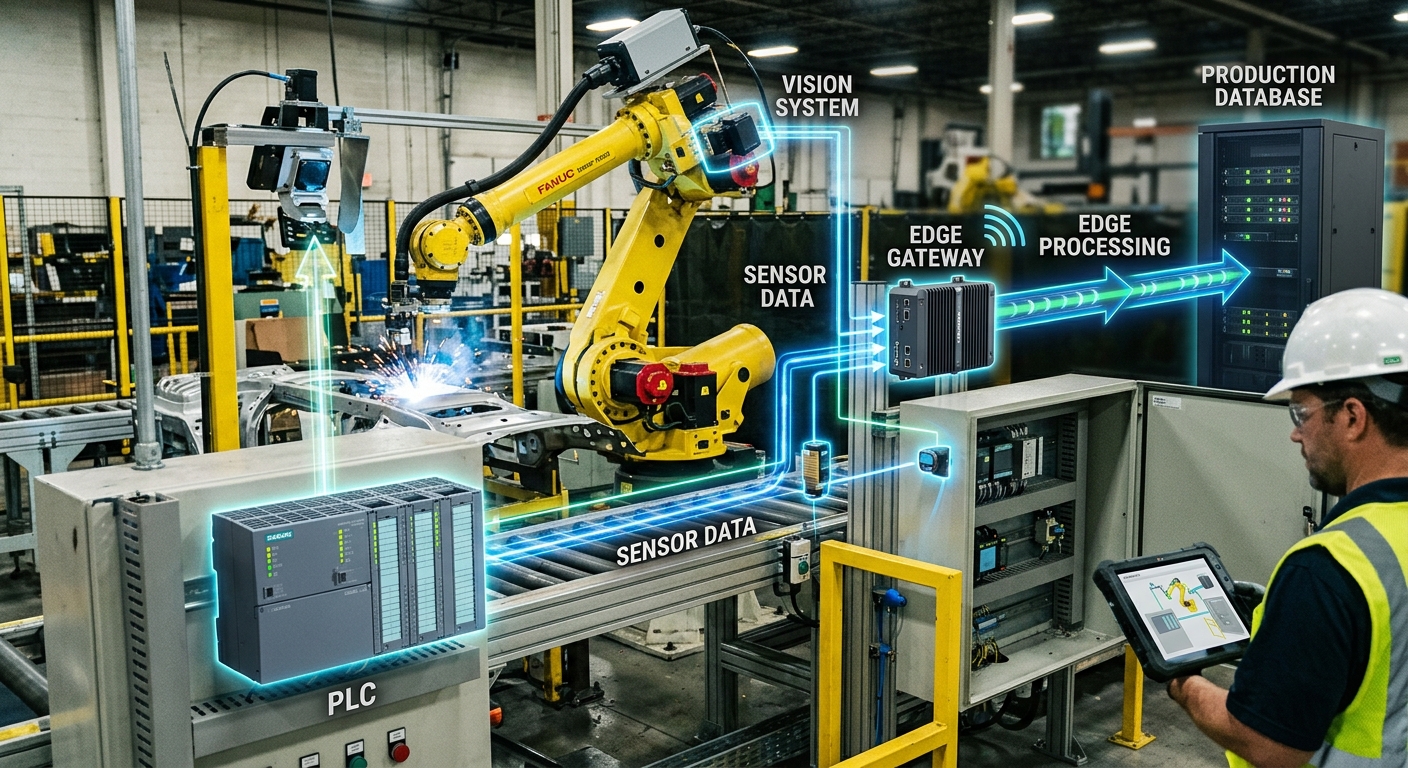

An industrial robot data architecture defines how information moves between the robot controller, PLC, sensors, machines, safety equipment, supervisory software, databases, and higher-level production systems. A useful architecture does not begin by collecting every available variable. It begins by deciding which information is required, who needs it, how quickly it must arrive, and what should happen when communication fails.
For most robot cells, the main design task is separating operational control from monitoring and historical analysis. Commands and interlocks that coordinate equipment have different timing and reliability requirements from data used for dashboards, maintenance analysis, quality records, or production reporting.
This article explains how to identify data sources, assign ownership, add context, select communication layers, organize storage, define retention and access, and validate the completed architecture. The objective is a data structure that supports production without making the robot cell unnecessarily complex or allowing supervisory data systems to interfere with critical control functions.
What Does an Industrial Robot Data Architecture Need to Do?
A robot cell may contain several systems that generate information independently. The robot controller can provide program states, positions, operating modes, and alarms. A PLC may coordinate the sequence. Sensors can report process conditions, while a CNC, vision system, or inspection station produces its own data.
Real-Time Control and Production Data Are Different
Some information directly affects the operating sequence. A robot may need confirmation that a fixture is closed before moving, or a machine may wait for confirmation that the robot has left its working area. These exchanges belong close to the control layer and should follow the timing and validation requirements of the actual process.
Production counts, alarm history, cycle information, and process trends usually have different requirements. They can often be transferred to supervisory or historical systems without becoming part of the machine-control handshake.
Start With Data Consumers and Use Cases
Before designing an industrial robot data architecture, identify who will use the data. Operators may need current cell status and actionable alarms. Maintenance personnel may need fault history and equipment states surrounding a stoppage. Production management may need completed cycles, downtime information, and job identifiers.
Define the Question Before the Tag List
A useful requirement is specific. “Collect robot data” does not define an architecture. “Record the active robot program, cell state, and alarm condition when an automatic cycle stops” identifies the information required and the event that gives it context.
This approach also limits unnecessary collection. High-frequency controller variables can create significant volumes of information without answering a production or maintenance question. Collection rates should therefore follow the intended use rather than simply the maximum rate available from the device.
Separate Control, Safety, Monitoring, and Business Data
Control information coordinates equipment. Monitoring information describes what the cell is doing. Business information may associate that activity with a product, order, batch, or production schedule. Keeping these functions conceptually separate makes interfaces easier to understand and troubleshoot.
Safety deserves separate treatment. A standard network message that reports a gate as closed is not automatically equivalent to a safety-rated protective function. Safety functions must be designed and validated according to the machinery, risk assessment, applicable requirements, and safety-related equipment used in the cell.
Assign Clear Ownership of Every Important State
Each important variable should have an authoritative source. If the PLC determines whether the cell is in automatic production, another application should not independently infer the same state from unrelated robot signals unless that interpretation is documented.
Clear ownership also helps after faults. Engineers need to know which system creates a value, which systems consume it, whether it remains valid after communication loss, and what condition clears or updates it.
Define Data Sources, Names, and Context
A reliable industrial robot data architecture requires a data map that identifies the source device, variable name, meaning, units when applicable, data type, update behavior,, and consumer. Names such as Robot_1_Auto_Mode or Cell_Cycle_Complete are more useful than unexplained register numbers once data leaves the controller where it originated.
Timestamps Need a Defined Source
Historical analysis becomes difficult when controllers and servers disagree about time. The architecture should define where timestamps are created and how participating devices maintain an appropriate time reference. The required precision depends on the process and the analysis being performed.
Context matters as much as the raw value. A cycle duration becomes more useful when it can be associated with the relevant machine, recipe, product, or operating state. Without context, large collections of tags can be difficult to interpret after production conditions change.
Choose Communication and Edge Layers According to Function
Communication choices are a central part of an industrial robot data architecture. Robot cells may combine discrete I/O, industrial networks, controller-specific interfaces, and higher-level interoperability technologies. No single method is automatically appropriate for every data path. Deterministic equipment coordination should remain in an architecture suitable for the required control behavior.
For an example of how different communication methods serve different functions, the RHTS article on Robot-CNC integration with M-codes, OPC UA, and MTConnect explains the distinction between machine sequencing, structured information exchange, and production monitoring.
Use an Edge Layer When It Solves a Defined Problem
An edge computer or gateway can isolate device-specific interfaces from higher-level applications. It may normalize tag names, collect information from several controllers, add timestamps or context, buffer data temporarily, and forward selected information to other systems.
An edge layer should not be added merely because it is available. Every additional computer, service, and interface requires configuration, cybersecurity management, backups, version control, and troubleshooting procedures.
Design Storage, Retention, and Access Before Collecting Data
Storage is another important part of an industrial robot data architecture. Not all robot data needs permanent retention. Current machine states may be useful only while the cell is operating, while alarms, production events, or selected process values may need historical storage. The appropriate period depends on the operational, maintenance, quality, and regulatory requirements of the application.
Match Storage to the Type of Information
Event records and time-series process values have different structures. An alarm event might require a timestamp, equipment identifier, alarm code, and operating state. A process trend may consist of repeated values associated with time. Production records may also need identifiers linking the cell event to a specific job or part.
Access should follow the same design discipline. Operators, engineers, maintenance systems, and enterprise applications do not necessarily need identical permissions. Read access for monitoring should be distinguished from the ability to change recipes, parameters, or controller variables.
Before commissioning an industrial robot data architecture, the following checks help confirm that data sources, interfaces, ownership, storage, and failure behavior have been defined clearly.
Eight Checks Before Implementing the Architecture
- List every data source. Identify robot controllers, PLCs, CNC machines, sensors, vision systems, inspection devices, and other equipment that produces required information.
- Define each use case. State whether the data supports control, operator visibility, maintenance, quality, traceability, production reporting, or another specific purpose.
- Assign data ownership. Record which controller or application is the authoritative source for each important cell state or value.
- Document interfaces. Specify the communication method, addresses or tags, data types, units, update behavior, and direction of exchange.
- Define context. Determine how robot events will be associated with cell state, product, recipe, program, machine, or production order when required.
- Specify failure behavior. Decide what happens when a device disconnects, data becomes stale, a server stops responding, or an expected message does not arrive.
- Set retention and access rules. Identify which information is stored, for how long, where it resides, and which users or systems can read or modify it.
- Test abnormal conditions. Verify communication loss, controller restart, server restart, power recovery, stale values, and interrupted production sequences before relying on the architecture.
Validate Cybersecurity, Safety, and Failure Behavior
An industrial robot data architecture must also account for cybersecurity when the cell communicates with supervisory or enterprise networks. Network segmentation, authentication, account management, software maintenance, backups, and controlled remote access should therefore be considered during architecture design rather than added after commissioning.
Data connectivity must also respect the cell’s safety architecture. ISO 10218-2:2025 addresses safety requirements for industrial robot applications and robot cells, including their integration, commissioning, operation, and maintenance. The ISO 10218-2:2025 standard is a relevant reference, although applicable legal and technical requirements still depend on the specific installation.
Validation should include failures instead of testing only successful communication. Disconnect a relevant network connection, restart data services, interrupt a sequence, and verify how stale or missing information is represented. A monitoring system should not continue presenting an old state as current simply because no new value has arrived.
For projects where the robot, PLC, production equipment, and supervisory systems need to be evaluated as one integrated architecture, contact Robotic Hi-Tech Solutions with the controller models, required data exchanges, and intended production use so the integration requirements can be reviewed against the actual cell.
A well-documented industrial robot data architecture also makes future troubleshooting and system changes easier because engineers can trace where information originates, how it is transferred, and which applications depend on it.
FAQ
What is an industrial robot data architecture?
It is the defined structure for acquiring, exchanging, contextualizing, storing, and accessing information generated by the robot cell and its connected systems.
Should all robot controller data be stored?
No. Data collection should follow defined operational, maintenance, quality, or reporting requirements. Storing variables without a use case can increase complexity without improving decisions.
Does a robot cell always need an edge gateway?
No. An edge layer is useful when protocol conversion, normalization, buffering, or aggregation is required. Simple architectures may communicate directly between existing controllers and supervisory systems.
Can OPC UA replace PLC control logic?
Not automatically. OPC UA can support structured information exchange, but control architecture depends on timing, controller capabilities, process requirements, validation, and the functions being coordinated.
What data should be collected for robot maintenance?
Useful information can include alarms, operating states, and relevant events around a failure. The exact variables should be selected according to the equipment and the maintenance questions being investigated.
Why are timestamps important in robot cell data?
Timestamps allow events from different devices to be placed in sequence. This is particularly useful when analyzing faults, cycle interruptions, and interactions between the robot, PLC, and other equipment.
Should safety signals be included in the production database?
They may be recorded for monitoring or analysis when appropriate, but recording a safety state does not replace the safety-rated devices, logic, and validation required to perform the protective function.
How should an industrial robot data architecture be tested?
Test normal production together with communication loss, stale data, controller and server restarts, power recovery, and interrupted sequences. Verify both the operational response and what supervisory systems display or store after each event.